
Also covered in: UFO Disclosure: Hearings, Whistleblowers, and the Proof Gap
Setup
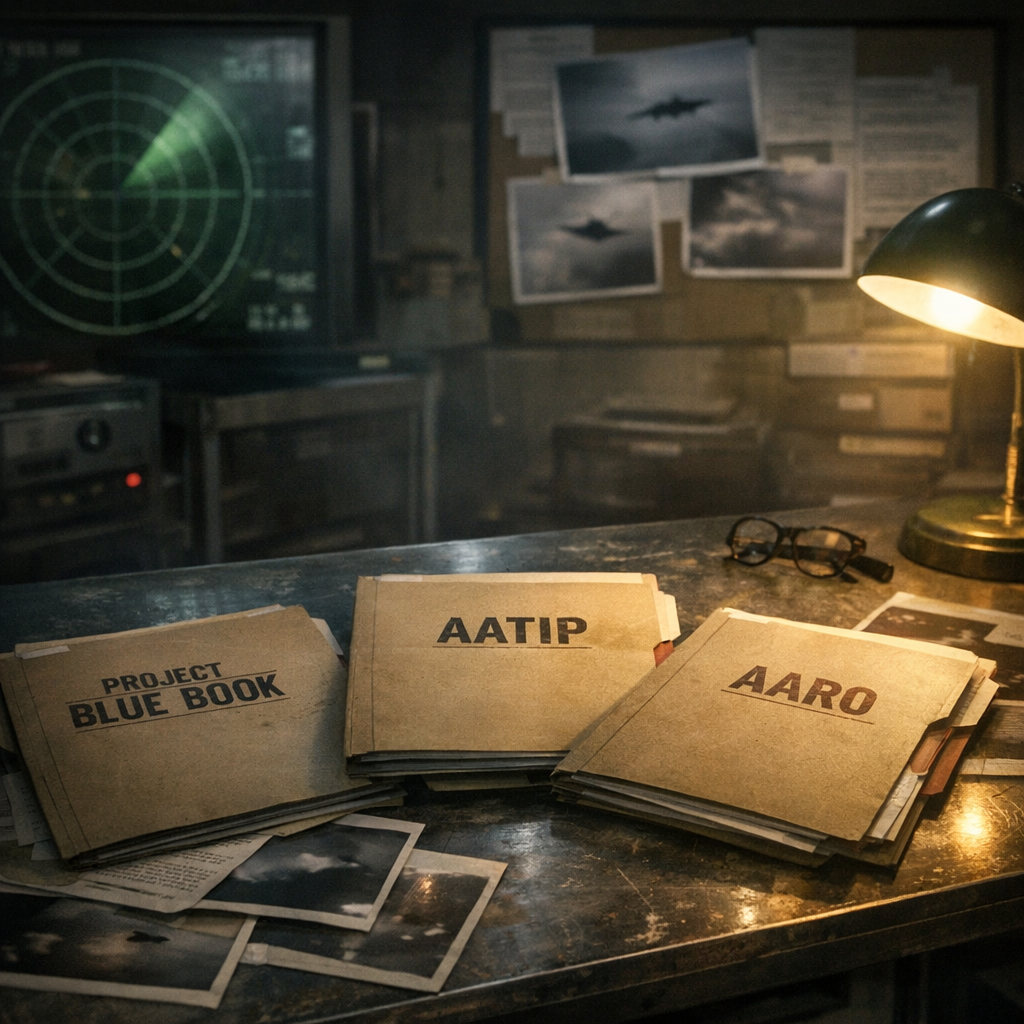
The history of government UFO programs does not begin with a dramatic admission about extraterrestrials. It begins with paperwork, anxious pilots, radar returns, and military institutions trying to decide whether strange reports represented public panic, foreign technology, bad data, or something they could not yet explain. In the late 1940s and 1950s, that uncertainty was enough to trigger formal study. The Air Force created Project Sign, then Project Grudge, and eventually Project Blue Book, the most famous official UFO program in American history.
Blue Book matters because it established a pattern that still shapes the debate. On paper, it looked like the government doing exactly what citizens might expect: collecting reports, sorting credible cases from weak ones, and trying to separate unknowns from exaggeration. But in practice, the program did two jobs at once. It investigated sightings, and it also reassured the public that the phenomenon was under control. Those are not always the same goal.
By 1969, Blue Book was closed after the Condon Report argued that further large-scale study was unlikely to deliver major scientific value. To many people, that should have ended the story. Instead, it created a vacuum. Once the best-known official program shut down, suspicion took root in two directions at once: either the mystery had been overblown from the start, or the real investigation had simply moved somewhere less visible. If you have read our breakdown of the Roswell UFO Crash, you have already seen how that pattern works. The less complete the public record feels, the easier it becomes for the myth to grow around the missing pieces.
What people claim
The strongest public claim is straightforward: government UFO programs prove officials know far more than they say and may have known for decades. Blue Book is often treated as the visible front end of a deeper system, while later programs are framed as evidence that the investigation never really stopped. In that reading, the changing labels are the point. One office closes, another appears years later, and the same subject survives under a more technical name.
That argument gained fresh energy in 2017, when reporting on the Advanced Aerospace Threat Identification Program, or AATIP, pushed the issue back into mainstream conversation. For many readers, the headline implication was obvious: if UFO interest had supposedly died after Blue Book, why was a Pentagon-linked effort still examining unusual aerial encounters? Later public discussion of the Unidentified Aerial Phenomena Task Force and then AARO, the All-domain Anomaly Resolution Office, only intensified that feeling. The language shifted from “UFOs” to “UAP,” but the central tension remained.
From there, more dramatic interpretations spread quickly. Some say these programs were part of slow disclosure. Others argue they were designed to manage public perception while withholding the most sensitive findings. And because secrecy around defense and intelligence work is real in many other areas, the idea does not sound impossible on its face. People are not imagining the existence of classified systems. They are asking what those systems were actually trying to understand.
Why it spread
This topic spread because it sits at the exact point where official documentation and unanswered questions overlap. Blue Book was real. AATIP was real. AARO is real. That alone separates government UFO programs from purely invented conspiracy folklore. There are records, budgets, memos, testimony, and institutional names people can point to. Once the basic foundation is factual, public imagination does the rest.
It also spread because modern UFO debate is not driven by one incident anymore. It is a web of connected stories. A post like Pentagon UFO Videos keeps the issue grounded in publicly acknowledged military footage. Alien Disclosure Timeline shows how official language and public interpretation keep colliding. Newer coverage like Phoenix Lights and the Rendlesham Forest incident gives readers witness-heavy cases that seem to demand some larger institutional context. Government programs become the bridge that ties all of those stories together.
There is also a psychological reason the subject keeps rebuilding itself. Secrecy is compelling, but selective disclosure is even more compelling. A total blackout leaves little to discuss. A small release of records, a hearing, a renamed office, or a carefully phrased statement creates exactly enough visibility to keep the argument alive without resolving it. That is why this subject survives news cycles better than most conspiratorial claims. It keeps producing partial confirmations instead of a final answer.
What evidence shows
The evidence supports a narrower conclusion than the internet’s loudest version of the story. It clearly shows that the U.S. government studied unexplained aerial reports in multiple eras and did not treat every case as meaningless noise. Blue Book reviewed thousands of reports. Later efforts such as AATIP and AARO show that unusual incidents in restricted airspace continued to draw official attention long after the public assumed the matter had been shelved.
That is significant. It means the subject was serious enough to justify real bureaucratic effort. It also means the old claim that “the government never investigated UFOs” is simply false. But that is not the same as proving extraterrestrial contact, recovered alien craft, or a fully hidden disclosure pipeline. The public evidence does not go that far.
Blue Book itself is a good example of the mixed record. It explained many cases through ordinary causes, including aircraft, weather effects, balloons, and insufficient data. Critics argue the program was also shaped by institutional pressure to reduce alarm and keep the issue from spiraling into a national-security embarrassment. Those ideas are not mutually exclusive. A program can explain many reports honestly and still leave people feeling that the hardest cases never received equally satisfying treatment.
The later programs are similar. AATIP’s existence does not prove an alien project. It proves organized interest in unusual aerospace incidents. AARO’s existence does not amount to open disclosure. It shows that the government wants a standardized process for reporting and evaluating anomalies across domains. In other words, the evidence confirms continuity of concern, not the most sensational explanation for that concern.
Where confusion came from
Most of the confusion came from people on both sides overstating what the record means. Believers often treat official study as proof of extraordinary conclusions, as if the existence of a program automatically confirms what the program supposedly found. Skeptics sometimes make the opposite mistake and act as if institutional interest proves nothing at all. Neither position fits the evidence very well.
Language also played a huge role. “UFO” carries decades of pop-culture baggage, while “UAP” sounds bureaucratic, technical, and less likely to trigger immediate ridicule. That shift changed the tone of public discussion. It allowed officials to speak more openly about unexplained incidents without sounding like they were endorsing science-fiction claims. But it also made some readers suspect the government was rebranding the same mystery to control the narrative.
Then there is the issue of expectation. People often want one of two endings: either the government admits aliens, or the entire subject collapses into misidentification and myth. The documentary reality is less dramatic. Institutions often study unresolved things because unresolved things can still matter operationally. A military office does not need an extraterrestrial conclusion to care about unknown objects near sensitive airspace. But once that practical motive gets wrapped in decades of silence, the public naturally reads a bigger story into it.
Reality Check
The most credible version of this story is not that the government secretly confirmed alien visitors and hid the truth in plain sight. It is that the government’s public posture toward unexplained aerial incidents has been inconsistent enough to create lasting distrust. Officials dismissed, studied, renamed, reopened, and reframed the subject across different eras. That inconsistency is real, and it is enough to explain why curiosity never went away.
So where does that leave the case? Somewhere in the middle. Government UFO programs are not imaginary, and they are not trivial. They prove a documented chain of official concern. But the available evidence still stops short of validating the stronger online claim that these programs amount to public proof of extraterrestrial contact. The most careful conclusion is still partial: the institutions were real, the attention was real, the mystery is real, and the biggest leap remains unproven.
🔎 If this story made you think, here are more conspiracy investigations worth exploring next:
- Pentagon UFO Videos: What the Navy Footage Confirmed — and What It Didn’t
- Alien Disclosure Timeline: Are We Seeing Revelation or Repackaged Secrecy?
- Roswell UFO Crash: What the Original Witnesses Claimed and What the Records Actually Show
📂 Explore more in this category:
Alien & UFO Theories