
The message hit the wires like something that had slipped out of a locked cabinet. In the summer heat outside Roswell Army Air Field, officers announced that they had recovered a “flying disc,” and for a few strange hours in July 1947, it looked as if the military had admitted the impossible. Then the story changed almost immediately, and that sudden reversal is why the Roswell UFO crash still refuses to die.
Also covered in: UFO Disclosure: Hearings, Whistleblowers, and the Proof Gap
What Happened
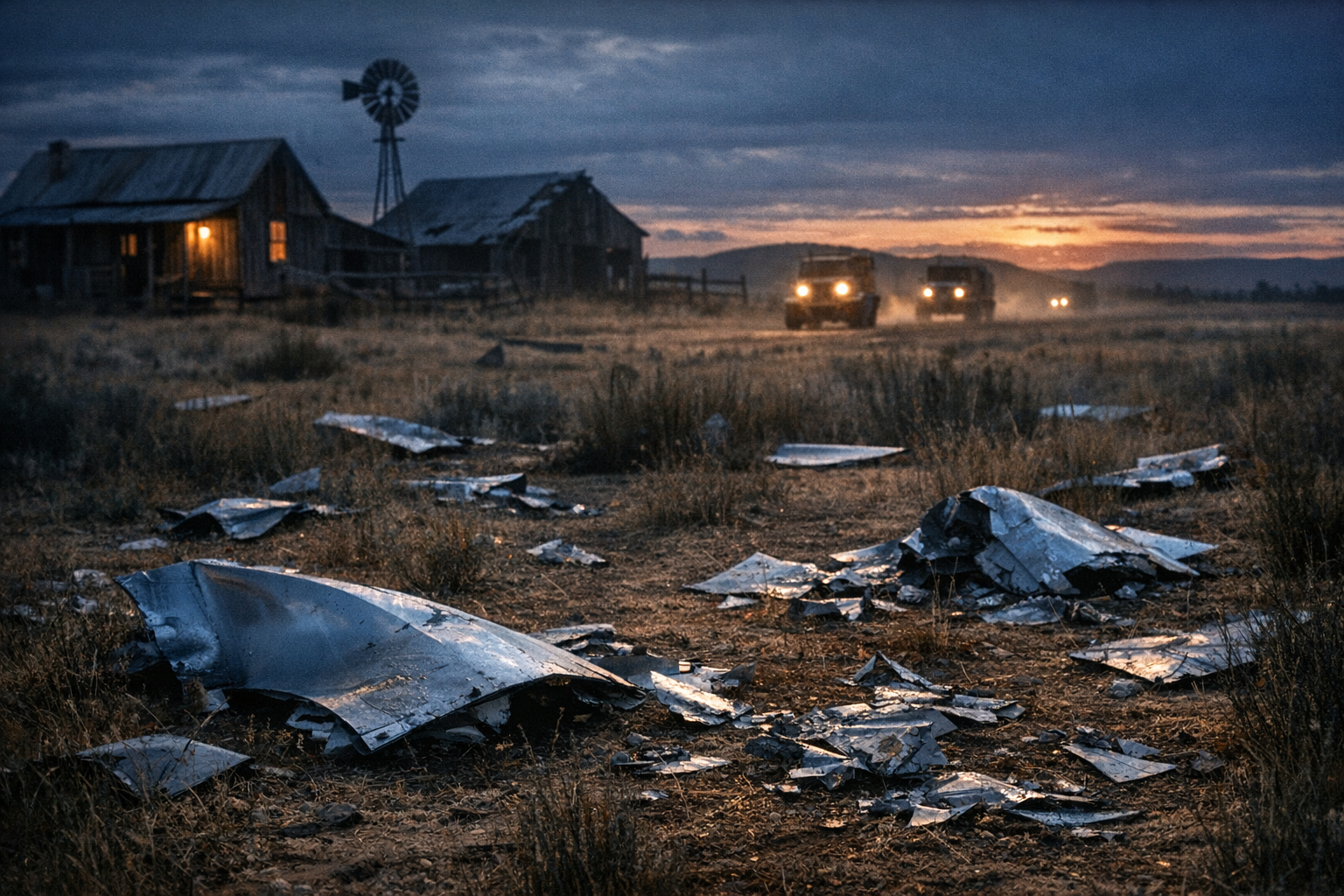
The Roswell story begins on a ranch in New Mexico in 1947. Rancher W.W. “Mac” Brazel found strange debris scattered across part of his land after a storm. Reports described thin foil-like material, sticks, paper-like pieces, and light wreckage spread over a wide area. Brazel eventually reported the debris, and military personnel from Roswell Army Air Field became involved.
On July 8, the Roswell base issued a press release saying the army had come into possession of a “flying disc.” That phrase mattered. This was only weeks after pilot Kenneth Arnold’s famous sighting helped launch the modern “flying saucer” craze. Newspapers were already full of speculation. So when a military base used those words, people paid attention immediately.
Then came the reversal. Within hours, Army officials said the object was not a flying disc at all. Brigadier General Roger Ramey told reporters it was a weather balloon, and photographs were taken showing wreckage on an office floor in Fort Worth. The military’s public position shifted from extraordinary to ordinary in a single day.
That one-two punch became the center of the mystery. If it was just a balloon, why did trained officers call it a disc first? If it was truly unusual, why walk the claim back so fast? That gap between the first announcement and the second explanation created a story shape that conspiracy theories thrive on: a glimpse of hidden truth, followed by official retreat.
🔎 Related Investigation: Alien & UFO Theories: The Cases, the Cover-Ups, and the Evidence People Still Debate
Years later, the case grew larger as former military members and local witnesses gave interviews that sounded far more dramatic than the original 1947 reports. Some described unusual debris that could not be cut, bent, or burned in normal ways. Others said there were whispers about bodies, sealed recovery areas, and a cover-up that started the moment the military realized what it had found.
It is easy to see why those later accounts had power. Picture a dusty ranch road, armed men arriving, locals being told to keep quiet, and a headline that seemed to open a door into forbidden knowledge before slamming it shut. Roswell did not become famous because the evidence was simple. It became famous because the story felt like something important had been briefly exposed and then hidden again.
Why People Believe It
People believe the Roswell theory for several reasons, and some of them are stronger than others. First, the military really did issue that first press release. This is not a made-up memory. An official statement said a flying disc had been recovered. For many believers, that is the single most important fact in the whole case.
Second, official explanations changed over time. In 1947, the public was told the debris came from a weather balloon. Decades later, the U.S. Air Force said the likely source was actually Project Mogul, a then-secret program that used high-altitude balloons and equipment to detect Soviet nuclear tests. To skeptics of the official story, changing explanations look less like clarification and more like damage control.
Third, witness stories became more detailed with time, not less. Some people see that as a sign that the truth was finally coming out once fear faded. Others point out that memory can grow more confident and more dramatic over decades, especially after books, TV specials, and constant retelling. Roswell sits right in that uncomfortable zone where testimony feels vivid, but distance from the event makes it harder to verify.
There is also a human reason Roswell sticks. The theory gives shape to a deeper suspicion: that governments sometimes hide major truths from the public. That suspicion is not irrational in the abstract. Real cover-ups have happened. On this site, stories like Operation Northwoods show that secret planning and deception are not fantasy. Roswell gains strength because it plugs into a real pattern people already know exists.
And then there is the timing. Roswell happened at the start of the Cold War, when secrecy was thick, military projects were classified, and ordinary citizens had very little idea what was happening behind fenced-off bases. In that environment, a strange crash plus sudden silence almost guaranteed a legend.
Claims vs Evidence
Claim: Roswell was the crash of an extraterrestrial spacecraft.
Evidence offered by supporters: the original “flying disc” press release, witness descriptions of unusual debris, and later stories about military secrecy. Some supporters also argue that the speed of the official reversal suggests panic from people who realized too much had been said.
What the records show: the military did publicly say “flying disc,” then quickly changed course. That part is documented. We also know the region was tied to secret military activity. What we do not have is verified physical evidence publicly demonstrating alien technology, nor authenticated records from 1947 proving a recovered spacecraft.
Claim: the weather balloon explanation was obviously false.
Evidence offered by supporters: witnesses who said the debris did not resemble an ordinary balloon and the sense that experienced military personnel should have recognized common weather equipment.
What the records show: later Air Force reports argued that the debris likely came from Project Mogul, not a standard weather balloon in the simple sense. That matters because Mogul hardware included specialized materials, targets, and components that might have looked unfamiliar, especially when described loosely to the public. In other words, the first explanation may have been incomplete without being extraterrestrial.
Claim: bodies were recovered from the crash site.
Evidence offered by supporters: late witness testimony, secondhand accounts, and stories repeated in books and documentaries.
What the records show: there is no confirmed contemporary 1947 documentation proving alien bodies were found at Roswell. Later government explanations suggested that some body stories may have become mixed with memories of anthropomorphic test dummies used in military research years afterward. That does not settle every question, but it does show how separate events can fuse into one dramatic narrative over time.
Roswell also gets extra energy from the way UFO culture expanded after 1947. Once the case became famous, every new disclosure, hearing, or unexplained military video seemed to throw fresh light backward onto Roswell. That is why stories like Pentagon UFO Videos: What the Navy Footage Proves often get pulled into Roswell conversations, even though they do not prove the same thing.
Reality Check
The strongest reason Roswell remains compelling is not that alien evidence is overwhelming. It is that the official handling of the case created distrust. When institutions say one extraordinary thing and then rapidly replace it with a safer explanation, people naturally ask what happened behind the scenes. On that point, Roswell believers are responding to something real: the confusion was created in part by the government itself.
But confusion is not the same as proof. The leap from “the military mishandled this” to “the military recovered an alien craft” is still a leap. The known facts support secrecy, inconsistency, and room for suspicion. They do not clearly establish extraterrestrial origin.
The Project Mogul explanation is often ignored because it is less dramatic than the alien version. But it deserves serious weight. Mogul was classified in 1947, which gives the military a reason to hide what it was actually doing. If officers chose a simple weather-balloon story to protect a secret surveillance program, that would explain both the reversal and the secrecy without requiring a crashed spacecraft.
At the same time, Roswell cannot be dismissed with a lazy wave of the hand. The case matters because it shows how myths are born when secrecy, real military programs, faulty communication, and powerful witness stories collide. Even if Roswell was not extraterrestrial, it became the blueprint for how modern UFO suspicion works.
The most honest conclusion is that Roswell is partially explained. There is solid historical support for the idea that secret government activity shaped the story. There is not solid public evidence proving an alien crash. That leaves Roswell in the space between total debunking and total belief, which is exactly where enduring mysteries tend to survive.
Conclusion
Roswell became bigger than a field of debris in New Mexico. It became the first great modern UFO story because it offered everything people fear and everything they crave: military secrecy, a crack in the official story, strange testimony, and the feeling that the public was allowed to see the truth for only a moment.
What we know is enough to explain why people still talk about it. What we do not know is enough to keep the argument alive. And that is probably the real reason Roswell never faded: the original witnesses gave the world a mystery, but the records only solved part of it.
🔎 If this story stayed with you, the author suggests these real cases next:
- Travis Walton UFO Incident: The 5 Days That Turned a Logger Into a Legend
- Pentagon UFO Videos: What the Navy Footage Proves
- UFO Sightings
Explore more Alien & UFO Theories stories here: