
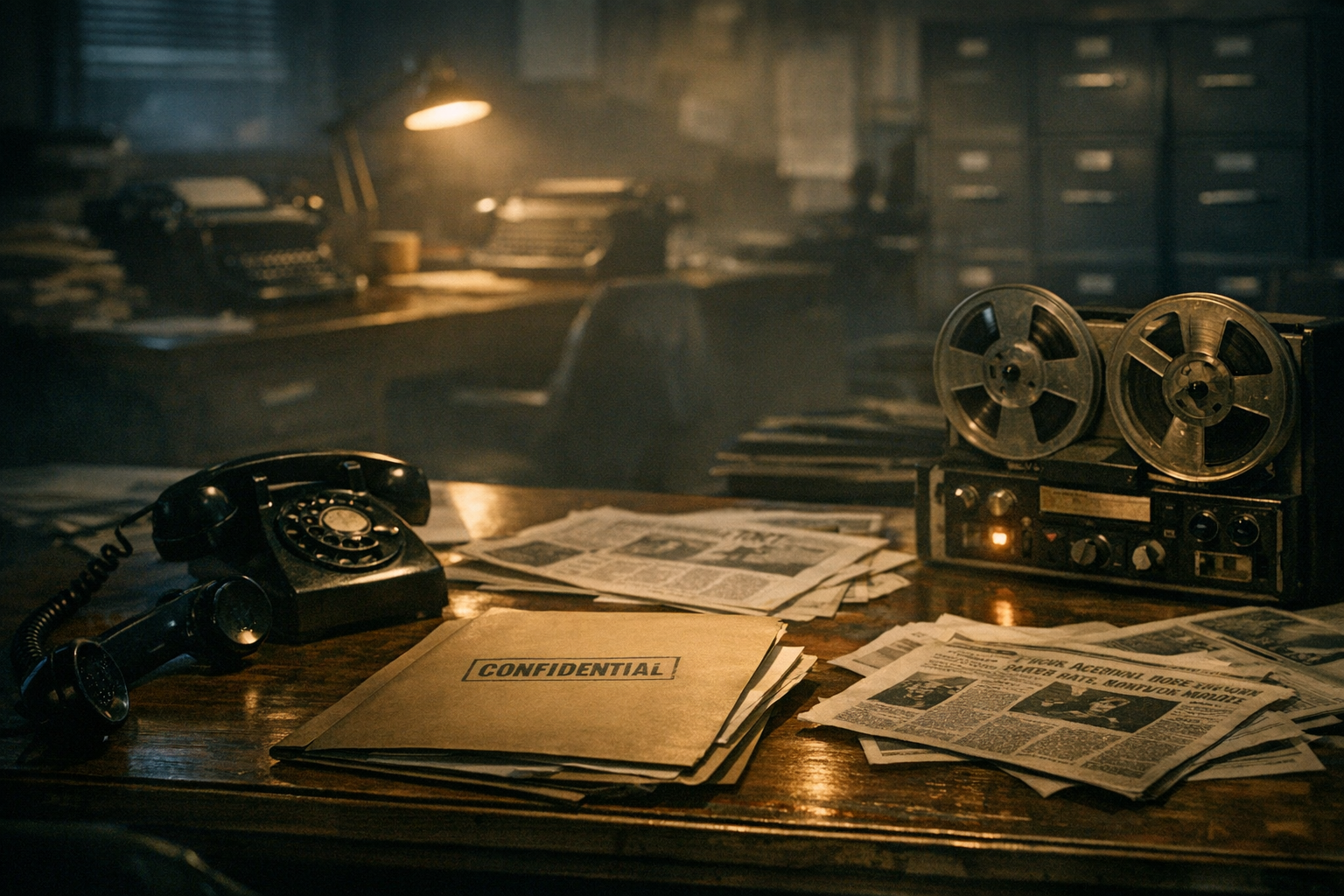
The phone call was supposed to stay private. Somewhere between a newsroom desk, a government office, and a Cold War fear that never really slept, a quiet question started spreading through Washington: what if some of the people telling the public what was true were also being guided by people who needed certain stories to win?
That question sits at the center of Operation Mockingbird, one of the most persistent media conspiracy stories in American history. It is not a simple tale of one secret switch that turned the entire press into a puppet. But it is also not pure fiction. What happened is more complicated, and in some ways more unsettling, than the internet version.
What Happened
The basic story begins in the early Cold War, when the United States was obsessed with propaganda, secrecy, and information control. The CIA, created in 1947, was not only collecting foreign intelligence. It was also operating in a world where public opinion mattered almost as much as military power.
🔎 Related Investigation:
In that atmosphere, journalists became unusually valuable. Reporters could cross borders, talk to officials, and hear things before almost anyone else. The term “Operation Mockingbird” is now used for the idea that the CIA shaped the news through relationships with members of the press, even though people often use that label to describe several different forms of influence at once.
There is real historical fuel behind the story. By the 1950s and 1960s, the CIA was involved in broad Cold War influence efforts, and the media world overlapped with that mission more than many readers would find comfortable. Then, in the 1970s, Watergate and intelligence hearings made older rumors about press-agency ties feel much more believable.
One human detail helps explain why this topic never dies. Imagine opening a paper over breakfast, trusting the byline in front of you, and then learning years later that some respected journalists had private relationships with intelligence officials. Even limited cooperation would be enough to leave a mark. Once trust cracks, it rarely seals cleanly.
Why People Believe It
People believe the Mockingbird story because part of it rests on documented history. Researchers, reporters, and congressional investigations have all shown that intelligence agencies did maintain relationships with journalists during the Cold War era.
Another reason is that the theory fits a deeper fear people already have: if power wants to protect itself, it will not only hide facts, it will shape the story around those facts. That fear becomes more believable when official records already show the government used propaganda abroad and sometimes pushed against the line between foreign and domestic influence.
There is also a psychological reason. A messy media failure is hard to accept. It is emotionally simpler to believe a hidden hand is coordinating everything than to accept that bias, career pressure, ideology, access journalism, and institutional groupthink can create similar results without one master controller. Conspiracy theories often grow strongest in that gap between a real pattern and an exaggerated explanation.
That is why Operation Mockingbird is so sticky. It offers something many people crave: a single key for a thousand locked doors. But history usually works differently. Real influence exists, just not always in the clean, total way the legend suggests.
Claims vs Evidence
Claim: The CIA secretly controlled all major American news outlets and dictated what the public was allowed to believe.
What the evidence shows: There is no confirmed evidence that the CIA fully controlled all major media or wrote the entire national narrative from one hidden command center. That sweeping version goes far beyond the historical record. Newsrooms were never one machine, and American media has always included competing owners, editors, and political interests.
🔎 Related Investigation:
Claim: The CIA did have relationships with journalists and used those relationships to influence information.
What the evidence shows: This part has serious historical support. Investigations in the 1970s, along with later reporting, showed that intelligence agencies had ties to members of the press. Some journalists provided information. Some cooperated in limited ways. Some publishers and executives were willing to work quietly with the government during the Cold War, especially when anti-Soviet goals were involved.
Claim: Every major news error today proves Mockingbird never ended.
What the evidence shows: That is where the theory usually outruns the facts. Bad reporting, herd behavior, political bias, and dependence on official sources can all produce weak or misleading coverage without requiring an active covert operation. A newsroom can fail on its own. That is less dramatic than a hidden program, but often more realistic.
Claim: The Church Committee and later reporting exposed a hidden press-intelligence relationship serious enough to damage public trust.
What the evidence shows: This is fair. The broader intelligence scandals of that era showed a pattern of overreach that made media ties much harder to dismiss. Later reporting, including high-profile journalism about the CIA’s connections with reporters, strengthened the case that at least some influence relationships were real and substantial.
The most grounded way to understand Mockingbird is to separate a documented core from a mythologized shell. The documented core is that intelligence agencies, especially in the Cold War, sought influence, cultivated media relationships, and sometimes crossed lines that should have remained bright. The mythologized shell is the idea that every headline, every anchor, and every editorial stance was centrally scripted by one covert hand.
That distinction matters for readers who also follow broader media-power theories. If you have read about shadow governments and hidden centers of power, Mockingbird can look like proof that invisible influence is everywhere. But proof of some covert relationships is not proof that all public life is stage-managed.
Reality Check
The strongest reality check is this: the truth is serious enough without stretching it. A democratic society should be alarmed by any verified case in which intelligence agencies built covert influence channels into the information ecosystem. That alone is a major problem.
At the same time, turning that history into an all-purpose explanation for everything the media does can make people easier to mislead, not harder. Once someone believes every uncomfortable fact is planted and every conflicting report is controlled, evidence stops mattering.
There is a practical lesson here. Readers should be skeptical of institutions, but also skeptical of oversimplified stories about those institutions. Real influence often works through access, incentives, fear, reputation, and selective leaks. It does not always require direct command.
That is also why political conspiracy topics often overlap without being identical. Concerns about elite power, hidden coordination, and public manipulation show up in stories about media influence, election distrust, and global control narratives. But each claim still has to be tested on its own evidence, the same way a reader should test broad theories like the New World Order conspiracy instead of accepting them as one giant package.
So where does Operation Mockingbird land? Not fully debunked, because there is enough historical record to show that intelligence-media relationships did exist. Not fully confirmed in its most popular form either, because the biggest version of the story claims far more control than the evidence proves. The most honest conclusion is that it is partially explained: rooted in real Cold War influence efforts, then expanded over time into a much larger theory than the records clearly support.
Conclusion
The enduring power of Operation Mockingbird comes from the fact that it touches a nerve most societies cannot afford to ignore. People need information they can trust. The moment they suspect that trusted institutions were quietly shaped by unseen government influence, even in limited ways, the damage spreads far beyond one era or one agency.
That is why this story still matters. It is not just about whether one covert program existed in exactly the way later retellings describe. It is about how easy it is for secrecy, national security, and media access to blur together until the public no longer knows where reporting ends and influence begins.
And maybe that is the real reason the story survives. Somewhere in the space between documented history and exaggerated legend, people recognize a fear that feels uncomfortably plausible: not that every story is fake, but that truth can be bent long before it reaches the front page.
🔎 If this story stayed with you, the author suggests these real cases next:
- Shadow Governments: Who Really Pulls the Strings Behind Power?
- New World Order Conspiracy: Who Really Controls the World?
- Election Fraud Theories
Explore more Political Conspiracies stories here: