
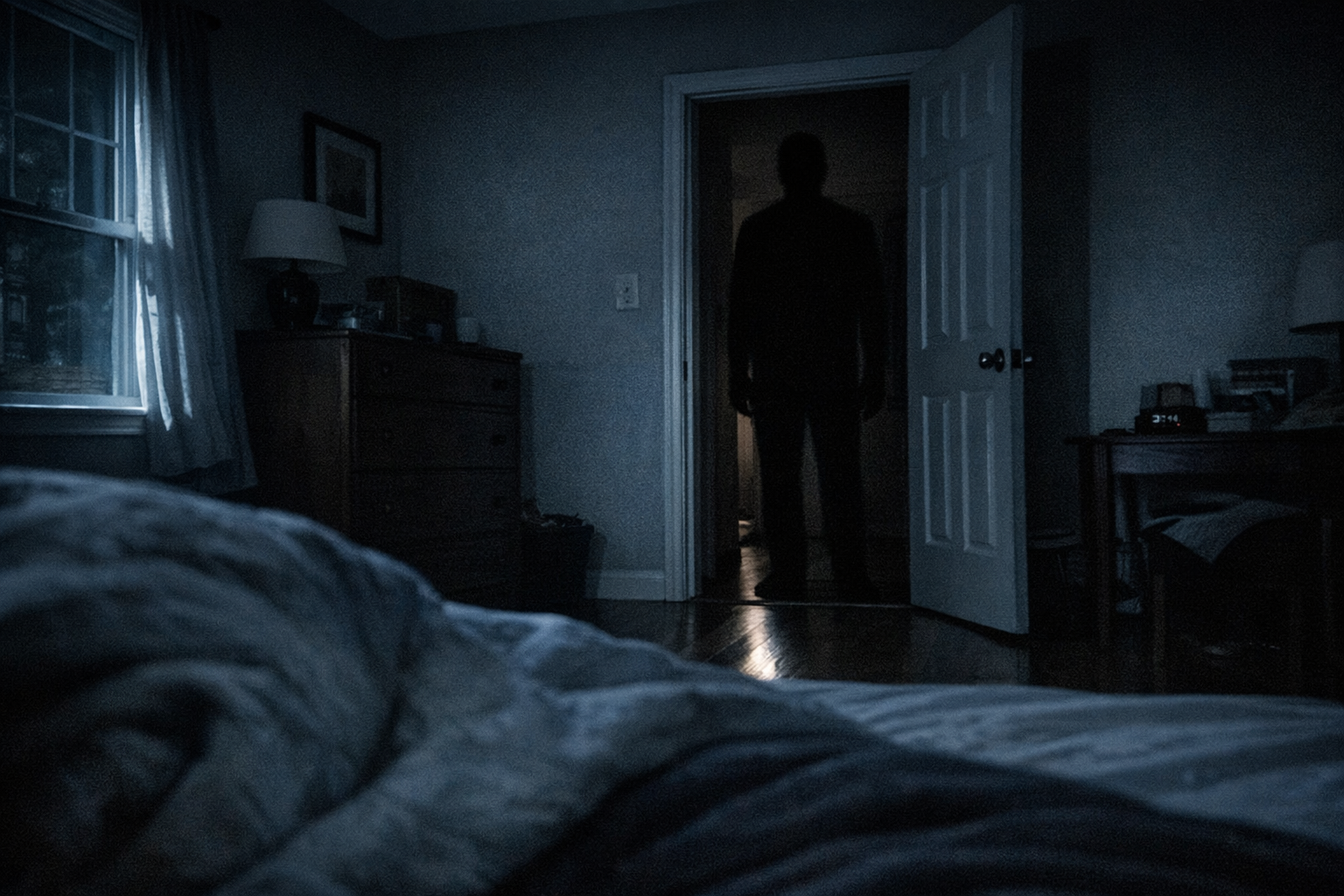
The room is dark except for a strip of moonlight cutting across the floor, and in that narrow light there seems to be someone standing near the door. You try to sit up, shout, or even turn your head, but your body will not move. For many people, that frozen moment is where the shadow people phenomenon begins � with the feeling that something hidden has entered a place it should never have reached.
What Happened
Reports of shadow people tend to follow a pattern so specific that it has become one of the most repeated stories in paranormal culture. A person wakes in the middle of the night. The room looks normal enough to recognize. Then they notice a tall, dark figure at the bedside, in a doorway, or just beyond the edge of the bed.
The figure is usually described as human-shaped, but not fully detailed. Witnesses often say it looks darker than the dark around it, like a silhouette cut out of the room itself. Some report red eyes or a hat-like shape. Others say it simply watches without speaking, which somehow feels even worse.
What makes these accounts so intense is not just what people say they saw. It is the physical state that often comes with it. Many witnesses say they were awake enough to see the room clearly, yet unable to move their arms, sit up, or call for help. That mix of awareness and helplessness turns a strange image into a terrifying event.
In one common version of the story, the person later replays every detail in their mind: the outline near the closet, the pressure in the chest, the soundless few seconds that felt much longer. It does not feel like a dream because parts of the room were exactly where they should have been. The bedroom was real. The fear was real. That is why the memory often stays with people for years.
Modern internet forums are filled with nearly identical stories from different countries, age groups, and belief systems. Some people are certain they encountered a spirit, demon, or interdimensional being. Others tell the story reluctantly because they do not even consider themselves believers. They just cannot explain why so many people describe the same scene.
Why People Believe It
The strongest reason people believe shadow people might be paranormal is simple: the experience feels personal, immediate, and impossible to dismiss. This is not a rumor heard secondhand. It is a memory tied to a real room, a real bed, and a very real wave of fear. That kind of experience is hard to file away as a mistake.
There is also the strange consistency of the reports. People who have never met each other describe a dark figure, nighttime stillness, and a sense of presence in language that sounds surprisingly similar. To believers, that pattern suggests a shared external cause rather than random imagination.
Cultural history adds another layer. Long before modern sleep research, many societies had stories about hostile night visitors, pressing spirits, or entities that appear when a person is caught between sleep and waking. The names change from place to place, but the core idea is familiar: something unseen enters the room at night and pins the witness in place.
Paranormal communities also connect shadow people to a larger world of unexplained experiences. A witness who already takes ghosts, hauntings, or strange encounters seriously may see the event as part of the same pattern. That is one reason articles about ghost stories that later collapsed under scrutiny and even debates about why uncertain sightings can still feel deeply convincing matter here. Once people know unusual encounters can shape memory and belief, each new event arrives with a ready-made framework.
And then there is the emotional factor. People often describe the figure not just as seen, but as felt. They sense hostility, attention, or intelligence. Even when no words are spoken and no attack happens, the atmosphere feels loaded. That emotional force convinces many witnesses that they were dealing with more than a tired brain misfiring for a few seconds.
Claims vs Evidence
Claim: Shadow people are real paranormal entities that enter bedrooms and watch or threaten sleeping people.
What supports the claim: Many witness stories sound similar, the fear feels genuine, and reports of nighttime entities show up across cultures and across long periods of history.
What the evidence does not show: There is no confirmed physical evidence that shadow people exist as independent beings. No verified recordings, biological traces, or controlled studies have demonstrated that a separate entity is present in the room during these experiences.
Claim: Because people describe the same dark figure again and again, the phenomenon cannot be a normal sleep event.
What supports the claim: At first glance, the repeated details do seem striking. A doorway figure. A dark silhouette. A pressure in the chest. A sense of dread. That consistency can make the reports sound too specific to be coincidence.
What the evidence shows: Sleep paralysis can create a very similar pattern. During sleep paralysis, the brain partly wakes while the body remains in a temporary state of muscle shutdown that normally happens during REM sleep. People may be conscious of the room around them, unable to move, and vulnerable to vivid visual or sensory hallucinations. That combination can produce exactly the kind of encounter many witnesses describe.
Claim: Witness certainty proves the event was real in an external sense.
What supports the claim: People often remember the room accurately and speak with total conviction. They are not always joking, attention-seeking, or committed believers in the paranormal. Some are embarrassed to talk about what happened at all.
What the evidence shows: Certainty is not the same as proof. Human perception can be persuasive even when it is wrong, especially during stress, darkness, interrupted sleep, and fear. A person can honestly report what they experienced without that experience confirming an outside entity.
Claim: Hat Man reports and similar recurring figures prove there are distinct paranormal types of shadow beings.
What supports the claim: Repeated motifs, including the so-called Hat Man, seem too specific to some observers to be random.
What the evidence suggests instead: Shared cultural stories can shape what people expect to see and remember. Once a certain figure becomes famous in books, videos, and forums, later accounts may be influenced by that template, even when the original fear was produced by a normal sleep-related event.
Reality Check
The most grounded explanation for the shadow people phenomenon is not that thousands of witnesses are lying. It is that many of them are describing a real experience with the wrong cause attached to it. Sleep paralysis is real. Hypnopompic and hypnagogic hallucinations are real. The fear, chest pressure, and visual sense of presence are all well documented in sleep research.
That matters because it explains why the stories feel so intense. A person in sleep paralysis may be partly awake, still seeing the room, while the brain is also generating dreamlike threat imagery. The result is a hybrid experience: part ordinary bedroom, part nightmare. That blend is exactly what makes it feel like forbidden evidence rather than a dream.
It also explains why similar reports appear around the world. Human sleep biology is shared. So is the way fear sharpens attention. When many brains under similar conditions produce similar sensations, the overlap can look paranormal even when the source is internal.
At the same time, the sleep-paralysis explanation does not solve every detail perfectly. Not every shadow person report happens during a clearly paralyzed state. Some stories are told secondhand. Others come from people who insist they were fully mobile. But once we separate what is verified from what is claimed, the evidence still leans much more strongly toward sleep-related perception than toward hidden beings entering bedrooms at night.
In other words, the real mystery may not be whether shadow people are stalking sleepers. It may be why the human brain is so good at turning a brief, disrupted state of consciousness into a scene that feels more convincing than ordinary memory. That is less supernatural, but not less fascinating.
Conclusion
Shadow people remain one of the most chilling modern paranormal stories because the core experience is so vivid and so intimate. It happens in private, in darkness, and at the exact moment when a person feels least able to question what they are seeing. That is why the stories spread, and why they stick.
There is no confirmed evidence that shadow people are independent paranormal entities. What we do have is a strong, well-supported explanation involving sleep paralysis, hallucinations during transitions in and out of REM sleep, and the way fear shapes memory. That does not make witnesses foolish. It makes them human.
The phenomenon sits in that unsettling space where a terrifying personal experience meets a more ordinary physical explanation. For believers, that can feel unsatisfying. For investigators, it is the most important distinction of all: something can feel supernatural without being proof of the supernatural.
?? If this story stayed with you, the author suggests these real cases next:
Explore more Paranormal and Supernatural stories here: