
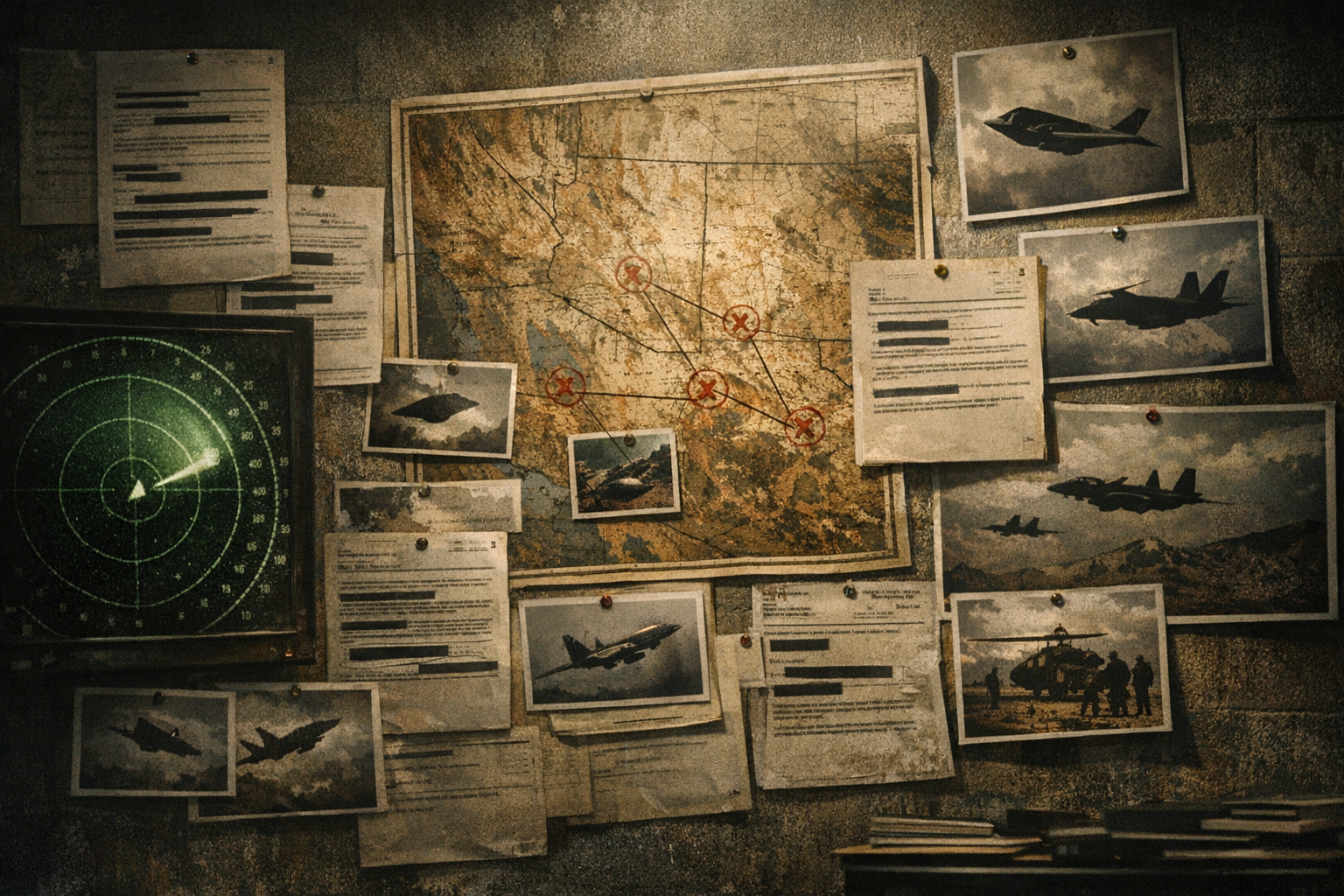
Some American UFO cases refuse to die for the same reason old intelligence scandals refuse to die: the file never quite closes. A witness says something impossible happened, officials confirm part of the story but not enough of it, and the gap between public explanation and private uncertainty becomes the real mystery people keep returning to.
UFO evidence in America usually means a mix of witness testimony, military footage, old crash stories, and government records that seem to confirm interest without settling the biggest claims. Supporters argue the strongest cases point toward hidden knowledge or extraordinary craft operating in plain sight. The likelier reality is narrower but still compelling: some cases remain unresolved, some official handling was inconsistent, and that combination is exactly why the mystery keeps rebuilding itself.
What Happened
America’s UFO archive is not one story. It is a chain of stories that keep feeding each other. A strange object is reported. A local military base, radar crew, or government office gets pulled into the narrative. The public receives part of an explanation, but not enough to fully calm the case. Then the incident joins a larger pattern that people use to reinterpret the next mystery.
That pattern is why the strongest American cases tend to fall into recognizable clusters. There is crash lore, with Roswell UFO Crash: What the Original Witnesses Claimed and What the Records Actually Show still serving as the most famous template for headline, reversal, and long-term distrust. There is military footage, where posts like Pentagon UFO Videos: What the Navy Footage Confirmed — and What It Didn’t and Tic Tac UFO Incident: Best Military Evidence or a Story Bigger Than the Data? show how official confirmation can make a mystery feel more serious without proving an alien answer.
There is also the institutional lane. Government UFO Programs: Why the Files Never Really Closed matters because it tracks a documented history of the government publicly minimizing the subject while continuing to study pieces of it behind the scenes. That does not prove a hidden extraterrestrial truth. But it does show why readers stop treating the topic like pure folklore.
Then there are the cases people use as bridges into newer debates. David Grusch UFO Claims: What Was Alleged, What Was Verified? pulls witness-based disclosure politics into the conversation. UFOs Over Nuclear Bases: Security Threat or the Pattern That Won’t Go Away? keeps the military-security angle alive. Black Triangle UFOs: Secret Aircraft or a Pattern Built from Night Sky Mistakes? sits in the witness-case lane, where recurring descriptions create the feeling of a stable phenomenon even when the evidence stays uneven.
Read together, these cases form something more useful than a pile of mysteries. They form a map of how American UFO belief is built: crash legend, official footage, secrecy, whistleblower testimony, repeat witness patterns, and the recurring sense that every partial answer leaves one door still open.
Why People Believe It
People believe America has unusually strong UFO evidence because the subject does not depend on a single weak anecdote. It draws power from overlap. One case may have a dramatic witness but little physical evidence. Another may have official records but limited public context. Another may have sensor data and credible observers but no final explanation. When those cases are stacked together, the category starts to feel larger than the gaps inside any one of them.
That stacking effect matters more than believers sometimes admit. Roswell still carries emotional force because it feels like the archetype of a truth that slipped out and then got pulled back. Pentagon-era footage carries institutional force because the military treated the incidents seriously enough to record, discuss, and later acknowledge them. Disclosure-era stories carry political force because they suggest the government is still managing how much the public gets to know, not just what happened in one old case.
Belief also grows because the American setting makes the story plausible in a very specific way. People already know the United States runs classified aerospace programs, compartmentalized intelligence work, and long-lived defense bureaucracy. That background means strange reports near military contexts do not appear against a blank wall. They appear inside a country where real secrecy is ordinary enough to make bigger hidden explanations feel possible.
And once a person accepts that official messaging has been incomplete before, every new unresolved case gains a head start. A hearing, report, pilot interview, or leaked claim does not have to prove everything. It only has to resemble older patterns closely enough to reactivate them. That is why the broader disclosure trail in Alien Disclosure Timeline: Are We Seeing Revelation or Repackaged Secrecy? keeps pulling readers back into older evidence debates. The story persists because new events rarely replace the archive. They re-energize it.
Claims vs Evidence
Claim: The strongest American UFO cases, taken together, amount to proof that nonhuman craft have operated in U.S. airspace. Evidence: The strongest cases do show repeated reports, official interest, and a handful of incidents that remain unresolved. What they do not show is final public proof of extraterrestrial origin. Unresolved events are real as investigative problems, but unresolved is still not the same thing as solved in favor of the most dramatic theory.
Claim: Crash stories like Roswell prove the government recovered extraordinary materials and has hidden the truth ever since. Evidence: Roswell remains important because the official story changed and permanently damaged trust. That is why it still anchors American crash lore. But the durable significance of Roswell is not that it publicly proved alien recovery. It is that it created a model for how secrecy, reversal, and ambiguity can feed suspicion for decades.
Claim: Military footage and pilot testimony are decisive because trained observers would not confuse ordinary objects for extraordinary ones. Evidence: Military witnesses are stronger than random internet uploads, and their reports deserve more serious attention. But trained observers still work under stress, at distance, with limited sensor context, and sometimes with footage the public sees only in fragments. Cases like the Pentagon videos and Tic Tac incident matter because they preserve credible uncertainty, not because they automatically settle the origin question.
Claim: Government UFO programs prove officials know much more than they are willing to admit. Evidence: Government programs prove the subject remained important enough to revisit, especially when military airspace, sensors, and national security concerns were involved. That supports a narrower and firmer conclusion: officials did not treat every report as meaningless. It does not, by itself, prove a seamless cover-up of alien craft or recovered technology.
Claim: The whistleblower and nuclear-base lanes confirm the older crash and witness cases. Evidence: They reinforce the atmosphere of seriousness around the topic, but reinforcement is not the same as confirmation. Grusch, nuclear-base cases, and broader disclosure narratives help explain why the public sees continuity. They do not erase the need to judge each case on its own records, testimony quality, and missing evidence.
The strongest evidence in America, then, is best understood by cluster. Military footage gives the category credible modern data points. Crash lore gives it emotional and historical weight. Government-program history gives it documented institutional grounding. Witness cases keep the human drama alive. Nuclear-base reports make the national-security angle feel sharper. What is still missing is the single public piece of evidence that closes all those loops at once.
Reality Check
The smartest way to read UFO evidence in America is to stop searching for one perfect proof case and start following the architecture of the category. Some stories are strongest as institutional evidence: they show the government cared, tracked, studied, or managed the subject more than it admitted publicly. Some are strongest as witness cases: the testimony is memorable, sincere, and culturally sticky even when the hard evidence stays thin. Some are strongest as modern media events: authenticated clips or hearings that move the topic from fringe discussion into mainstream attention.
That is what this post needed to become: a real authority hub, not just a broad guide. The category is now mature enough to route readers by type of evidence. If you want crash lore and the trust problem it created, start with Roswell. If you want official footage and the sensor-ambiguity problem, move through Pentagon videos and Tic Tac. If you want program history, go to Government UFO Programs. If you want the politics of renewed disclosure, follow David Grusch and the disclosure timeline. If you want the security angle, read the nuclear-base cases. If you want repeating witness-pattern stories, the black triangle phenomenon is a useful pressure test.
That structure also clarifies the central misconception. People often talk about “UFO evidence in America” as if it were one solid body of proof that only needs to be revealed. It is not. It is a mixed archive made of testimony, footage, documents, rumors, reversals, and unresolved incidents. That archive is substantial enough to keep the question alive. It is not yet strong enough to force a final answer.
Conclusion
The best UFO cases in America keep returning because they combine real uncertainty with real institutional friction. Witnesses saw things they could not identify. Officials sometimes studied those reports more seriously than their public tone suggested. New hearings and disclosure claims repeatedly send people back through the old archive looking for the missing link. That cycle is why the mystery keeps rebuilding itself.
If you want the strongest UFO evidence explained clearly, the key is to separate proof pressure from story pressure. The story pressure is enormous because the cases connect so neatly: crash rumors, military footage, government files, whistleblowers, nuclear-security incidents, and repeated witness descriptions. The proof pressure is weaker, because each lane still carries its own evidence gaps. That tension is not a flaw in the topic. It is the reason the topic survives.
🔎 If this story stayed with you, the author suggests these real cases next:
- Roswell UFO Crash: What the Original Witnesses Claimed and What the Records Actually Show
- Pentagon UFO Videos: What the Navy Footage Confirmed — and What It Didn’t
- Government UFO Programs: Why the Files Never Really Closed
Explore more Alien & UFO Theories stories here: