
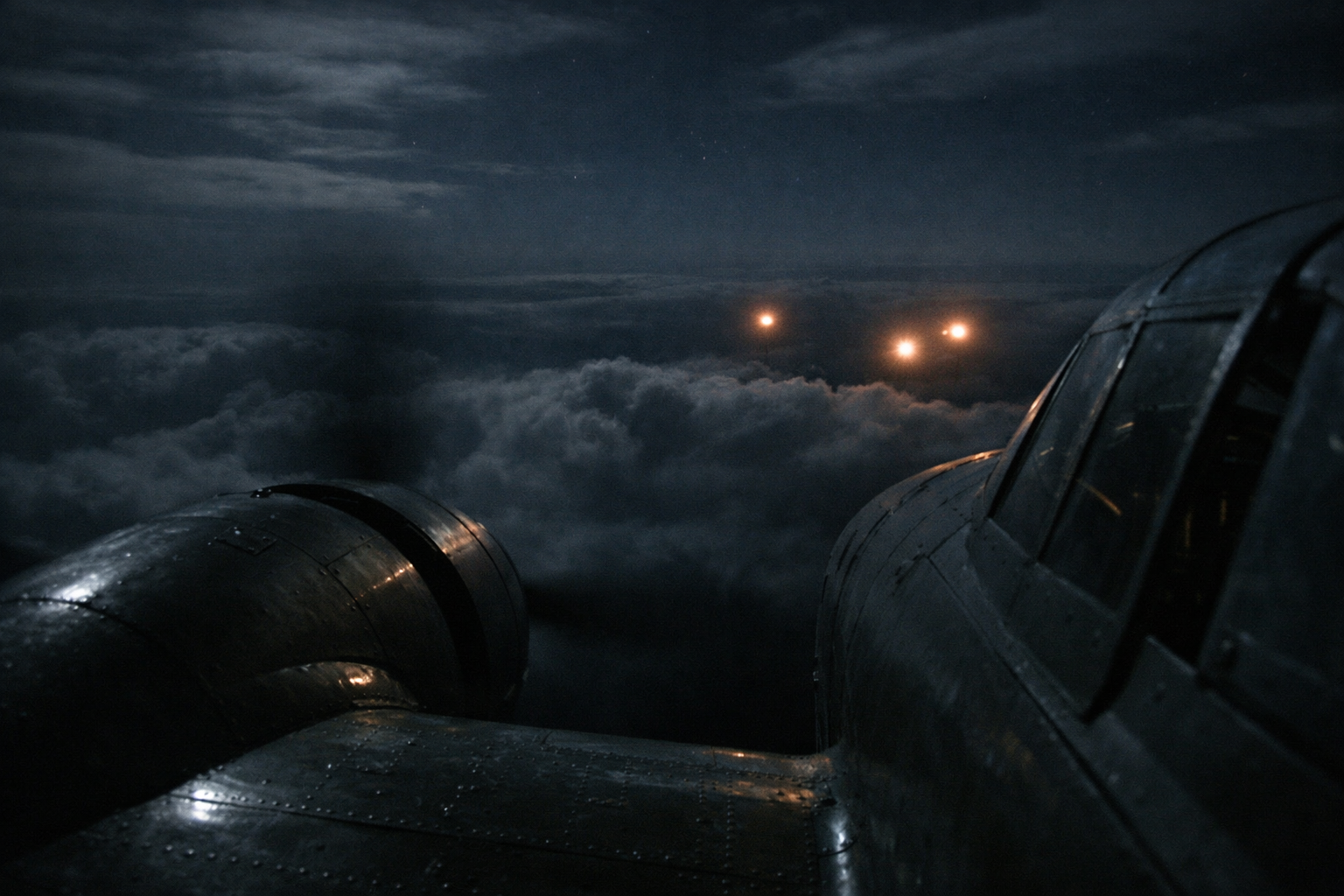
The reports were never supposed to leave the cockpit. In the last months of World War II, pilots scanning black skies for flak, enemy fighters, and anything else that could kill them started seeing glowing objects pacing their aircraft. What should have remained a wartime curiosity instead became one of the earliest and most persistent military UFO mysteries on record.
Foo Fighters UFOs were unexplained aerial lights reported by Allied pilots during World War II. People who lean toward the mystery argue the sightings may have involved hidden enemy technology or even something nonhuman because trained crews kept describing lights that seemed to follow aircraft. The likeliest reality is narrower: the reports were genuine, but the surviving evidence never proved whether the lights were advanced weapons, atmospheric effects, visual misreadings, or a mix of several causes.
What Happened
The nickname “foo fighters” did not begin as a scientific label. It came out of wartime slang, reportedly borrowed from a comic strip phrase, and it stuck because pilots needed a name for what they kept seeing. These were usually glowing balls, lights, or bright shapes that appeared near aircraft at night and seemed to move with unusual control.
Imagine the setting. A night fighter crew is flying through darkness over occupied Europe. The cockpit is cramped. Engines are loud. Every flicker outside the canopy matters. One wrong call could mean enemy fire, a collision, or a crash on the way home. In that atmosphere, when a cluster of lights appears off the wing and seems to hold position, nobody shrugs it off casually.
Many of the best-known reports came from Allied airmen in late 1944 and 1945. Crews described glowing orange, red, or white lights that trailed aircraft, flew alongside them, or appeared to react to evasive movement. In some cases, pilots feared they were facing a new German weapon. That worry made sense. World War II was full of technological surprises, and both sides were racing to improve radar, rockets, aircraft design, and electronic warfare.
The problem was that the foo fighters did not behave like an ordinary weapon that could be quickly identified. They did not consistently attack. They were not recovered. Radar confirmation was uneven or missing. And after the war, no single enemy program emerged that neatly explained all major reports. That gap between sincere testimony and missing proof is exactly why the story survived.
Seen from a modern angle, the case matters because it looks less like a random old legend and more like an early version of a pattern that keeps returning in military UFO history. You have credible witnesses, high-stress conditions, incomplete instrumentation, and just enough uncertainty for the mystery to live on. That is why foo fighters work best on this site as historical timeline support for later military cases, not as a catchall “aliens in World War II” article.
That bridge becomes clearer when you compare the wartime reports with later episodes like the Rendlesham Forest Incident: Britain’s Roswell or a Cold War Story That Grew in the Dark? and the Belgian UFO Wave: Mass Sighting, Radar Case, or a Story Shaped by Expectation?. The settings changed. The technology changed. But the core tension stayed familiar: military witnesses reported something strange, and the public evidence never became complete enough to settle every argument.
Why People Believe It
People believe the foo fighters story because the witnesses were not random storytellers. They were trained military personnel operating in dangerous conditions where observation mattered. Even if pilots could still make mistakes, their reports carry more weight than a casual rumor told years later with no documentation behind it.
There is also something powerful about the timing. These sightings happened before modern UFO culture became huge. Supporters argue that the aircrews had less reason to interpret strange lights through a ready-made alien storyline. In that view, the reports feel cleaner than later cases shaped by films, television, and decades of conspiracy language.
The story also survives because war naturally breeds secrecy. If pilots kept seeing unexplained lights near combat zones, it is easy to imagine governments knew more than they admitted. Once that suspicion enters the story, every missing document, vague summary, or inconclusive explanation can feel like evidence of a cover-up even when it may only reflect ordinary wartime confusion and record loss.
Another reason belief sticks is pattern recognition. Readers who already accept that trained crews sometimes encounter things they cannot identify tend to place foo fighters at the start of a long military-UFO timeline. From wartime Europe to Cold War bases to the modern Navy footage discussed in Pentagon UFO Videos: What the Navy Footage Confirmed – and What It Didn’t, the same structure keeps reappearing: credible people, unusual motion, thin public data, and endless debate about what counts as proof.
And then there is the emotional logic of unfinished stories. Cases with total explanations usually die. Cases with no credible witnesses get dismissed. Foo fighters landed in the more stubborn middle. The reports are detailed enough to stay interesting and thin enough to stay unsettled. That middle ground is exactly where conspiracy thinking tends to grow.
Claims vs Evidence
Claim: Foo fighters were extraterrestrial craft shadowing wartime aircraft.
Evidence: There is no confirmed evidence that the lights were alien vehicles. The strongest support is eyewitness testimony from pilots and crews who described objects behaving in ways they could not easily explain. That makes the reports important, but it does not identify the source.
Claim: Foo fighters were secret German or Japanese weapons.
Evidence: This was one of the first theories pilots themselves considered, and it made sense in context. However, no definitive wartime or postwar record has surfaced proving a single enemy device was responsible for all major reports. Some sightings may have involved experimental technology, anti-aircraft effects, or misunderstood defensive measures, but that explanation does not close the case by itself.
Claim: The sightings were just stress, reflections, or pilot error.
Evidence: Some cases may fit that explanation. Combat fatigue, darkness, weather, St. Elmo’s fire, distant flak bursts, reflections on canopies, and misjudged motion can all make lights look stranger than they are. But reducing every report to pilot confusion is too neat. The contradiction at the heart of the story is that experienced crews kept reporting similar patterns, yet the evidence stayed too thin to settle the question.
Claim: Foo fighters were the first modern military UFO case.
Evidence: That works better as a framing idea than as a proven historical fact. What makes the comparison useful is not that World War II pilots secretly proved aliens were real. It is that the reports already contained the same ingredients seen in later UAP debates: credible witnesses, limited data, uncertain instrumentation, and a wide gap between “unexplained” and “extraordinary.”
Claim: Because the sightings were unexplained, they point to one hidden answer that governments never admitted.
Evidence: What we do know is narrower than that. The reports show that unusual aerial observations happened and were taken seriously enough to be remembered. What they do not show is a single confirmed explanation, much less proof of a long-running secret program about them. Unexplained cases can remain unexplained without automatically pointing to one grand answer.
Reality Check
The smartest way to read the foo fighters story is not as proof, but as an early lesson in how military aerial mysteries work. Trained observers can report something sincerely. Different crews can notice similar features. The event can feel important in the moment. And the final answer can still remain out of reach.
That is what makes the case durable. If the sightings had all been obvious illusions, they would have faded. If they had been clearly documented weapons, they would have become straightforward military history. Instead, they landed in the uncomfortable middle: too credible to laugh off, too under-evidenced to solve cleanly.
A key distinction matters here. “Unexplained” does not mean “alien.” It means the available evidence does not let us identify the cause with confidence. That is a lower bar, but it is also the honest one. Believers often jump from mystery to extraterrestrial explanation. Hardline skeptics sometimes jump from uncertainty to dismissal. Both shortcuts flatten what makes the case interesting.
The wartime environment also matters. These pilots were dealing with darkness, weather, enemy threats, stress, and fast-moving technology. Under those conditions, unusual lights could come from several sources, including atmospheric effects and human-made systems that were hard to judge from the air. At the same time, the repeated nature of the reports helps explain why the mystery lodged itself so deeply in memory and later UFO culture.
So were foo fighters real? The reports were real. The pilots were real. The uncertainty was real. What remains unproven is the leap from those facts to any single explanation, especially an extraterrestrial one. In that sense, foo fighters are best understood as a wartime mystery that helped establish the pattern later readers would recognize in modern military UFO debates.
Conclusion
Foo fighters sit at an important point in UFO history because they arrived before the full machinery of modern UFO culture took over the conversation. Even so, they already showed the same pattern that would define later debates: credible witnesses, strange behavior, limited evidence, and a public imagination ready to fill the gap.
That is why the story still matters. Not because it proves alien visitors crossed wartime skies, but because it shows how an unresolved aerial event can survive across generations when the facts stop just short of certainty. As a historical military-mystery support piece, it helps connect World War II sightings to later cases without pretending the evidence is stronger than it is.
🔎 If this story stayed with you, the author suggests these real cases next:
- Rendlesham Forest Incident: Britain’s Roswell or a Cold War Story That Grew in the Dark?
- Belgian UFO Wave: Mass Sighting, Radar Case, or a Story Shaped by Expectation?
- Pentagon UFO Videos: What the Navy Footage Confirmed – and What It Didn’t
Explore more Alien & UFO Theories stories here: