
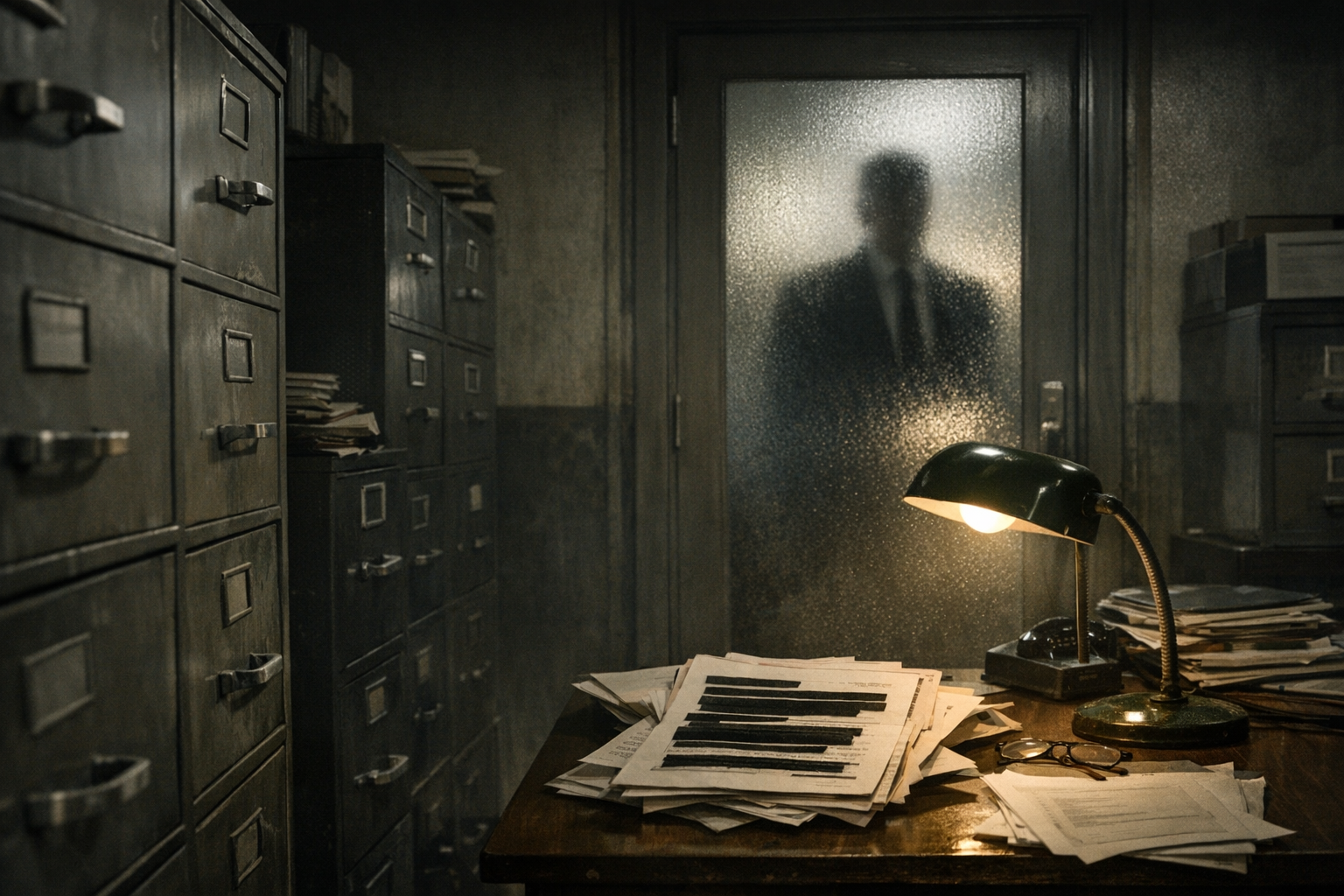
The doors are supposed to be open. That is the promise at the center of democracy. But the deeper you look into the government transparency myth, the stranger the picture becomes: sealed files, blacked-out pages, closed hearings, and decisions made far from public view. You are told power works in daylight, yet some of its most important movements still happen behind frosted glass.
That tension is exactly why this story has such a long life. Most people do not need to believe in a secret ruling cabal to feel uneasy. They only need to notice how often governments speak in the language of openness while relying on classification, delay, and controlled disclosure when the stakes get high.
What Happened
The basic idea behind the theory is simple. Governments present themselves as transparent systems with public records, press briefings, elections, oversight, and legal checks. In theory, citizens can see how decisions are made. In practice, many of the most sensitive choices move through channels the public cannot fully access in real time.
Some secrecy has always existed. Military planning, intelligence operations, diplomatic negotiations, and active investigations are rarely conducted in full public view. That alone is not shocking. Most people understand that a government cannot publish every detail of every operation the moment it happens.
The trouble begins when limited secrecy starts looking less limited. Classification systems can keep documents hidden for years. Freedom of Information Act requests can take months or even longer. Released records often arrive heavily redacted. Congressional oversight can happen in closed sessions. And by the time key facts reach the public, the decision that mattered may already be long over.
That gap creates a powerful human moment. Picture an ordinary citizen hearing officials say the system is transparent while reading page after page of documents covered in black bars. It feels less like being informed and more like being allowed to peek through a keyhole after the room has already been cleared.
Modern distrust did not appear out of nowhere either. Declassified scandals, covert programs, surveillance revelations, and misleading official statements have taught the public that government secrecy is not just theoretical. Stories like Lobbying Power Influence: Legal Access or the Closest Thing to Hidden Rule? and later debates around Intelligence Agencies and Hidden Government Power: How Much Happens Behind Closed Doors? gave people a real historical reason to question how much “open government” actually reveals.
Why People Believe It
People believe this theory because the branding and the reality often do not match. Leaders talk about accountability and openness, but major issues can still disappear into classified systems, legal exemptions, and procedural delays. When that happens often enough, transparency starts to feel like a slogan instead of a condition.
Another reason is timing. Transparency that arrives years later does not feel fully transparent. If the public only learns the truth after policies are carried out, wars are launched, surveillance is expanded, or private deals are signed, the disclosure can feel more like cleanup than openness.
There is also a logic problem built into public trust. Governments ask citizens to believe that internal oversight works even when the public cannot see it. That may sometimes be true. But to a skeptical person, invisible oversight can sound a lot like invisible accountability. If the system says, “Trust us, we reviewed it,” suspicion naturally grows.
Then there is the emotional side. People are more likely to suspect hidden power when they feel shut out of major decisions. Complex bureaucracies, security language, and delayed records create distance. That distance invites theory. Once a person starts to feel that the real discussion is happening somewhere else, every missing detail becomes a possible clue.
The internet sharpens all of this. One verified scandal, one leaked memo, one redacted file, and one unsupported theory can circulate in the same feed. Soon the line between “governments sometimes hide important things” and “governments hide almost everything important” becomes easier to blur.
Claims vs Evidence
Claim: Government transparency is mostly theater, and real power operates almost entirely in secret.
Evidence: There is real evidence that many important actions happen with partial visibility. Classification, redactions, back-channel diplomacy, and closed oversight are genuine features of government. But that does not prove that nearly all meaningful power is hidden from the public at all times.
Claim: If a document is redacted or delayed, it means officials are hiding wrongdoing.
Evidence: Not necessarily. Some redactions protect sources, methods, privacy, or active operations. Others may protect embarrassment, political exposure, or institutional interests. The existence of a redaction proves secrecy, but not automatically a criminal conspiracy.
Claim: Public-record laws and disclosure systems are fake because they never reveal the full truth.
Evidence: Disclosure systems are real, and they do release important material. Journalists, watchdog groups, and researchers have exposed major stories using public-record tools. The limitation is that these systems are often slow, partial, and reactive. They can reveal a great deal, but rarely on the public’s preferred timeline.
Claim: Hidden access proves a hidden government.
Evidence: This is where the theory often stretches too far. Restricted briefings, classified channels, and internal negotiations show that governments manage information unequally. They do not automatically prove the existence of a separate secret regime controlling everything from the shadows.
The strongest evidence supports a narrower but important conclusion: modern governments are partly transparent and partly opaque, and the opaque part can shape public life in serious ways. The weaker claim is that this opacity alone proves every hidden-hand theory built on top of it.
Reality Check
The reality check is not comfortable for either side. People who insist democracies are fully open have to deal with a long record of secrecy, delayed disclosure, and official filtering. But people who argue transparency is a total myth often flatten major differences between temporary secrecy, bureaucratic protection, lawful confidentiality, and actual misconduct.
What we do know is that governments have real transparency mechanisms. Courts can force disclosure. Legislatures can investigate. Journalists can obtain records. Inspectors general can expose wrongdoing. Archives do open. Whistleblowers do change public understanding. That is not nothing.
What we also know is that those mechanisms often work slowly and unevenly. Agencies can stall. Officials can overclassify. Sensitive matters can be discussed in rooms the public never enters. A democratic structure may exist on paper while public visibility remains limited in practice.
That is why the best conclusion here is partial, not absolute. Transparency is not fake in the sense that it does not exist. It clearly does. But it is also not complete in the way public messaging sometimes implies. Important parts of power remain hidden, delayed, or filtered long enough to shape events before citizens can properly judge them.
The key mistake is moving too fast in either direction. Blind trust ignores how often secrecy has protected mistakes, manipulation, or institutional self-interest. Blind suspicion ignores the fact that some confidentiality is real, legal, and sometimes necessary. The honest reading sits in the middle: transparency exists, but it has limits large enough to keep conspiracy thinking alive.
If anything, that may be the deeper lesson. The public does not become suspicious only because of rumor. It becomes suspicious because openness arrives in fragments. When power says, “Nothing to worry about,” and the record appears years later with half the story missing, distrust is not hard to understand.
Conclusion
The government transparency myth survives because it touches a real contradiction. Democracies promise public accountability, yet many important decisions still move through hidden channels, delayed disclosures, and carefully managed information systems. That does not prove every theory about secret rule. But it does explain why so many people feel the official picture is incomplete.
The clearest conclusion is that this story is partly explained. Openness is real, but so are secrecy, delay, and filtered access. The public is not wrong to notice the gap. It just becomes a mistake when that gap is treated as automatic proof of a grand hidden power behind every unanswered question.
In the end, the theory lasts because it feeds on something simple and stubborn: when the lights come on late, people start wondering what happened in the dark.
🔎 If this story stayed with you, the author suggests these real cases next:
- Lobbying Power Influence: Legal Access or the Closest Thing to Hidden Rule?
- Intelligence Agencies and Hidden Government Power: How Much Happens Behind Closed Doors?
- Secret Trade Deals: Hidden Negotiations or Just How Global Politics Works?
Explore more Political Conspiracies stories here: