
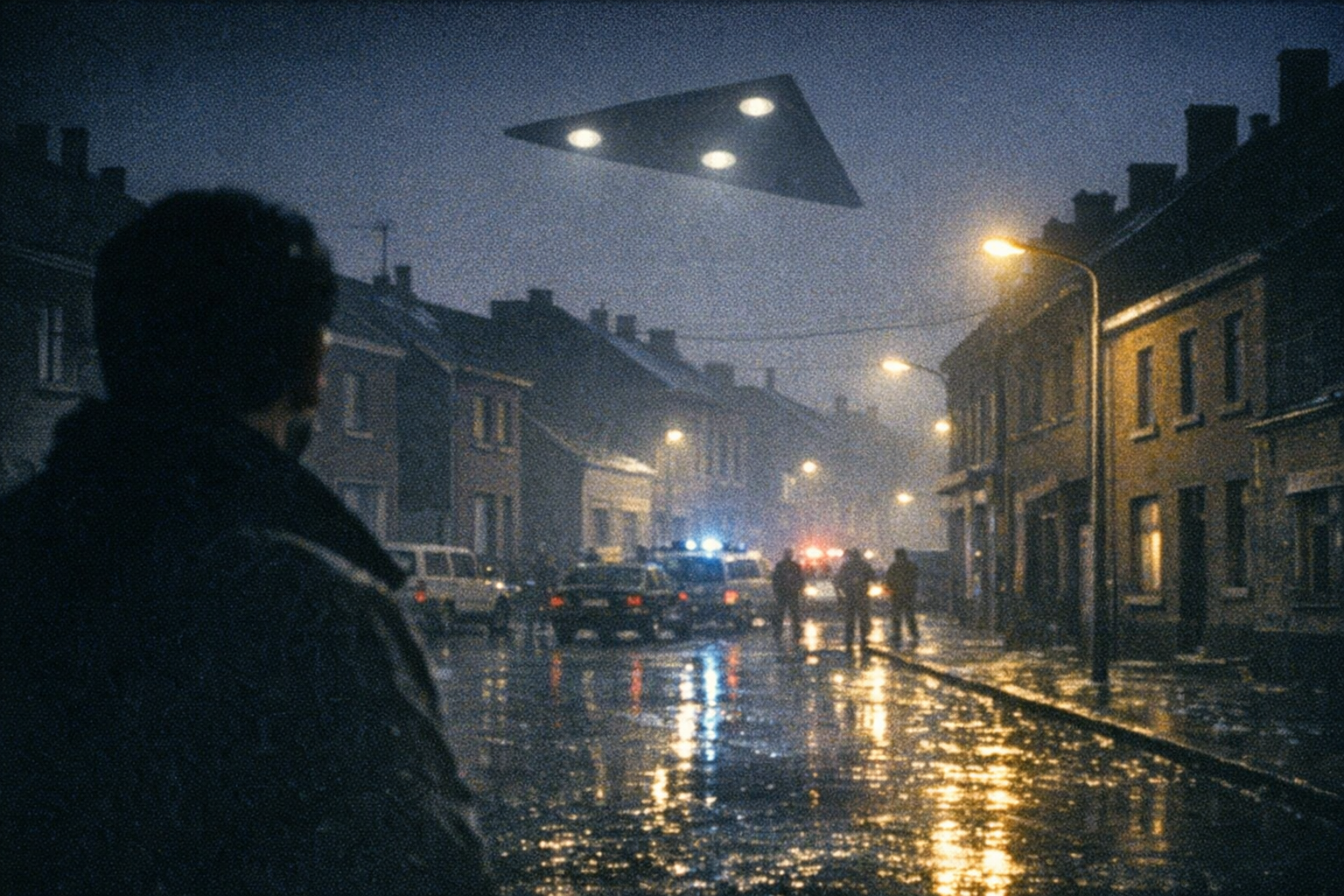
The file cabinets were locked, the radar rooms were restricted, and yet the story still leaked into the winter streets. On cold nights across Belgium in 1989 and 1990, people looked up at dark skies and described the same thing: a silent, low-moving triangle hanging above neighborhoods as if it had slipped into view from somewhere it was never meant to be seen. The Belgian UFO Wave did not become famous because of one dramatic witness. It became famous because the sightings seemed to climb from sidewalks and car windows into the world of police reports, military attention, and radar discussion.
The Belgian UFO Wave refers to a surge of sightings in 1989 and 1990, when witnesses across Belgium described dark triangular objects and unusual lights in the night sky. Believers argue the wave stands out because police reports, military attention, and radar discussion suggest something truly extraordinary was present. The most likely reality is less dramatic but still intriguing: Belgium experienced a real cluster of unusual reports, yet the evidence still falls short of proving alien craft.
What Happened
The Belgian UFO wave refers to a stretch of sightings reported between late 1989 and early 1990, with the most famous moments centered on November 1989 and March 1990. Witnesses in different towns described large triangular objects with bright lights, slow movement, and little or no noise. It was not one sighting. It was a chain of reports that began to look connected.
The most important early night came on November 29, 1989. Police officers and civilians, especially around Eupen, reported unusual objects in the sky. Some described a triangle with lights at the corners and a red light in the middle. Others focused on movement that seemed too controlled or too strange to fit an ordinary aircraft.
More sightings followed. Newspapers picked them up. UFO groups collected statements. The Belgian Air Force publicly addressed the case, which gave the wave a kind of official weight that many UFO stories never get. Once military interest entered the story, it stopped feeling local and started feeling national.
One of the most talked-about episodes came on the night of March 30 to 31, 1990, when Belgian Air Force F-16s were scrambled after reports of unusual objects. Radar activity from that night became central to the case. Supporters later pointed to radar locks and military response as proof that something solid and extraordinary had been in the sky. Skeptics argued that radar confusion and witness expectation can turn a strange night into a legend faster than most people realize.
Imagine being one of the drivers on a wet Belgian road that winter: streetlights reflecting off the pavement, bare trees cutting across the sky, and a shape above you that seems both close and impossible. That human moment explains why the case stayed alive. Whatever people saw, many of them felt they were watching something beyond the normal rules of flight.
Why People Believe It
The Belgian UFO wave has lasted because it checks boxes that make a mystery hard to dismiss. There were many witnesses. Some witnesses were police officers, which many readers treat as a sign of reliability. The military did not ignore the story. And radar became part of the public conversation. In UFO culture, that combination is powerful. A story feels stronger when it seems to move from personal testimony to institutional attention.
There is also the triangle itself. The image is simple and memorable: three lights, dark body, silent movement. A clean visual pattern is easier to remember and easier to repeat than a messy one. Once that pattern enters public imagination, later reports can start fitting the same shape more easily. People are not always lying when this happens. Sometimes they are trying to describe something strange using the strongest image already available to them.
The timing also mattered. Europe was still full of anxiety about advanced aircraft, military secrecy, and things governments might know but not say. Belgium was not an obvious stage for cosmic drama, which oddly made the case feel more credible to many readers.
The case gained even more force because it was not a crash tale like Roswell or a school encounter like Ariel School. It looked instead like a mass-sighting wave that briefly touched military systems, and that gave it unusual staying power.
Claims vs Evidence
Claim: Belgium experienced repeated sightings of unusual aerial objects that many witnesses described in similar ways. Evidence: This is well supported. There were documented reports, press coverage, and real public discussion involving officials and investigators. The sightings happened. The open question is what the sightings represent.
Claim: Belgian authorities took the case seriously. Evidence: Also supported. The Belgian Air Force commented publicly and scrambled aircraft during the March 1990 event. That does not prove alien craft were present, but it does show the reports were not dismissed as meaningless noise from the start.
Claim: Radar confirmed an extraordinary craft performing impossible maneuvers. Evidence: This is where the story gets slippery. Radar contacts were reported, and that is one reason the case became so famous. But radar data does not always equal a clear picture of a structured craft. Radar can be affected by tracking limits, interpretation problems, atmospheric conditions, and ordinary confusion during a fast-moving event. Supporters often present the radar episode as final proof. It was important, but it was not simple proof.
Claim: The wave proves extraterrestrial visitors were operating over Belgium. Evidence: There is no confirmed evidence that this conclusion follows. No craft was recovered. No official record established alien origin. No physical evidence settled the matter. That gap matters. A case can be unusual, even deeply unusual, without crossing the line into confirmed extraterrestrial contact.
A famous photograph often linked to the Belgian wave also deserves caution. For years, one dramatic image of a triangular craft helped define public memory of the case. Later, the photo was widely treated as a hoax. That does not erase the wider wave, but it does show how weak evidence can attach itself to a stronger mystery and distort it.
The larger pattern fits what we see in other major UFO stories, including Pentagon UFO Videos and Government UFO Programs: official attention can deepen a mystery without confirming an extraordinary answer.
Reality Check
The strongest reading of the Belgian UFO wave is not that it proves alien craft visited Europe. The strongest reading is that it remains one of the more credible mass-sighting UFO cases because multiple witnesses, police reports, and military involvement created a layered record. That is already enough to make it significant.
But significance is not the same as certainty. Human beings are pattern-makers. Once a few dramatic sightings are reported, later witnesses may interpret lights, aircraft, or ambiguous shapes through the same lens. A long wave of sightings can become partly self-reinforcing. Media coverage helps. Local discussion helps. The more famous the story becomes, the easier it is for expectation to shape what people think they saw.
There are also ordinary explanations that can cover parts of the wave without covering every report. Aircraft lights at night can appear strange, distance and darkness make size hard to judge, and radar anomalies can deepen a mystery without solving it. None of that proves the witnesses were wrong. It simply shows why the biggest conclusion should be held back.
The best honest conclusion is that Belgium produced a real wave of unusual reports, some serious enough to involve the military, and that the case still resists a clean one-line explanation. That places it in the middle category: partially explained. Something happened, but the leap to confirmed alien craft is still much bigger than the evidence allows.
Conclusion
The Belgian UFO wave endures because it sits in the uncomfortable space between rumor and proof. It was too public to ignore, too layered to dismiss with a shrug, and too thin on hard evidence to close the case. That is exactly why it stayed alive. It feels like a mystery that almost crossed into certainty, then stopped just short of the door.
If you strip away the later mythology, what remains is still compelling: winter skies, repeated witnesses, police unease, radar debate, and a country briefly forced to ask whether ordinary explanations were enough. That does not make the answer alien. It does make the case one of the strongest examples of how a UFO story becomes durable when institutions and eyewitnesses collide.
If this angle pulled you in, compare it with other cases where public reports met official attention, like the military questions around the Phoenix Lights and the Cold War tension surrounding the Rendlesham Forest Incident.
If this story stayed with you, the author suggests these real cases next:
- Phoenix Lights: The Night Hundreds Looked Up and the Questions Stayed
- Rendlesham Forest Incident: Britain’s Dark Forest Mystery Still Under Debate
- Ariel School UFO Encounter: When a Schoolyard Story Refused to Fade
Explore more Alien & UFO Theories stories here: