
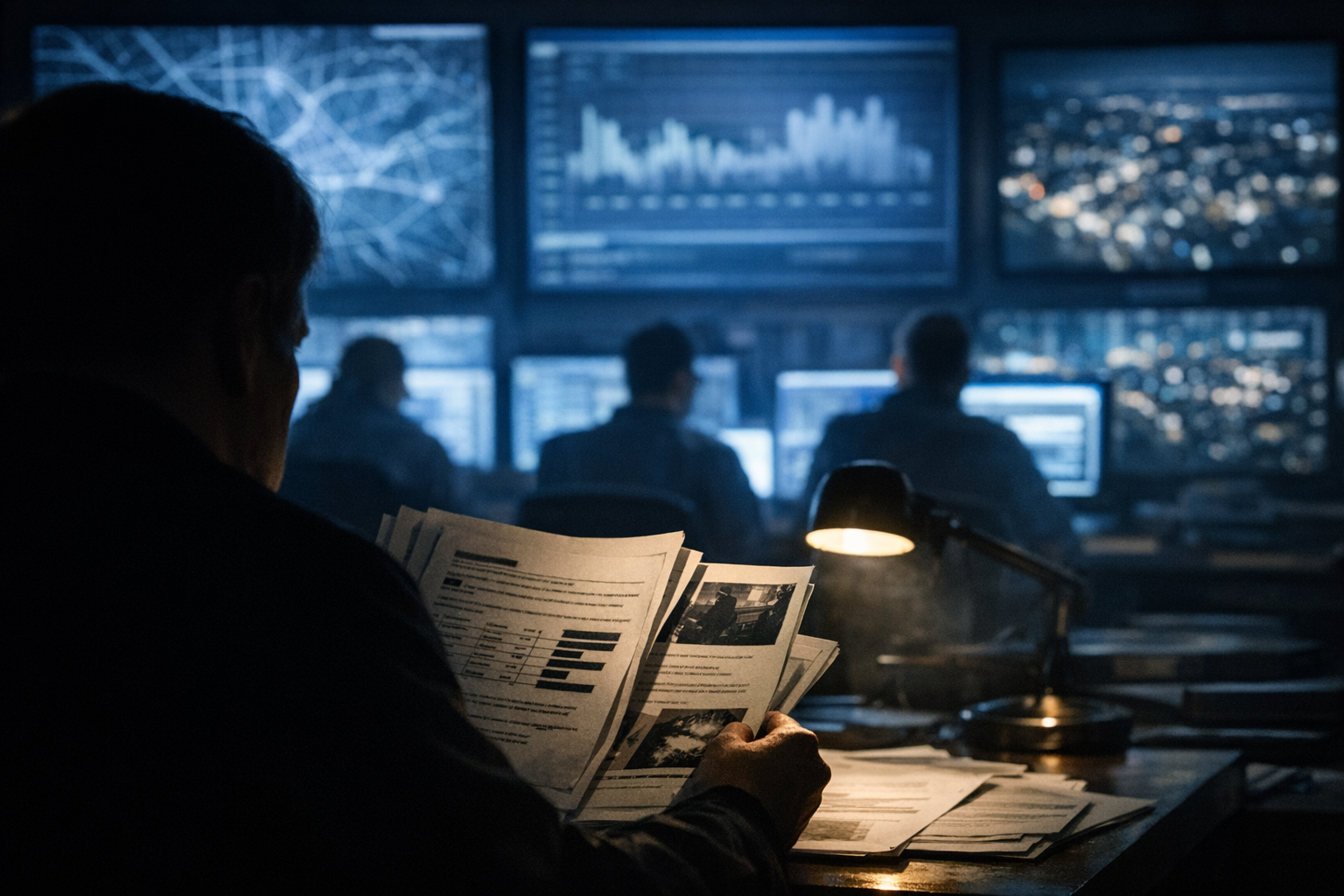
The phrase mass surveillance state used to sound like something whispered behind closed doors, the kind of warning people passed around when they thought the government was listening. Then came the glow of leaked slides on laptop screens, the black bars of classified files, and the uneasy realization that some of what sounded paranoid had, in fact, been documented.
That is what makes this story harder to dismiss than most. It does not begin with a blurry photo or a rumor from a message board. It begins with real intelligence programs, real disclosures, and a public forced to ask whether the line between national security and constant watching had already moved far beyond what most people imagined.
What Happened
For decades, governments have collected information in the name of security. That by itself is not a conspiracy. Intelligence agencies track foreign threats, investigate criminal networks, and monitor communications tied to real risks. The deeper controversy started when the scale of that monitoring appeared much larger than the public had been told.
In the United States, one of the biggest turning points came in 2013, when documents leaked by former National Security Agency contractor Edward Snowden showed how broad modern surveillance capabilities had become. Reports described the collection of phone metadata, the targeting of digital communications, and systems built to gather huge amounts of information moving through the internet.
🔎 Related Investigation:
To many readers, the shock was not just that surveillance existed. It was the size of it. The image that stuck was simple: millions of ordinary people carrying phones in their pockets while agencies quietly built tools that could map calls, contacts, and patterns of behavior. Even if officials argued they were not listening to every call in real time, the idea that so much information could be gathered at all changed the public mood.
There was also a human moment that gave the story its power. Imagine someone sitting at a kitchen table late at night, reading one leaked report after another, realizing that words once treated like fringe warnings now appeared in major newspapers with government names and program labels attached. That shift, from rumor to record, is why this theory lasted.
But the story did not start with Snowden. Earlier decades already gave people reasons to be suspicious. The FBI’s COINTELPRO operations, Cold War intelligence abuses, and later debates over the Patriot Act all fed the idea that governments often expand surveillance first and explain limits later. The modern fear grew on top of a real historical foundation.
That history connects to other long-running political distrust stories on the site, including Deep State Explained: Hidden Ruling Network or Just the Machinery of Government?. In both cases, the core fear is not random. It comes from the belief that powerful institutions can keep doing important things outside normal public view.
Why People Believe It
People believe mass surveillance stories because part of the story is proven. That matters. This is not like a theory built only on anonymous claims. Leaks, court debates, official statements, and declassified records all confirm that modern governments developed serious surveillance capacity. Once that much is established, broader fears spread easily.
The second reason is that digital life creates a trail almost all the time. Phones know location. Apps track behavior. Browsers save searches. Platforms collect clicks, contacts, and habits. When people already feel watched by private technology companies, it does not seem like a huge leap to imagine governments accessing or demanding similar streams of data.
There is also a trust problem. Officials often describe surveillance programs in narrow, careful language. Critics hear that language and suspect the truth is being softened rather than explained. That suspicion gets stronger when secret courts, classified legal opinions, or delayed disclosures are involved. Even lawful surveillance can look deceptive if the public only learns the details years later.
Another reason the theory survives is emotional logic. Most people do not picture surveillance as a boring spreadsheet. They picture an unseen observer. They imagine a private message, a late-night search, a phone call, or a location history being quietly stored somewhere they cannot reach. That image turns an abstract policy debate into something personal.
Mass surveillance also overlaps with wider fears about manipulated information. If powerful systems can monitor behavior at scale, people naturally wonder what else those systems can do. That is part of why the topic sits near stories like Operation Mockingbird: Did the CIA Really Shape the News?, where the deeper issue is not just spying, but institutional influence over how reality is managed and understood.
Claims vs Evidence
Claim: The government monitors nearly everyone all the time and watches private lives in total real time.
Evidence: There is documented evidence of large-scale surveillance capabilities, including metadata collection and broad intelligence access to communications streams. However, that is not the same as proof that every citizen is being individually watched around the clock by a live human observer. The strongest confirmed evidence shows powerful collection systems, not omnipotent moment-by-moment control over every person.
Claim: Leaked documents proved that privacy no longer exists.
Evidence: The leaks showed that privacy was more vulnerable than many people believed, especially in digital communication. But “privacy no longer exists” is too absolute. There are still legal limits, technical barriers, oversight structures, and differences between what agencies can collect, retain, search, or use. Those limits may not satisfy critics, but they matter analytically.
Claim: Surveillance powers are used only against foreign threats and dangerous criminals.
Evidence: History gives people reason to doubt that clean boundary. Past intelligence abuses show that surveillance tools can expand beyond their original purpose. What we do know is that governments often justify broad powers through security needs, while critics warn that once systems exist, mission creep becomes a real risk.
Claim: The existence of surveillance programs proves a hidden authoritarian control system is already fully in place.
Evidence: This goes further than the confirmed record supports. Documented surveillance capacity is real. So are secrecy and institutional self-protection. But claims of total behavioral control usually lean on assumption rather than public evidence. Supporters of the theory often jump from “the state can gather a lot” to “the state secretly controls everything.” That leap is much harder to prove.
Claim: If officials denied parts of the story before, the most extreme versions are probably true.
Evidence: This is where conspiratorial thinking often grows fastest. Real deception or incomplete disclosure can make people more open to bigger claims. But a government being misleading about one surveillance issue does not automatically confirm every later claim about blackmail databases, full-spectrum social control, or universal live monitoring.
Reality Check
The reality check here is uncomfortable because both sides hold part of the truth. Skeptics are right that not every sweeping surveillance claim is supported by evidence. Believers are right that governments have, in fact, built powerful systems the public did not fully understand until leaks and reporting exposed them.
This is why the topic feels different from weaker conspiracy stories. The foundation is real. Secretive intelligence work, classified programs, and large-scale data collection are not fantasy. The mistake comes when documented capability gets stretched into unlimited capability, or when justified concern turns into certainty about total control.
There is also a modern systems problem. Surveillance is no longer only about one agency in one building. It sits at the intersection of governments, telecom companies, platforms, legal demands, contractors, and data retention. That complexity makes the whole structure harder for ordinary people to see clearly, which in turn makes it easier for fear to fill the gaps.
Still, the facts matter. Snowden-era disclosures confirmed that mass data collection was not just a paranoid slogan. They did not prove that every dramatic claim attached to the phrase was true. The available evidence supports a partial conclusion: governments developed serious surveillance reach, often with more secrecy than the public realized, but the most extreme stories about near-magical total oversight remain unproven.
In plain terms, the public had reason to be alarmed. It just did not have reason to assume every device had become a perfect window into every human life at all times. The gap between those two ideas is where careful analysis has to stay.
Conclusion
The mass surveillance state story survived because it crossed a rare line: parts of it moved from suspicion into documentation. Once people saw real program names, real court fights, and real leaks, the old instinct to laugh the topic away stopped working.
At the same time, documented surveillance is not the same as unlimited surveillance. What the evidence shows is serious enough on its own: governments can collect far more information than many citizens once believed, and secrecy made that reality harder to judge in real time. What the evidence does not clearly show is an all-seeing system that perfectly tracks and controls every person without limit.
That leaves this conspiracy in the middle ground where some of the fear is earned. The strongest conclusion is not that the watching story was fake, and not that the wildest version is confirmed. It is that modern surveillance power is real, history gives the public good reason to stay skeptical, and the line between protection and overreach will keep being fought over as long as the tools keep expanding.
🔎 If this story stayed with you, the author suggests these real cases next:
- Deep State Explained: Hidden Ruling Network or Just the Machinery of Government?
- Operation Mockingbird: Did the CIA Really Shape the News?
- Election Fraud Theories: What the Claims Said vs What the Evidence Actually Showed
Explore more Political Conspiracies stories here: