
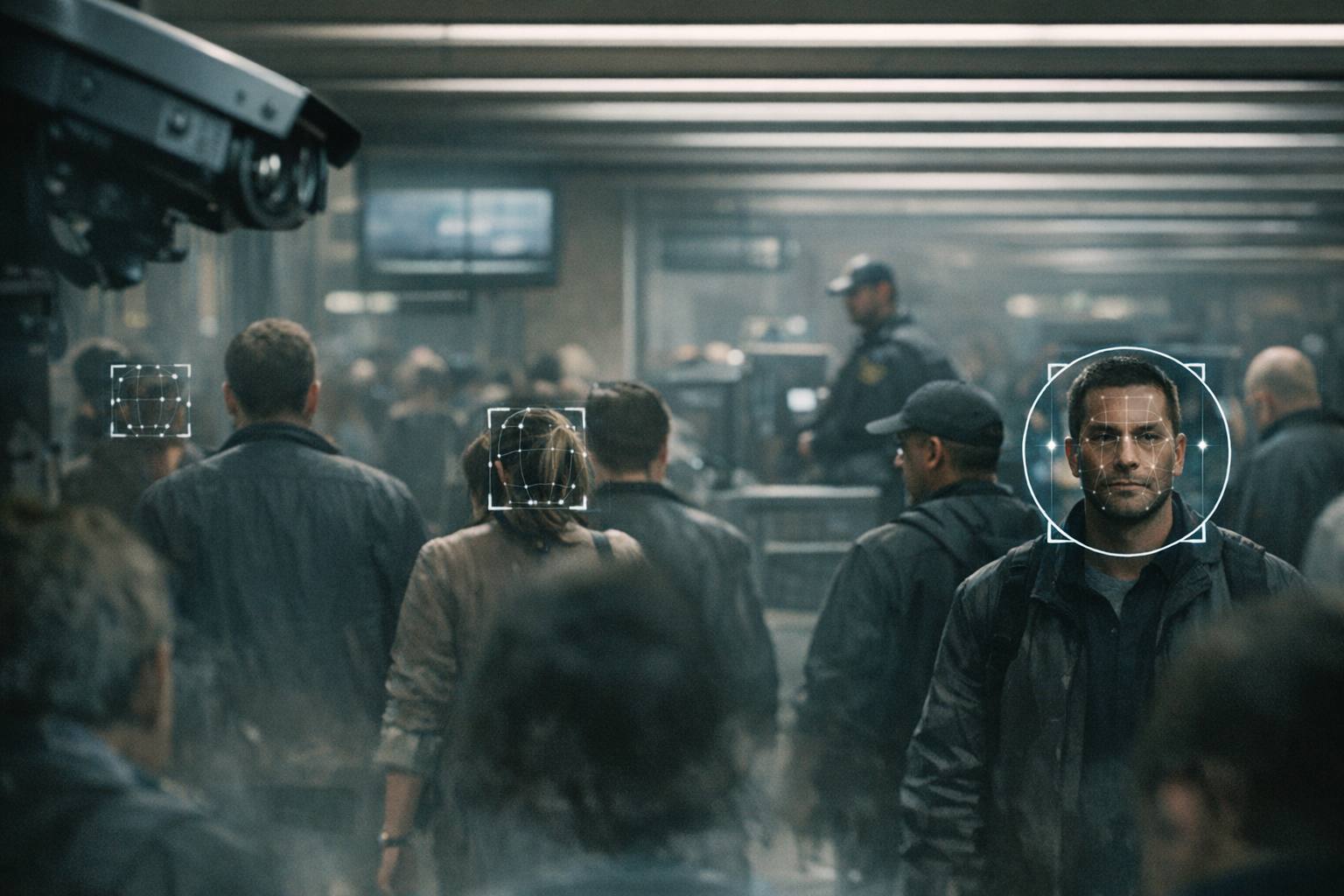
The promise always sounds harmless at first. A faster airport line. A safer office entrance. A camera that does more than watch because it can recognize who passed through. That is why the biometric surveillance conspiracy keeps spreading: the technology is real, the convenience is obvious, and the fear is that a simple identity check can quietly become the first layer of a much larger control system.
Biometric surveillance is the use of physical or behavioral traits such as faces, fingerprints, irises, or gait patterns to identify people. Supporters of the conspiracy claim it is becoming a permanent tracking system that could tie identity to movement, access, and behavior across daily life. The more grounded reality is that biometric tools are already expanding in powerful ways, but the public evidence points more clearly to growing surveillance capacity, mission creep, and weak oversight than to proof of one hidden master control grid.
What Happened
Biometric surveillance did not arrive as one dramatic secret program. It grew step by step through systems that were sold as practical improvements. Border agencies used face matching to compare travelers against records. Smartphones normalized fingerprint and facial unlock tools. Offices and apartment buildings began replacing keys and badges with scans. Stadiums, stores, and transportation hubs started exploring systems that could verify identity faster than a person showing a physical card.
That gradual spread changed the emotional weight of surveillance. A normal camera records what happened in a space. A biometric system can try to answer who was there. That turns surveillance from passive observation into identity-based tracking. Once that shift becomes visible, people stop thinking only about security and start wondering where the information goes next.
The published fears around this topic did not come from nowhere. Modern life already includes a web of location data, app tracking, account logins, and public camera networks. The debate around the mass surveillance state gave readers the wider frame long before biometric systems became common talking points. Biometric tools make that larger fear feel more personal because the credential is no longer a badge, password, or device. It is your own face, body, or movement.
This is also where the “control grid” language enters the story. Critics argue that once enough institutions adopt biometric tools, a person can be recognized across more parts of daily life without ever choosing to opt in meaningfully. Even when each system is justified separately, the combined effect can feel like an identity layer settling over public life. That does not prove one secret central command structure already exists. It does explain why people see the trend as more than routine tech adoption.
Public safety remains the main argument for expansion. Supporters point to fraud prevention, secure access, missing-person searches, and faster screening. Those are real use cases, not imaginary cover stories. But the same systems can also create large stores of sensitive data, open the door to silent monitoring, and make sharing between agencies or vendors more tempting over time. As later debates around digital identity systems like Real ID show, the public worry is often less about one device and more about the way separate identification tools can start fitting together. The central issue is not whether the tools exist. It is how far they can expand before the public fully understands the trade-off.
Why People Believe It
People believe the biometric surveillance conspiracy because it begins with visible facts instead of impossible science fiction. Cameras already exist in huge numbers. Face matching already works well enough to attract governments, employers, and private companies. Databases already store identity information at scale. The leap from “this tool exists” to “this tool could be overused” feels short, which makes the broader theory emotionally persuasive.
Trust is another major factor. Surveillance systems are often introduced with a narrow purpose, then quietly stretched into wider use later. A verification tool becomes an investigative tool. A building-access system becomes a workforce-monitoring system. A safety database becomes something other agencies want to search. That pattern resembles older worries explored in FISA surveillance fears, where the deepest public concern is not just capability but oversight. Once people believe institutions rarely give up useful monitoring tools, every new biometric rollout feels like the beginning of something larger.
Biometric data also feels uniquely personal. A password can be changed. A card can be canceled. A face or fingerprint cannot be swapped out so easily once it has been copied, leaked, or shared. That permanence gives the subject more weight than ordinary data collection. Even people who are relaxed about cookies, apps, or location permissions often react differently when the system is built around their body itself.
The theory spreads quickly online because the visuals are easy to imagine. A commuter walks through a station. A camera recognizes them. The scan is logged. The timestamp is stored. Another database links it to a ticket, a phone, or a government record. Each step seems plausible on its own. The total picture becomes frightening because it does not depend on one wild leap. It depends on many small steps that already look technically possible.
Finally, the conspiracy survives because it attaches itself to a broader modern fear: that convenience technologies are quietly reshaping freedom. That is one reason readers often connect this issue to the CBDC conspiracy. The subjects are different, but the emotional logic overlaps. In both cases, people are asking whether systems built for efficiency and control of risk can later become tools for tracking, restriction, or pressure.
Claims vs Evidence
Claim: Biometric surveillance is already one hidden permanent tracking grid that follows everyone everywhere.
Evidence: There is strong evidence that biometric identification is expanding in transportation, border control, policing, workplaces, and private security. There is much weaker evidence for one seamless, centrally controlled hidden system tying all of it together. The stronger conclusion is that a patchwork of systems can still create many of the same surveillance effects people fear even without one secret command center.
Claim: Once biometric systems are introduced for safety or convenience, they inevitably become social-control tools.
Evidence: Mission creep is a real and well-known risk. Systems often gain new uses once the data exists and institutions see value in it. But a serious risk of expansion is not the same thing as proof that every deployment already serves a hidden plan. What the evidence supports is the need for strict limits, transparency, and public scrutiny before narrow uses become much broader ones.
Claim: Facial recognition and related tools can identify anyone with near-perfect accuracy.
Evidence: Some systems are powerful, but accuracy still depends on lighting, image quality, training data, watchlist quality, and how the tool is actually used. False positives and false negatives remain important. That does not make the systems harmless. A biometric tool can be invasive, influential, and wrong at the same time, which may be even more dangerous for ordinary people.
Claim: Secrecy around watchlists, vendor contracts, and procurement proves a much bigger conspiracy.
Evidence: Opacity absolutely feeds suspicion. When the public cannot see who has access to sensitive identity data, how long it is stored, or which organizations can search it, distrust grows fast. But secrecy alone does not prove one giant hidden master plan. What it does prove is that accountability often lags behind the technology itself.
Claim: Biometric surveillance means anonymous public life is disappearing.
Evidence: In some settings, that concern is increasingly plausible. The more identity tools overlap with cameras, access systems, and digital records, the harder practical anonymity becomes. The shift is uneven rather than total, but it is real enough to explain why the control-grid framing resonates so strongly with readers.
The key divide is this: the strongest version of the conspiracy says the finished system already exists in the shadows. The stronger evidence says society is building more identity-based surveillance capacity in plain sight, often without a fully informed public debate about how that power could be used later.
Reality Check
The reality check is that biometric surveillance does not need to become one perfect global grid to change everyday life. A messy network of airports, offices, police tools, vendor databases, event spaces, and transportation checkpoints can still make movement easier to monitor than most people expect. Fragmentation does not automatically protect privacy. Sometimes it only makes responsibility harder to trace.
There is no clear public proof that one hidden authority has already unified every biometric tool into a single command structure. But there is clear reason for concern. Identification technology is spreading. Institutions find it useful. Data systems tend to expand once they are in place. Public oversight often arrives late. That combination is enough to justify skepticism without claiming that the biggest theory has already been fully proven.
The real danger may be normalization more than secrecy. People accept faster lines, smoother login systems, and easier access control because those benefits feel immediate. The long-term cost is less visible. By the time the public asks how often the scans are stored, shared, searched, or reused, the infrastructure may already be too embedded to unwind easily.
That is why the conspiracy remains powerful. It exaggerates some conclusions, but it does so by pushing a real trend to its most unsettling end point. The fear is not irrational. The evidence simply supports a more careful version of the warning: biometric surveillance is becoming more common, more capable, and more normalized, even if the final image of a total hidden control grid still goes beyond what has been publicly proven.
Conclusion
The biometric surveillance conspiracy endures because it is built on a technology that already exists and a public fear that already makes sense. Supporters may overstate how unified or secret the system currently is, but the broader concern should not be waved away. When identity becomes machine-readable at scale, surveillance stops being only about where you go or what device you carry. It starts becoming about what you are.
The most honest conclusion is that biometric surveillance is neither a paranoid fantasy nor confirmed proof of one all-powerful hidden control system. It is a real and expanding capability with enough reach to justify legal scrutiny, public skepticism, and tighter limits. If the conspiracy keeps growing, it is because the world keeps moving closer to the exact kind of identity-based monitoring people were told not to worry about.
🔎 If this story stayed with you, the author suggests these real cases next:
- Mass Surveillance State: How Much Does the Government Really See?
- FISA Surveillance Fears: Secret Spy Tool or a System People No Longer Trust?
- CBDC Conspiracy: Financial Control Grid or a Fear Built on Real Surveillance Anxiety?
Explore more Political Conspiracies stories here: