
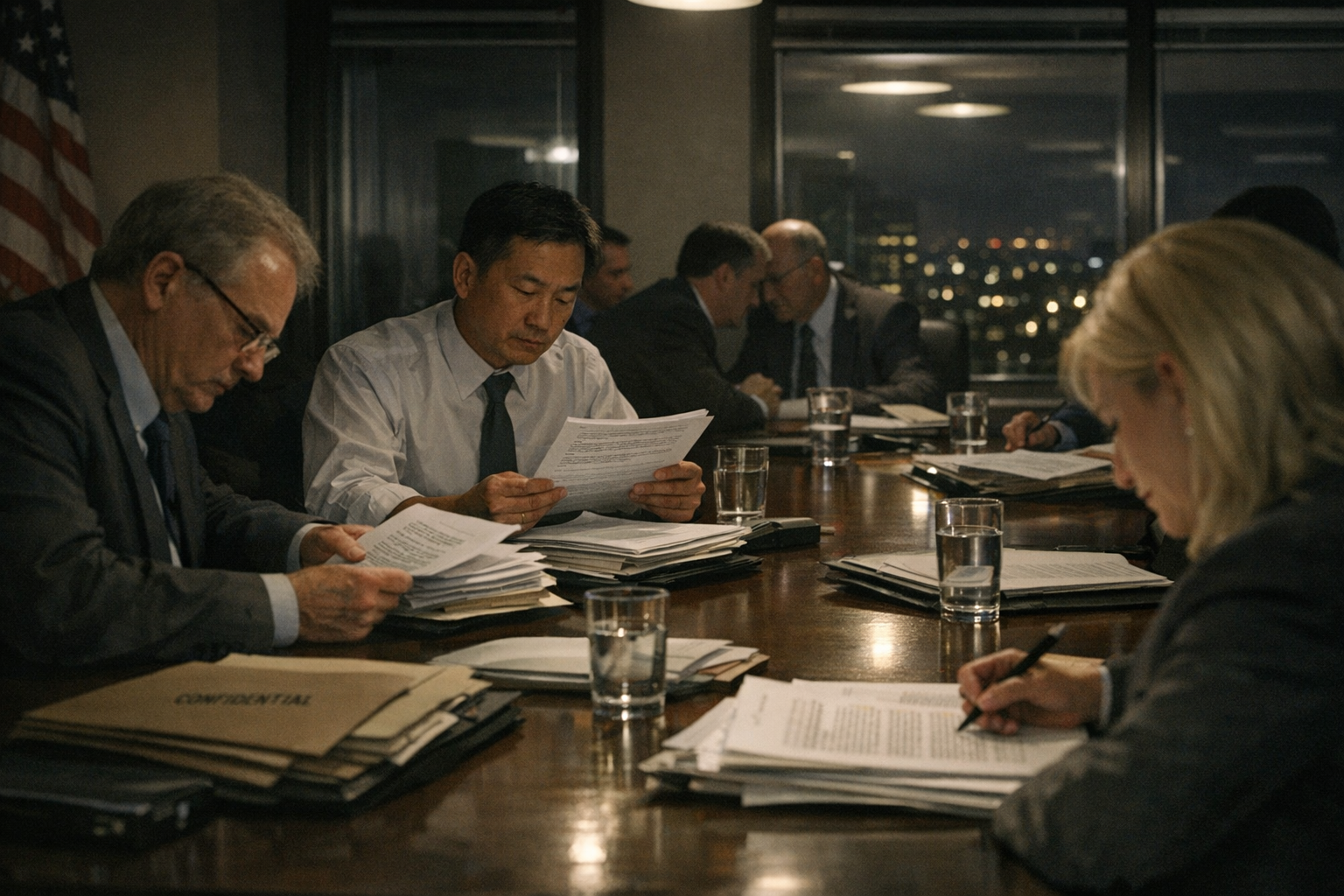
Behind heavy doors, long before voters or workers ever see the final text, negotiators sit under cold lights marking up pages that could reshape jobs, prices, and national policy. That hidden process is where the fear around secret trade deals begins: not in some dramatic bunker, but in ordinary rooms where major rules are written while almost everyone affected is locked outside.
That image has fueled suspicion for decades. If trade agreements can change what factories make, what medicines cost, and how much power multinational companies hold, why do so many negotiations happen in private? Is that secrecy proof that the public is being outplayed, or is it simply how difficult international bargaining works when every country wants leverage?
What Happened
Trade deals are not new. Countries have always tried to lower tariffs, protect exports, and gain better access to foreign markets. But modern trade agreements became much bigger than simple import taxes. They started covering patents, data, labor standards, food rules, environmental enforcement, digital commerce, and investment disputes. In other words, trade talks began touching daily life far beyond the port or factory gate.
That expansion changed the emotional weight of secrecy. It is one thing for diplomats to quietly discuss shipping rules. It is another when leaked draft chapters suggest that decisions about medicine prices, online speech, agricultural imports, or corporate legal rights are being shaped before the public can even read the language.
A familiar pattern kept repeating. Officials would say talks needed privacy so negotiators could bargain honestly. Critics would answer that privacy had turned into insulation. By the time a public version appeared, large parts of the agreement were already politically locked in, and ordinary people were being asked to react to something they had no role in shaping.
You can almost see why the theory grows so easily. Picture a labor union member hearing that a deal affecting manufacturing jobs is being drafted overseas. Picture a small farmer learning that new import rules may undercut local prices. Picture an activist reading leaked pages late at night, trying to understand why corporate advisers seemed to have access long before the public. Even without a grand conspiracy, the human feeling is immediate: decisions this big should not feel pre-decided.
Deals like NAFTA, the Trans-Pacific Partnership, the Transatlantic Trade and Investment Partnership, and other major negotiations all fed this tension in different ways. Each one became a stage where technical policy language collided with public distrust. Once that distrust was in place, trade secrecy stopped looking procedural and started looking like motive.
Why People Believe It
People believe the darker version of the trade-deal story because the raw ingredients are real. Negotiations are often confidential. Lobbyists and industry groups sometimes get closer to draft language than the public does. National leaders do make choices that can benefit some sectors more than others. None of that is fantasy. It is documented political behavior.
There is also a deeper fear underneath it. Trade agreements feel distant, technical, and hard to challenge. When people cannot clearly follow a process, they often assume the real winners were chosen in advance. That does not mean they are always wrong. Complex systems do create blind spots, and blind spots create suspicion.
Another reason the theory sticks is that trade outcomes are uneven. One town may gain cheaper goods while another loses stable factory work. One company may gain easier market access while local producers feel squeezed. When the pain lands unevenly, it becomes very easy to believe the people in the room were serving private interests from the start.
The same pattern shows up in other political stories on the site. In WikiLeaks Revelations, hidden documents strengthened the belief that official transparency often arrives only after leaks force it into daylight. And in Military-Industrial Complex, public policy looks less neutral when powerful institutions keep benefiting from the same broad direction of events.
Once those themes combine, secret negotiations stop feeling like boring diplomacy and start feeling like a quiet transfer of control. That is why the theory survives even among people who do not think every trade pact is evil. The secrecy itself becomes the first piece of evidence in their minds.
Claims vs Evidence
Claim: Secret trade deals are designed mainly to help corporations override national sovereignty.
What we know: Some trade agreements have included investor-state dispute mechanisms and other rules that critics argue give corporations unusual leverage. That concern is not invented. However, there is no single confirmed body of evidence showing every major trade agreement is secretly built as a corporate takeover tool. The details vary by treaty, country, and enforcement mechanism.
Claim: The public is deliberately kept in the dark because governments know the terms would never survive open debate.
What we know: Governments often do limit access during negotiations, and leaked drafts have shown how much can be hidden from ordinary citizens. But officials usually defend that secrecy as standard bargaining practice, saying public line-by-line negotiation would harden positions and make compromise harder. That explanation may frustrate critics, but it is different from proving a hidden anti-public scheme.
Claim: Industry insiders have more influence over trade terms than voters do.
What we know: This is one of the strongest concerns, because advisory access and lobbying are real. Business groups, legal experts, and sector representatives often have better channels into the process than ordinary citizens. Still, stronger access is not identical to total control. Influence can be significant without amounting to a master plan.
Claim: Trade negotiations prove that elected governments are only the public face of a deeper global system.
What we know: There is no confirmed evidence that trade talks themselves prove a single hidden world government. What they do show is that complex policy can be shaped in elite spaces that feel far removed from democratic life. That gap is real, but it does not automatically confirm the largest conspiracy version.
Reality Check
The most grounded way to read this story is to avoid the two easiest mistakes. The first mistake is pretending secrecy means nothing. It does matter. When major policy is negotiated far from public view, trust drops, and not without reason. People are right to ask who had access, who pushed for what, and when the public was allowed to see the draft.
The second mistake is assuming secrecy proves a single hidden plot. International bargaining is often secret because governments do not want every concession exposed in real time. That explanation may be unsatisfying, but it is also normal in diplomacy. Closed-door negotiation existed long before the internet turned leaks into political events.
What makes trade deals so combustible is that both truths can exist at once. The process can be standard and still feel unfair. Confidential bargaining can be normal and still favor well-connected interests more than ordinary citizens. A treaty can reflect real compromise while also being shaped by unequal access.
That is the part conspiracy thinking often simplifies. Instead of seeing a messy system with power imbalances, people reach for a cleaner story: a few hidden actors wrote the future in secret and everyone else was just manipulated. Sometimes that story feels emotionally right because it gives a clear villain. But in reality, the stronger concern is usually structural, not cinematic.
Trade politics works through ministries, advisers, industry pressure, geopolitical strategy, legal drafting, and limited public oversight. That system can absolutely produce outcomes that look rigged from the outside. Yet that is still different from proving every agreement is a covert trap designed by one invisible hand.
So the real issue is not whether secrecy exists. It clearly does. The harder question is whether that secrecy crosses the line from negotiation into democratic failure. In some cases, critics have a serious point. In others, the biggest claims outrun the record. The reality is less neat than the conspiracy, but not always comforting.
Conclusion
Secret trade deals became a political conspiracy magnet because they touch real power while hiding much of the process from public sight. That combination is almost perfect fuel for suspicion. People can see the consequences, but they often cannot see the full argument that shaped them.
There is no confirmed evidence that every major trade pact is proof of a single hidden global command structure. But there is solid reason to scrutinize confidentiality, advisory access, and the way technical negotiations can leave ordinary citizens reacting too late.
The most honest conclusion is that this theory is partially explained. The secrecy is real. The distrust is understandable. The leap from closed-door bargaining to total hidden control is much larger than the verified evidence. And that gap is exactly where the story keeps finding new believers.
🔎 If this story stayed with you, the author suggests these real cases next:
- Deep State Explained: Hidden Ruling Network or Just the Machinery of Government?
- Shadow Governments: Who Really Pulls the Strings Behind Power?
- WikiLeaks Revelations: Transparency Breakthrough or Conspiracy Fuel Machine?
Explore more Political Conspiracies stories here: