
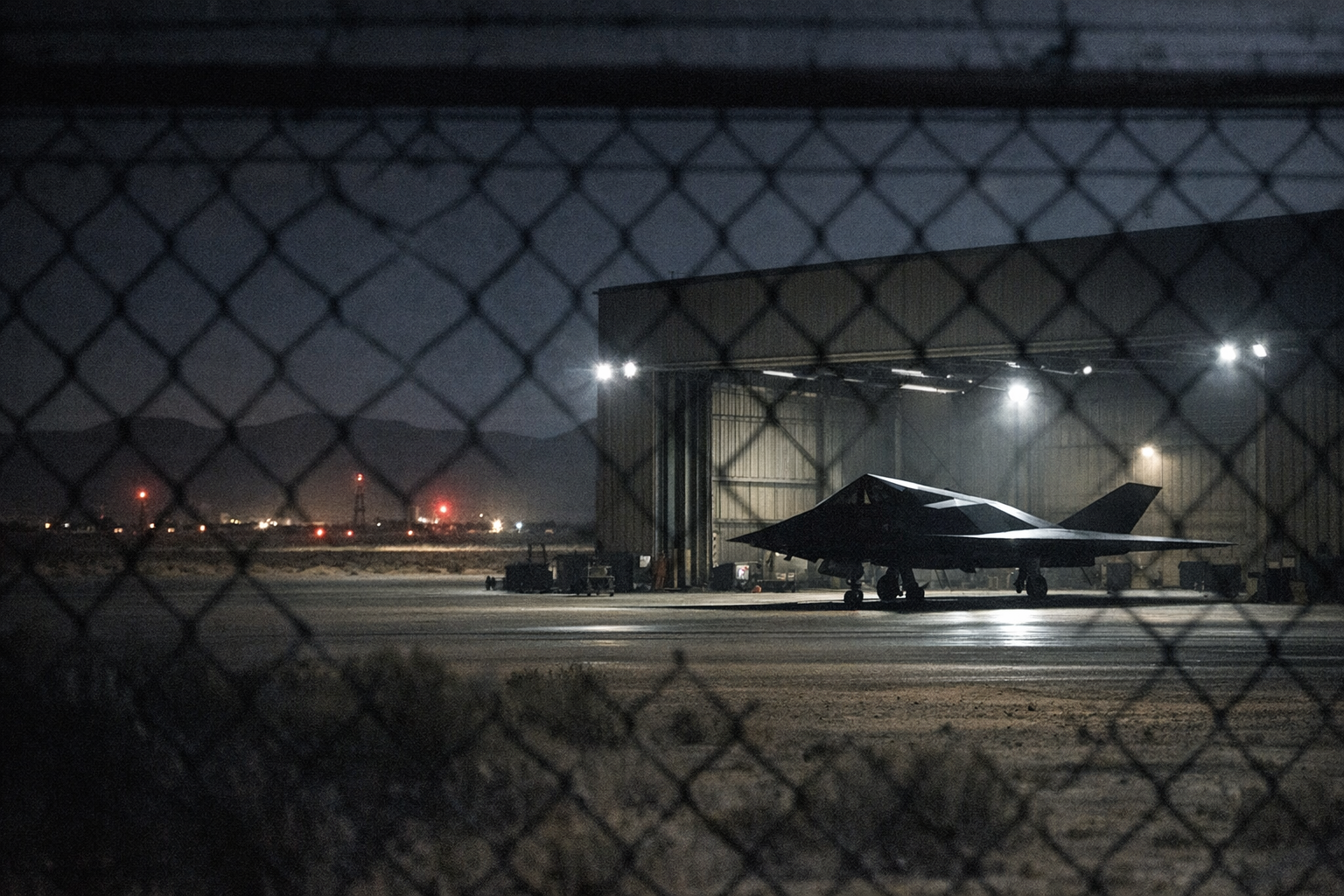
The doors were closed, the paperwork was buried, and the budget line looked like it had been built to disappear. In rooms most taxpayers will never see, officials have long approved programs so secret that even many people inside government do not know they exist. That is where the idea of government black projects begins: not with science fiction, but with the unsettling fact that some parts of national defense really do live in the dark.
What Happened
“Black projects” is the common name for highly classified government and defense programs, usually tied to weapons, aircraft, surveillance, intelligence, or advanced research. Some are protected because they involve real military advantages. Others are hidden because revealing them too early could expose methods, capabilities, or vulnerabilities. In simple terms, these are projects designed to stay out of public view for as long as possible.
History gives people plenty of reasons to believe such programs exist. The U-2 spy plane was secret before it became public. The F-117 stealth fighter was developed in deep secrecy before most Americans even knew aircraft like that were possible. Programs at places like Area 51 and other test ranges were hidden for years, which meant ordinary sightings in the sky often reached the public long before the explanation did.
That gap matters. Imagine seeing an aircraft move in a way you cannot identify, then hearing the government deny or refuse to discuss it. For the people on the ground, that silence does not feel neutral. It feels like proof that something is being withheld. Sometimes that feeling is wrong. Sometimes, history shows, it is partly right.
The modern black-project conspiracy goes further than that. It does not stop at “the government has secret programs.” It asks whether those programs hide politically explosive truths: technologies far beyond what the public knows, covert operations shielded from oversight, or entire systems of power that operate behind elected institutions. Supporters point to compartmentalization, missing details in budgets, contractor secrecy, and scattered whistleblower statements as signs that the official story is only the outer shell.
This is where the theory becomes powerful. It grows from something real. Classified programs are not fantasy. Special access programs are documented. Defense contractors do work behind layers of clearance. Congress itself has, at times, struggled to get full visibility into hidden spending and restricted programs. Once people know that, it becomes easier to believe the hidden world is much larger than admitted.
There is also a human side to the story. Picture a late-night desert highway, a distant test range, and an unmarked aircraft crossing a black sky without warning lights. Someone sees it, tells friends, and years later the memory hardens into a story about technology no ordinary person was supposed to witness. That kind of moment is not hard to imagine. In fact, it may be one of the main reasons black-project theories keep surviving.
That same tension shows up in other political secrecy stories on the site. Cases like Intelligence Agencies and Hidden Government Power and Deep State Explained explore how real secrecy can blur into much larger fears about who is really making decisions.
Why People Believe It
People believe black-project theories because the starting point is already confirmed. Governments do hide military programs. They do classify information. They do move money into restricted channels. That means believers do not have to prove secrecy exists. They only have to argue that the secrecy goes further than officials admit.
Another reason is that black projects sit at the intersection of fear and pattern recognition. When people notice strange aircraft, unexplained contracts, redacted documents, or whistleblowers speaking in fragments, the mind naturally tries to connect the dots. The less clear the picture becomes, the more tempting it is to assume the missing parts are missing on purpose.
Distrust also plays a major role. In the last few decades, public confidence in institutions has been damaged by real scandals, hidden surveillance, false public claims, and long-delayed disclosures. Once people see one lie or one major omission, they become more willing to believe there are ten more behind it. Black projects fit neatly into that mindset because they offer a believable container for suspicion.
Popular culture has amplified that belief for years. Movies, leaked-photo culture, UFO lore, and stories about hidden labs or underground facilities all push the same idea: somewhere behind the fence line, powerful people know more than they will ever say. Even when those stories are fictional, they shape how real secrecy is interpreted.
And then there is the contractor problem. When military work is split across private companies, subcontractors, and compartmentalized teams, it creates a structure that feels almost designed to resist public understanding. For believers, that looks less like routine security and more like an architecture of plausible deniability.
Claims vs Evidence
Claim: Black projects hide technology decades ahead of public knowledge. Evidence: There is real evidence that secret programs have produced capabilities unknown to the public at the time. Stealth development is the classic example. However, there is no confirmed public evidence that governments are sitting on limitless breakthrough technologies that would completely rewrite civilian life overnight.
Claim: Buried budgets prove massive hidden operations beyond oversight. Evidence: Classified spending exists, and budget transparency in national security is limited. Some lawmakers have raised concerns about poor visibility into restricted programs. But limited visibility is not the same as proof that every hidden line funds unlawful or world-shaping conspiracies.
Claim: Whistleblowers reveal the true scale of secret defense systems. Evidence: Whistleblowers can expose real wrongdoing, and some have raised serious questions about secrecy, procurement, and accountability. The problem is that fragments, secondhand testimony, and suggestive language are often treated like final proof. In most cases, they raise questions rather than settle them.
Claim: Strange sightings near test areas point to hidden programs too extreme to acknowledge. Evidence: This claim is partly supported by history. Secret aircraft really have been mistaken for impossible objects. But that same fact can cut both ways. A genuine secret aircraft may explain some sightings, while other stories grow far beyond what the evidence can support.
Claim: Black projects shield political power from democratic control. Evidence: There is a serious accountability concern whenever major programs operate under heavy secrecy. That concern is reasonable. Still, evidence of secrecy alone does not automatically prove a hidden ruling structure. It proves that security systems can limit visibility, not that elected government is entirely for show.
This is also why black-project theories often connect with stories about the military-industrial complex. Real defense relationships between government and contractors create a strong factual base for concern, even if the most dramatic claims often outrun the available proof.
Reality Check
The strongest version of this theory is also the hardest to prove. Yes, black projects are real. Yes, some programs stay hidden for years. Yes, secrecy can reduce oversight and feed public suspicion. But those facts do not automatically confirm every larger story built around them.
What we do know is that governments classify information for reasons that range from sensible to self-protective. Sometimes secrecy protects real national-security interests. Sometimes it protects embarrassment, bureaucracy, or political control. The public usually cannot tell which is which in real time, and that uncertainty is exactly where conspiracy thinking grows.
The weakness in the biggest black-project claims is not that secrecy is impossible. It is that extraordinary conclusions still need direct evidence. If someone claims hidden programs have produced impossible propulsion, total off-book governance, or technology generations beyond public science, then the burden of proof rises sharply. Suspicion can open the question, but it cannot close it.
There is another important limit here: secrecy creates shadows, and people often fill shadows with the most dramatic shape available. A classified aircraft can become alien technology. A hidden procurement line can become proof of a hidden state. A vague insider comment can become a master key that explains every unexplained event. That does not mean the concern is foolish. It means the leap from “hidden” to “all-powerful” is usually where the evidence starts to thin out.
So the clearest conclusion is a partial one. Black projects are real, and they give conspiracy theories a believable foundation. They show that governments can hide major programs, delay public understanding, and operate in ways most citizens never fully see. But there is still a wide gap between documented secrecy and the claim that black projects contain the answer to every suspicion people carry about hidden power.
Conclusion
Black projects remain one of the most durable conspiracy frameworks because they are built on a fact no one can seriously deny: some state activity is deliberately hidden. That makes them different from theories that begin with pure speculation. But it also makes them easy to overextend.
The real story is not that every suspicion is true. It is that real secrecy creates the conditions for suspicion to thrive. When the public sees only fragments, every missing piece starts to look intentional. Sometimes it is. Sometimes it is only the shape of a security system doing what it was built to do.
In the end, government black projects are best understood as a genuine hidden world that invites much larger stories than the evidence can usually carry. That is why the theory persists. The door is not fully closed, the room is not fully lit, and for many people that is enough to keep asking what is still being kept out of sight.
🔎 If this story stayed with you, the author suggests these real cases next:
- Intelligence Agencies and Hidden Government Power: How Much Happens Behind Closed Doors?
- Military-Industrial Complex: Does Endless War Follow the Money?
- Deep State Explained: Hidden Ruling Network or Just the Machinery of Government?
Explore more Political Conspiracies stories here: