
Also covered in: UFO Disclosure: Hearings, Whistleblowers, and the Proof Gap
That shift created immediate tension. Was the world watching a slow reveal of something extraordinary, or was it watching old secrecy get repackaged into a cleaner, more careful public story? The answer is not simple, and that is exactly why this theory keeps growing.
What Happened
The modern disclosure story did not begin with one dramatic confession. It grew through a chain of moments that felt small on their own but powerful when placed side by side. A leaked document here. A pilot video there. A former official speaking more openly than expected. Each moment looked like another piece of a puzzle that had been hidden for decades.
🔎 Related Investigation:
One of the biggest turning points came in 2017, when reporting around the Advanced Aerospace Threat Identification Program, or AATIP, pushed UFO secrecy back into mainstream discussion. The idea that a real Pentagon-connected effort had examined unusual aerial incidents gave believers something they had wanted for years: official language that sounded less dismissive than the old jokes and denials.
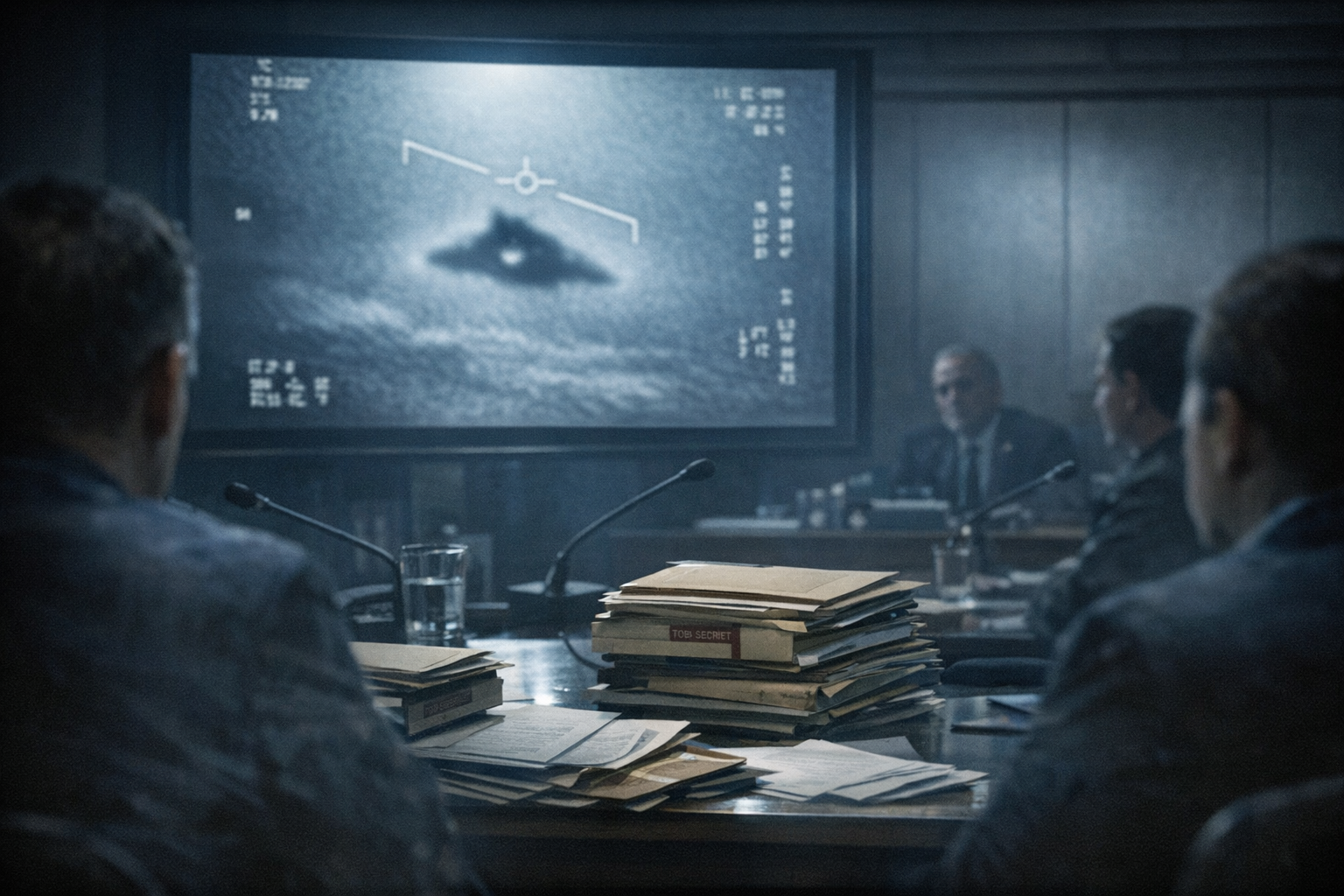
Then came the Navy videos. Short clips with names like “Gimbal” and “GoFast” spread everywhere. They were blurry and limited, but that almost made them stronger as public symbols. To many viewers, they looked like the first public glimpse of something the government had long refused to admit. To others, they were interesting footage that still proved far less than the internet claimed. That tension is central to the whole story. Pentagon UFO Videos shows how a narrow official acknowledgment can quickly turn into a much larger public belief.
By 2020 and 2021, the language was changing even more. Officials started using the term UAP — unidentified anomalous phenomena — instead of UFO. That was not just a branding decision. It made the issue sound more serious, more technical, and easier to discuss inside military and intelligence channels. It also widened the gap between what people hoped was being implied and what officials were actually saying.
Congressional hearings added another layer. For many people, seeing lawmakers ask public questions about unexplained objects felt historic. A hearing room has a certain gravity. The cameras are bright. The language is formal. The setting makes everything feel important. In that space, even cautious testimony can look like the edge of a revelation.
There is also a very human side to this story. Imagine a late-night shift worker scrolling through hearing clips on a phone after everyone else has gone to sleep. They see a former pilot describe something he cannot explain. They hear a senator say the issue deserves attention. In that moment, the distance between rumor and reality feels much smaller. That is how belief spreads — not only through evidence, but through atmosphere, timing, and the feeling that hidden knowledge is finally becoming public.
At the same time, official bodies kept stopping short of the conclusion many people wanted. Reports acknowledged that some incidents remained unresolved. That mattered. But unresolved does not mean extraterrestrial. It means the available data was incomplete, conflicting, or too limited for a confident answer. Government UFO Programs helps explain how real review efforts can fuel public imagination without confirming an alien explanation.
Why People Believe It
The disclosure theory is powerful because it feels like a story with momentum. For decades, believers argued that governments knew more than they admitted. Then official language shifted just enough to make that older suspicion seem partly justified. When institutions move from total dismissal to careful acknowledgment, people naturally ask what changed — and what is still being held back.
There is also the issue of trust. Governments have kept real secrets before. Military programs have been hidden. Intelligence operations have been denied and later confirmed. Once the public knows that secrecy is real, it becomes easier to believe that the biggest secret might still be ahead. That does not prove alien contact. But it does explain why many people treat each new hearing or report like the next step in a long-delayed confession.
Another reason the theory sticks is emotional timing. The modern internet turns scattered updates into a rolling drama. A clip is posted. A former official gives an interview. A headline hints that more testimony is coming. Soon it feels less like a set of separate events and more like a timeline heading somewhere important. People do not just read the news. They read direction into the news.
There is also a gap between official caution and public imagination. When an agency says, “We cannot explain every case,” believers often hear, “We cannot say the truth yet.” That leap is understandable, especially after years of mockery around UFO stories. Many people feel they are watching the authorities slowly catch up to what witnesses have claimed all along.
Claims vs Evidence
Claim: Governments are gradually preparing the public for confirmed alien contact.
Evidence: There is real evidence of a policy and language shift. Government offices have reviewed unusual aerial incidents. Officials have acknowledged that some cases remain unexplained. Hearings and reports show the subject is being treated more seriously than it was in many earlier decades.
What that does not prove: None of that amounts to confirmed extraterrestrial evidence. An unresolved case is still unresolved. A military review is not the same thing as an admission of alien craft. Serious attention can reflect flight safety concerns, sensor uncertainty, intelligence gaps, or genuine curiosity without proving non-human origin.
Claim: The release of videos and testimony is part of a planned disclosure sequence.
Evidence: There has been a visible sequence of public moments: leaks, official confirmations that certain videos are authentic military footage, the creation of review offices, formal reports, and hearings. That sequence is real.
What that does not prove: A sequence is not necessarily a script. Bureaucracies react to pressure, media attention, internal concerns, and political oversight. It is possible for events to line up without being part of a grand reveal plan. People are very good at turning a messy timeline into a clean narrative once they know the ending they want.
Claim: The use of the word UAP instead of UFO signals a deeper truth that officials are trying to soften for the public.
Evidence: The term UAP does signal a deliberate framing shift. It sounds less loaded than UFO and fits better with defense and intelligence reporting. It may help officials discuss unknown incidents without triggering decades of cultural baggage.
What that does not prove: A terminology change is not proof of alien knowledge. It can just as easily reflect bureaucratic caution, a desire for cleaner reporting categories, or an effort to take the issue seriously without making extraordinary claims.
Reality Check
The strongest reality check is this: the modern disclosure timeline shows a real change in public handling, not confirmed alien revelation. That distinction matters. It is true that governments and military institutions are speaking differently now. It is true that some incidents remain unexplained. It is true that public hearings would have seemed unlikely years earlier.
But the leap from “the issue is being handled more openly” to “official alien disclosure is underway” still goes beyond the evidence. The public record shows caution, ambiguity, and institutional adjustment. It does not show a verified extraterrestrial case being prepared for release. In fact, one reason the theory remains so strong is that ambiguity keeps it alive. If officials said too much too clearly, the mystery would either harden into proof or collapse into something more ordinary.
There is also a pattern worth noticing. Real secrecy creates fertile ground for bigger theories. A genuine classified program, a real hearing, or an authentic military clip gives people a foundation. Then the human mind does what it often does with mystery: it fills empty space with the most dramatic possible answer. That same pattern helped turn places like Area 51 into permanent symbols of hidden knowledge, even when the documented truth remained narrower than the legend.
So where does that leave the timeline? Somewhere in the middle. It is not fair to call the whole thing a fantasy, because official behavior really has changed. It is also not fair to call it proof, because the central claim — confirmed alien revelation — still lacks verified public evidence. The most honest conclusion is that we are watching a serious shift in how unexplained aerial cases are discussed, while the public keeps projecting a larger ending onto an incomplete record.
Conclusion
The alien disclosure timeline feels compelling because it combines everything conspiracy stories need: secrecy, official tension, symbolic footage, and the promise that the next reveal could finally change everything. It offers believers a story of slow unveiling instead of one impossible confession. That makes it easier to sustain and harder to disprove cleanly.
What we do know is important. Governments have not treated the subject the same way across time. Some unknown incidents have been reviewed seriously. Public language has shifted. But there is still no confirmed public evidence that officials are preparing humanity for verified alien contact. For now, the timeline looks less like full revelation and more like a mix of real institutional change, limited evidence, and a public imagination that keeps racing ahead of what the record can actually support.
🔎 If this story stayed with you, the author suggests these real cases next:
- Government UFO Programs: From Project Blue Book to AATIP to AARO
- Pentagon UFO Videos: What the Navy Footage Confirmed — and What It Didn’t
- Area 51 Alien Rumors: Why a Real Secret Base Became the Center of UFO Lore
Explore more Alien & UFO Theories stories here: