
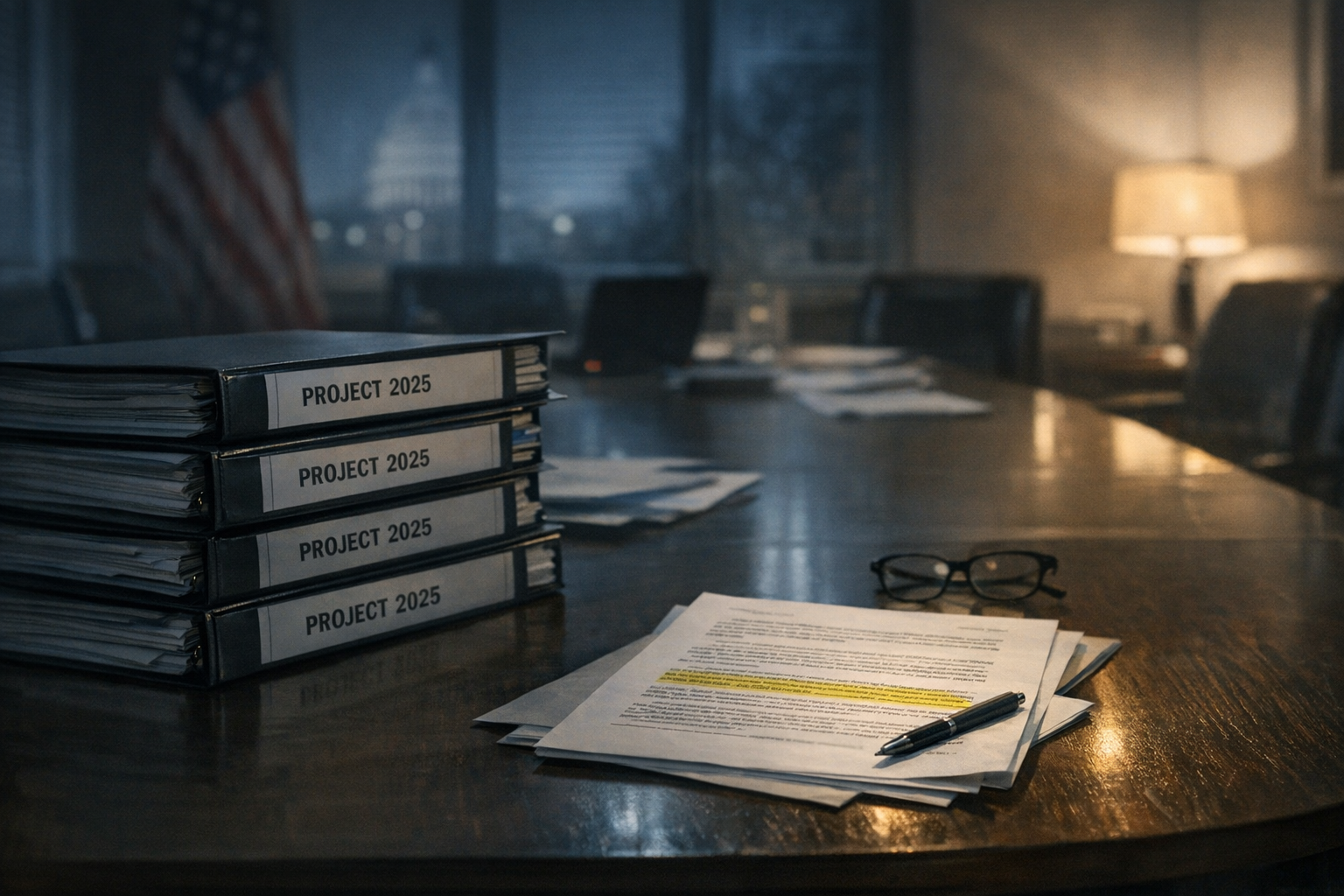
The document was never hidden in a locked basement. It sat in public view, printed in clean policy language, while screenshots and alarmed posts spread across the internet like someone had stumbled onto a plan they were not supposed to understand. That is the tension at the center of the Project 2025 conspiracy: not a secret blueprint in the usual sense, but a public one that many readers saw as proof of something darker moving in plain sight.
Project 2025 is a published conservative policy roadmap tied to a network of right-leaning organizations, most visibly the Heritage Foundation. People who call it a conspiracy argue that it is more than a policy agenda and instead reveals a coordinated plan to take over government from the inside, reshape federal power, and reduce democratic limits. The more likely reality is narrower but still serious: it is an explicit ideological governing plan, not secret in itself, but its scale, staffing goals, and aggressive use of executive power make it easy for hidden-control claims to grow around it.
What Happened
This article follows one angle on purpose: the key issue is not whether Project 2025 exists. It does. The real question is why a public policy document started getting treated like evidence of a hidden takeover. To answer that, you have to separate the plain text on the page from the larger story people built around it.
Project 2025 emerged as a transition and governing framework for a possible future conservative administration. It was presented openly as a plan to prepare personnel, policy priorities, and institutional strategy in advance. In ordinary political terms, that is not unusual by itself. Major movements, parties, and think tanks often prepare long wish lists and staffing pipelines before an election is even settled.
What made this case different was the scale and tone. The project was not just selling broad ideas. It was associated with a detailed manual, a recruiting pipeline, and a vision for moving quickly inside the federal government. To supporters, that looked organized. To critics, it looked like a prewritten script for concentrating power.
You can picture the mini-scene that helped the theory spread. Someone opens a social post late at night and sees a screenshot from a dense policy page, maybe a line about reorganizing agencies, replacing officials, or changing how the executive branch works. They do not read a bland staffing memo. They read it like a map. Suddenly the document no longer feels like political planning. It feels like a key to a locked room.
That emotional shift matters. Online, the label ?conspiracy? often does not begin with proof of secret meetings. It begins when people feel they are seeing the machinery of power stripped of its polite cover. Project 2025 became one of those moments because it was both public and intimidating. It did not look hidden, but it looked coordinated, which is often enough to trigger hidden-network suspicion.
The topic also landed in a political climate already shaped by deep distrust. Many Americans have spent years watching arguments about the deep state, permanent bureaucracy, intelligence influence, and the limits of public accountability. In that climate, a highly organized blueprint does not arrive as a neutral PDF. It arrives inside a culture primed to ask who really runs government and how much is planned before voters ever see the final version.
Why People Believe It
People believe the Project 2025 conspiracy because the document hits a rare pressure point. It is openly published, but it describes a level of planning that feels unusually ambitious. That creates the perfect environment for two stories to grow at once: one grounded, one more extreme.
The grounded story is easy to understand. A movement wants to staff agencies with aligned people, use executive power aggressively, and steer government in a particular direction. That is not automatically a hidden conspiracy. It is a visible strategy. But visible strategy can still feel unsettling when it sounds less like campaigning and more like institutional capture.
The more extreme story goes further. In that version, Project 2025 is treated as proof that democratic process is just a stage set, while a coordinated network already knows how to dominate the system regardless of public debate. This is where ordinary policy planning turns into takeover language. The public document becomes a symbol of secret intentions, even when the strongest evidence people point to is sitting in plain sight.
There is also a pattern readers already recognize from other power narratives on the site. When institutions are seen as opaque, people stop drawing a clean line between legal strategy and hidden rule. That is why Project 2025 connects naturally to arguments about shadow governments and the broader complaint in Government Transparency Myth that public systems often reveal just enough to avoid the deeper question.
Another reason belief grows is that the project uses bureaucratic language for goals that sound sweeping in ordinary speech. ?Reform,? ?restructure,? and ?personnel alignment? can sound procedural on paper. To a reader already worried about centralization, those phrases translate into something much harsher: purge, control, loyalty, and long-term insulation from oversight. The emotional meaning of the language changes depending on the trust level of the person reading it.
That gap between official wording and public interpretation is where conspiracy thinking often starts. It is not always born from false information. Sometimes it grows from real information that feels too neat, too strategic, or too revealing of elite intention. Project 2025 carries that exact energy.
Claims vs Evidence
Claim: Project 2025 proves a secret plan for hidden takeover.
Evidence: The project itself is not secret. It was publicly described, publicly discussed, and connected to known organizations. That matters because a hidden conspiracy usually depends on concealed existence. Here, the stronger evidence supports something different: a visible, organized ideological agenda that many people strongly oppose.
Claim: Because it is public, it cannot be conspiratorial at all.
Evidence: That conclusion is too simple. A plan does not have to be secret to raise serious concerns about coordination, influence, or concentration of power. Political actors can openly publish ideas that still aim to reshape institutions in aggressive ways. The lack of secrecy weakens the ?hidden cabal? framing, but it does not erase the importance of the project or the reasons critics treat it as a warning sign.
Claim: Project 2025 shows that elections no longer matter because control is already scripted.
Evidence: There is no confirmed evidence that the document alone overrides elections, law, courts, bureaucracy, or political resistance. Plans are not outcomes. A blueprint can be detailed and still run into legal challenges, internal disagreement, public backlash, and the ordinary friction of governing. This is one of the most misunderstood details in the debate: people often confuse preparedness with inevitability.
Claim: The staffing and executive-power parts are why the theory feels bigger than a normal platform.
Evidence: This is probably the strongest point supporters of the concern make. What people react to is not just ideology, but operational readiness. The project appears to focus on personnel pipelines and on how authority can be used quickly from inside the executive branch. That does not prove a hidden state takeover, but it does explain why readers see more than just campaign rhetoric.
A contradiction sits at the center of the story. If the project is evidence of secret control, why describe so much of it publicly? But if it is nothing more than ordinary policy planning, why does it feel more like a systems manual than a typical election-season platform? The most realistic answer is that the project lives in the middle. It is public enough to read, structured enough to alarm, and forceful enough to invite broader theories.
That is also where Declassification Delays becomes a useful contrast. In secrecy stories, people suspect hidden knowledge because records stay locked away. Here, the suspicion comes from almost the opposite condition: too much strategic clarity in public view. Different mechanism, same distrust.
Reality Check
The reality check is not that Project 2025 is imaginary. It is that people often use the word ?conspiracy? to compress several different fears into one dramatic label. Some are about ideology. Some are about executive power. Some are about staffing the state. And some are about the older suspicion that formal democracy hides a more durable machinery underneath.
Once those fears merge, the document stops being treated as a policy proposal and starts being treated as a confession. That makes the debate harder to reason through. Critics may correctly identify aggressive institutional goals but then leap too quickly into claims of total hidden control. Defenders may point out that the document is public and then act as if public visibility cancels every concern. Neither move really solves the question people are asking.
The better answer is more controlled. Project 2025 appears to be an open governing blueprint with strong ideological intent and unusually clear operational planning. That alone is enough to generate legitimate concern, debate, and scrutiny. It does not, by itself, prove an all-powerful secret network operating outside visible politics.
At the same time, dismissing the reaction as mere paranoia misses why the story travels so well. Modern conspiracy culture feeds on the feeling that elite systems tell the public less than they already know. When a document seems to show how power may be consolidated in advance, readers do not experience it as neutral planning. They experience it as a rare glimpse behind the curtain.
That is why this topic fits the angle so tightly. The strongest interpretation is not ?hidden plan exposed? and not ?nothing to see here.? It is that an openly published political project became conspiracy fuel because it looked like formal proof that organized power can prepare itself long before voters see the final shape. The public text is real. The biggest hidden-control claims built around it go further than the evidence currently supports.
Conclusion
Project 2025 matters because it blurs a line most people want to believe is clear. They want policy agendas to look like normal politics and conspiracies to look like secret plots. This case refuses that neat division. The plan is public, but the implications people draw from it feel private, strategic, and unsettling.
So is Project 2025 a conspiracy? In the strongest hidden-takeover sense, there is not confirmed evidence that it proves a secret cabal overriding the whole system. But it is also not just empty internet panic. It is a real blueprint that makes visible how organized political movements try to prepare for power, and that visibility is exactly what turns ordinary strategy into a story about hidden rule.
In the end, the document does not prove every fear attached to it. What it does prove is that trust is now so thin that even a public policy manual can be read like leaked evidence from inside the machine.
?? If this story stayed with you, the author suggests these real cases next:
- Deep State Explained: Hidden Ruling Network or Just the Machinery of Government?
- Shadow Governments: Who Really Pulls the Strings Behind Power?
- Government Transparency Myth: How Open Is Power When So Much Stays Hidden?
Explore more Political Conspiracies stories here: