
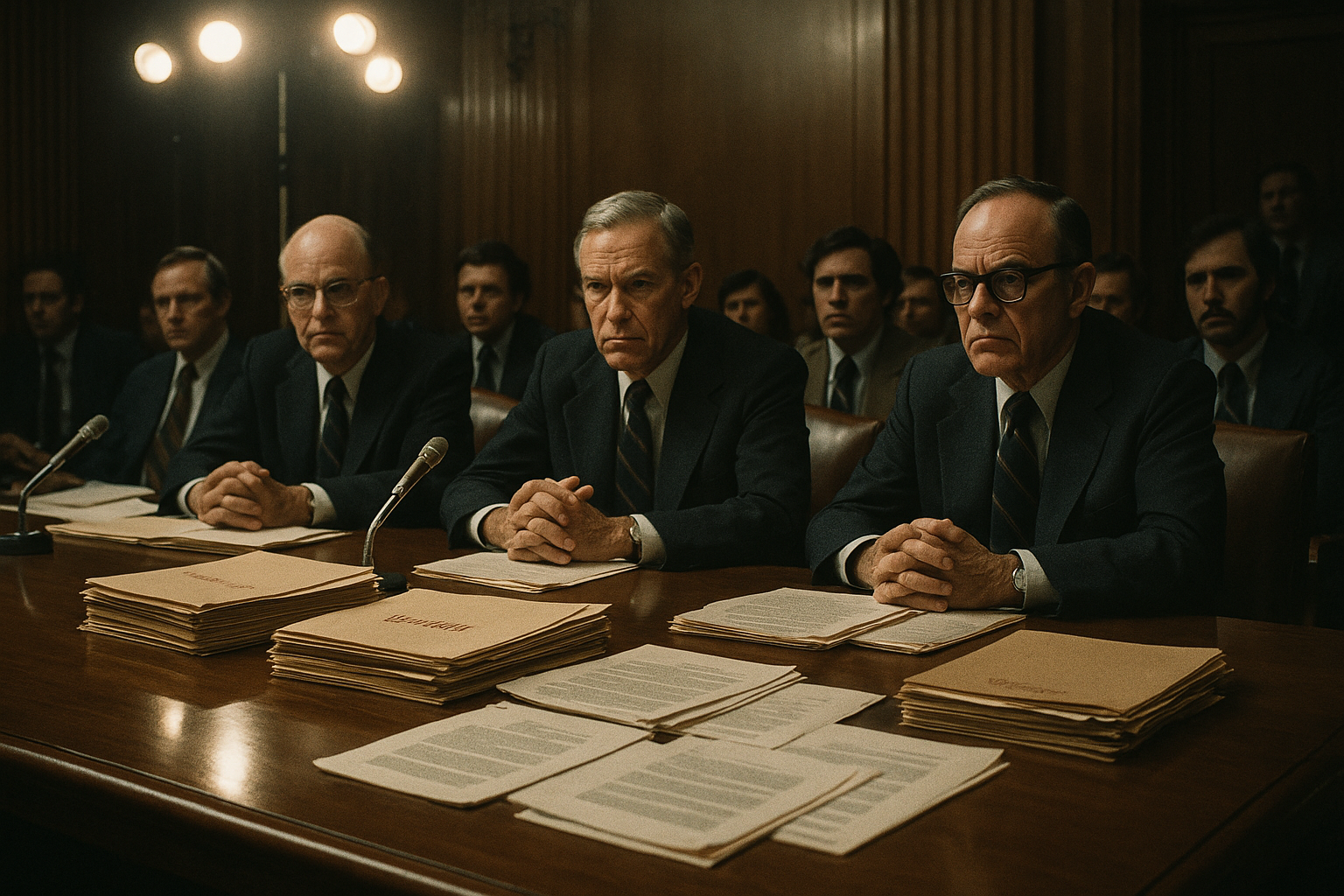
The hearing room was supposed to deal in controlled secrets. Senators sat beneath bright television lights while folders marked by years of silence opened in public, and the country suddenly had to hear the words it had been told belonged only to paranoia. In that tense atmosphere, the Church Committee hearings turned hidden government conduct into a national spectacle.
The Church Committee hearings were a 1975 Senate investigation into abuses by U.S. intelligence agencies. Supporters of hidden-power theories point to the hearings as proof that secret government programs were targeting citizens and operating without real oversight. The more grounded reading is that the hearings documented genuine misconduct and secrecy, but they did not prove a single all-powerful force controlling every major event from the shadows.
What Happened
In 1975, the U.S. Senate created a special committee led by Senator Frank Church of Idaho to investigate intelligence abuses. The official name was long and formal, but most people remember it simply as the Church Committee. Its job was to examine whether agencies like the CIA, FBI, NSA, and IRS had crossed legal or ethical lines.
The timing mattered. Watergate had already shattered trust in government. Then came reporting that the CIA had spied on Americans, despite rules saying it was not supposed to operate that way at home. What had sounded to many people like rumor suddenly had enough smoke around it that Congress could no longer ignore it.
Much of the committee’s work happened behind closed doors because the material involved intelligence methods and classified records. But some hearings were public, and that is what changed the cultural memory of the story. Americans watched lawmakers question officials about surveillance, covert programs, and operations that had been hidden for years.
One reason the hearings hit so hard is that they were not built around a single shocking event. They revealed a pattern. Investigators found evidence of FBI efforts to disrupt civil rights and anti-war groups through COINTELPRO, examined CIA misconduct described in the agency’s so-called “Family Jewels,” and exposed NSA programs that had collected communications in ways the public never knew about.
Imagine being an ordinary viewer in late 1975, sitting in a living room while the evening news explained that government agencies had monitored activists, opened mail, kept watch lists, and interfered with political life in ways that sounded closer to a spy thriller than a constitutional republic. That human shock is a big part of why the story never fully faded.
Why People Believe It
For many people, the Church Committee became proof that “the conspiracy people were right all along.” That reaction is easy to understand. Once a government confirms real abuse, the public naturally starts wondering what else has not been admitted yet.
The hearings also arrived with something conspiracy stories often lack: official status. This was not a fringe pamphlet, a blurry tape, or a rumor on late-night radio. It was a Senate investigation, backed by testimony, documents, and a final report. That gave the revelations unusual weight.
Another reason the story endures is that it connects directly to fears people already have about hidden power. If agencies could secretly target activists, influence information, or gather personal data once, then the broader suspicion is that they could do it again in new forms. That line of thinking helps explain why the Church Committee is still cited in debates about surveillance, secrecy, and the reach of the national security state.
It also fits a simple emotional pattern: when institutions say “trust us,” but later documents show misuse of power, trust does not snap back into place. It erodes slowly, then hardens into a worldview. That is why modern readers often connect the hearings to stories like CIA Assassination Plots: What Was Declassified — and What Got Added Later? and Operation Mockingbird: Did the CIA Really Shape the News?.
Claims vs Evidence
Claim: The Church Committee proved that the U.S. government runs every major political event from the shadows.
Evidence: No. What the committee actually documented was serious misconduct and weak oversight across several agencies over many years. It found intelligence “excesses” and concluded that constitutional checks had not been properly applied. That is a major finding, but it is not the same as proving a single all-controlling secret government behind every later crisis.
Claim: The hearings exposed only the CIA.
Evidence: Also no. The investigation reached across the CIA, FBI, NSA, and IRS. It examined domestic surveillance, covert action, mail opening, intelligence watch lists, and efforts to disrupt groups seen as threats. The scale of the inquiry is part of what made it so significant.
Claim: Everything discussed by the committee was already known.
Evidence: Not really. Some journalists and critics had raised alarms earlier, especially after press reports in the early 1970s. But the committee gave those concerns official confirmation and a much broader documentary base. Public suspicion existed before the hearings. Public proof, at least in part, came during them.
Claim: The Church Committee proved every later surveillance theory is true.
Evidence: This is where the story often gets stretched too far. The hearings showed that real abuse had happened. They did not give automatic support to every future claim about mind control, election manipulation, or total social control. Each later theory still needs its own evidence.
What we do know is that the committee uncovered enough misconduct to justify major concern. It examined programs tied to domestic spying, covert interference, and secret monitoring. It reviewed evidence that intelligence power had grown faster than public accountability. But the most responsible reading is precise: the hearings confirmed abuse, not omnipotence.
Reality Check
The strongest lesson of the Church Committee is not that every suspicion is true. It is that democratic systems can hide serious misconduct for long periods when oversight is weak, secrecy is routine, and the public is told that security requires silence.
That matters because the real story is already dramatic enough. According to Senate history, the committee interviewed hundreds of witnesses, reviewed roughly 110,000 documents, and issued a report warning that intelligence agencies had undermined citizens’ rights because constitutional checks were not being applied. That is not myth. That is the official record.
At the same time, the hearings did not reveal a perfect, unified machine controlling history from one room. The abuses came from different agencies, programs, and eras. They reflected mission creep, weak supervision, Cold War fear, and a culture that often treated secrecy as its own excuse. That is disturbing, but it is different from a tidy master-conspiracy.
The reforms that followed also matter. The committee’s work helped lead to the permanent Senate Select Committee on Intelligence and fed into broader demands for oversight, including the path toward the Foreign Intelligence Surveillance Act. Whether those reforms solved the deeper problem is still debated, but the hearings did produce structural change.
There is another reality check here too: many people use the Church Committee as a shortcut. They cite it as if it ends every argument. It does not. It supports skepticism toward unchecked intelligence power. It does not remove the need for evidence when new claims appear. In that way, it sits near the center of the site’s larger question raised by stories like Mass Surveillance State: How Much Does the Government Really See?: how do you stay alert without turning every hidden program into a universal explanation?
Conclusion
The Church Committee hearings were not proof that every theory about hidden power is correct. They were proof of something more uncomfortable and more important: powerful institutions had engaged in real secret abuses, and many Americans learned that only after Congress forced the record open.
That is why the story still carries weight. It begins like a conspiracy narrative, with sealed files, classified programs, and things the public was not supposed to see. But it lands somewhere firmer. The real warning is not that there is a single invisible hand behind everything. It is that secrecy, left alone long enough, can turn misconduct into routine and suspicion into a permanent part of public life.
🔎 If this story stayed with you, the author suggests these real cases next:
- CIA Assassination Plots: What Was Declassified — and What Got Added Later?
- Operation Mockingbird: Did the CIA Really Shape the News?
- Intelligence Agencies and Hidden Government Power: How Much Happens Behind Closed Doors?
Explore more Political Conspiracies stories here: