
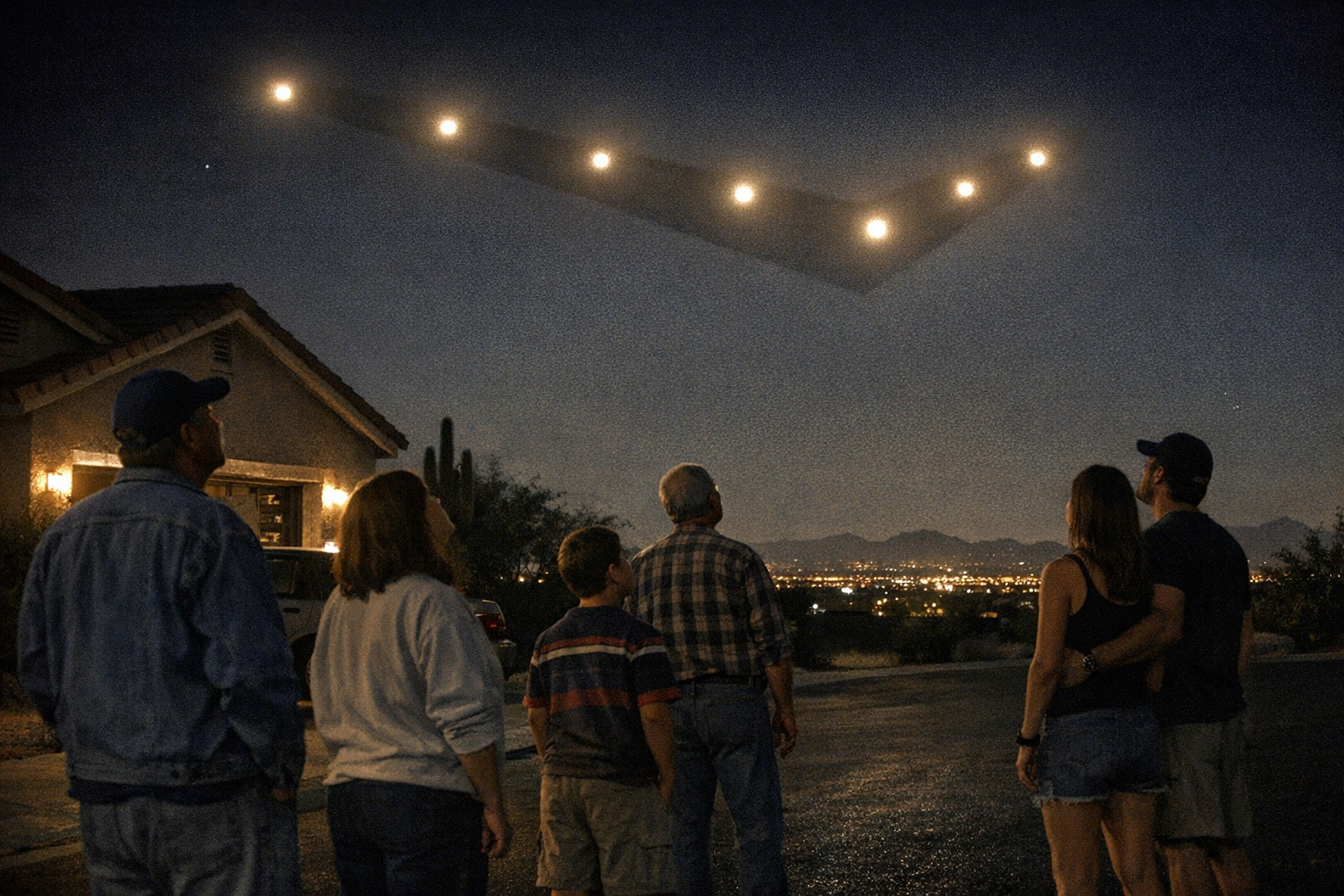
The videos were grainy, the sky was dark, and for a few uneasy minutes in March 1997, people across Arizona felt like they were watching something they were not supposed to see. The Phoenix Lights did not unfold over an empty desert. They appeared over neighborhoods, highways, and backyards, where ordinary people stepped outside, looked up, and realized the strangers around them were seeing the same thing.
What Happened
On the night of March 13, 1997, reports began spreading across Arizona about unusual lights moving through the sky. Witnesses described a huge V-shaped formation, sometimes as a row of lights, sometimes as a massive dark object with lights attached. The sightings stretched over a wide area, from northern Arizona down toward Phoenix.
What made the story different from a normal UFO rumor was the scale. This was not one person on a lonely road claiming they saw something strange for a few seconds. Families, drivers, retired military personnel, and police officers all reported seeing unusual lights. Some said the object moved silently. Others said it seemed too large and too slow to be a normal aircraft.
There was also a human moment at the center of the story that gave it staying power. People were not reacting in private. They were calling friends onto porches, pulling over on roadsides, and phoning radio stations and local newsrooms. One witness would describe a shape, then hear another witness describe the same shape from miles away. That kind of overlap made the event feel less like imagination and more like a shared experience that needed an explanation.
Later in the evening, another set of lights appeared near Phoenix and was widely filmed. This second event became the most famous visual part of the case. A line of glowing orbs seemed to hang in the sky over the city and nearby mountains. For many people, those lights became the image of the Phoenix Lights story itself.
Officials eventually pointed to military activity. In the most common explanation, the later lights were flares dropped during exercises by the Maryland Air National Guard at the Barry Goldwater Range. That answer addressed an important part of the event, but it did not fully settle the earlier reports of a large moving formation seen by witnesses across the state. That split is why the case still feels unfinished.
🔎 Related Investigation:
The story also gained more public attention because of Arizona Governor Fife Symington. At first, his office mocked the situation in a famous press event. Years later, however, Symington said he had seen something unusual himself and did not believe the object he observed matched a normal explanation. That reversal gave believers a powerful talking point: if even the governor later changed his tone, maybe the public had been laughed off too quickly.
Why People Believe It
People believe the Phoenix Lights point to something extraordinary for a simple reason: the witness list is hard to brush aside. This was a mass-sighting event. When one person tells an extraordinary story, it is easy to blame confusion, poor lighting, or memory. When large numbers of people tell similar stories from different locations, the case feels stronger.
There is also the issue of scale. Supporters of the mystery argue that witnesses were not just describing bright dots. Many described a structured craft or formation blocking out stars as it passed overhead. That detail matters because it suggests a solid object rather than random lights in the distance. If the object was real and physically large, then simple explanations start feeling less satisfying.
Another reason the case endures is timing. The 1990s were full of rising interest in UFO culture, secret military programs, and government cover-up ideas. The public had already been primed by stories about Area 51, Roswell, and hidden defense projects. So when a major city reported unexplained lights, many people naturally placed the event inside a bigger pattern of secrecy.
Believers also point to the emotional tone of the witnesses. Many did not sound like thrill-seekers trying to become famous. They sounded unsettled. Some seemed careful, even reluctant, when explaining what they saw. That kind of restraint often makes testimony feel more credible, especially when the people involved include pilots, former military members, and long-time residents who insist they know what ordinary aircraft look like.
Finally, the official explanation itself helped the mystery survive. Once the flare explanation became widely known, many people accepted it for the later lights but asked a natural follow-up question: what about the earlier formation that people described moving silently across Arizona? When one answer covers only part of a famous event, the unanswered part tends to grow larger in the public imagination.
Claims vs Evidence
Claim: A massive structured craft flew over Arizona, and the military never honestly explained it. Supporters of this claim point to consistent witness descriptions, reports of a dark V-shaped object, and the sense that the event involved more than simple lights in the sky.
What the evidence supports: There is strong evidence that a real mass-sighting took place. Many people reported unusual lights on the same night, across a wide area, and the later cluster of lights was captured on video. This was not an invented event. Something visible happened, and it drew attention from the public, media, and officials.
Claim: The later lights prove a hovering craft remained over Phoenix. This idea gained traction because the footage looks eerie even today. The lights appear suspended, calm, and almost arranged for the camera.
What the evidence supports: There is no confirmed evidence that the later lights were a hovering alien craft. The flare explanation fits many details of that second event, especially the position of the lights over the mountain range and the way they appeared to fade one by one. Flares can look strange at night, especially from far away, and video quality from 1997 was limited.
Claim: Witnesses who described a huge silent craft prove the flare explanation is false. This is one of the strongest believer arguments because it focuses on the earlier part of the timeline, not just the filmed lights near Phoenix.
What the evidence supports: Witness testimony does support the idea that many people saw an unusual moving formation earlier in the night. However, testimony alone does not fully identify what that formation was. Human perception at night can be misleading, especially when separate lights appear to belong to one object. Distance, angle, and missing sound cues can change how large or solid something seems.
Claim: The government covered up the truth. Supporters often argue that quick ridicule, incomplete explanations, and military involvement are classic signs of information management.
What the evidence supports: There is no confirmed evidence of a cover-up proving extraterrestrial craft. What we do know is that military exercises were happening, official communication was not especially satisfying, and public trust was already weak. In cases like this, an information gap can create almost as much suspicion as a hidden truth.
🔎 Related Investigation:
Reality Check
The strongest version of the Phoenix Lights story is not that it proves aliens visited Arizona. It is that it shows how a real unexplained event can resist clean closure. That matters because conspiracy culture often grows best in exactly this kind of space: enough evidence to make people curious, not enough evidence to make everyone agree.
The later lights likely do have a grounded explanation. Military flares are a serious answer, not a lazy one, and they match part of the timeline very well. Ignoring that would mean treating every eerie image as proof of something bigger, which is not good investigation. The flare explanation should stay on the table because it explains a major visual piece of the event.
But it is also fair to say the flare explanation does not erase the entire case. Earlier witnesses described something moving across the state before the best-known videos were recorded. Some of those witnesses sounded calm, detailed, and convinced they had seen an enormous object. Their accounts are not proof of an alien craft, but they are also not nothing.
This is where the case becomes a credibility test. If you start from the assumption that all UFO stories are nonsense, you will likely dismiss the witness reports and keep only the flare explanation. If you start from the assumption that authorities always hide the truth, you will likely treat the witness reports as decisive proof. Neither extreme is very useful.
A more careful reading is harder and less satisfying, but probably more honest. Something unusual happened over Arizona. The later lights were probably flares. The earlier reports remain harder to pin down. That leaves the Phoenix Lights in the same category as many famous mystery cases: partially explained, but not fully closed.
That middle ground is one reason the story still feels alive. It offers just enough confirmed detail to feel real, and just enough uncertainty to keep people arguing. In conspiracy culture, that combination is powerful. It turns one strange night into a case file people revisit again and again, each time hoping the missing piece will finally appear.
Conclusion
The Phoenix Lights remain one of the most famous UFO events in modern American history because they combined scale, fear, and incomplete answers in a way few cases ever do. Thousands of people did not imagine the same headlines into existence. There were real reports, real footage, and a real public reaction.
At the same time, there is no confirmed evidence that the event revealed extraterrestrial craft or a hidden government secret. The best available explanation covers part of the night well, but not every question people still ask. That does not make the story solved, and it does not make it supernatural by default.
What the Phoenix Lights really show is how mystery hardens when official answers arrive late, feel partial, or fail to match what witnesses believe they experienced. In that gap between event and explanation, a simple sighting can become something much bigger: a modern legend people are still trying to close.
🔎 If this story stayed with you, the author suggests these real cases next:
- Pentagon UFO Videos: What the Navy Footage Confirmed — and What It Didn’t
- Roswell UFO Crash: What the Original Witnesses Claimed and What the Records Actually Show
- UFO Sightings: What People Are Really Seeing in the Sky
Explore more Alien & UFO Theories stories here: