
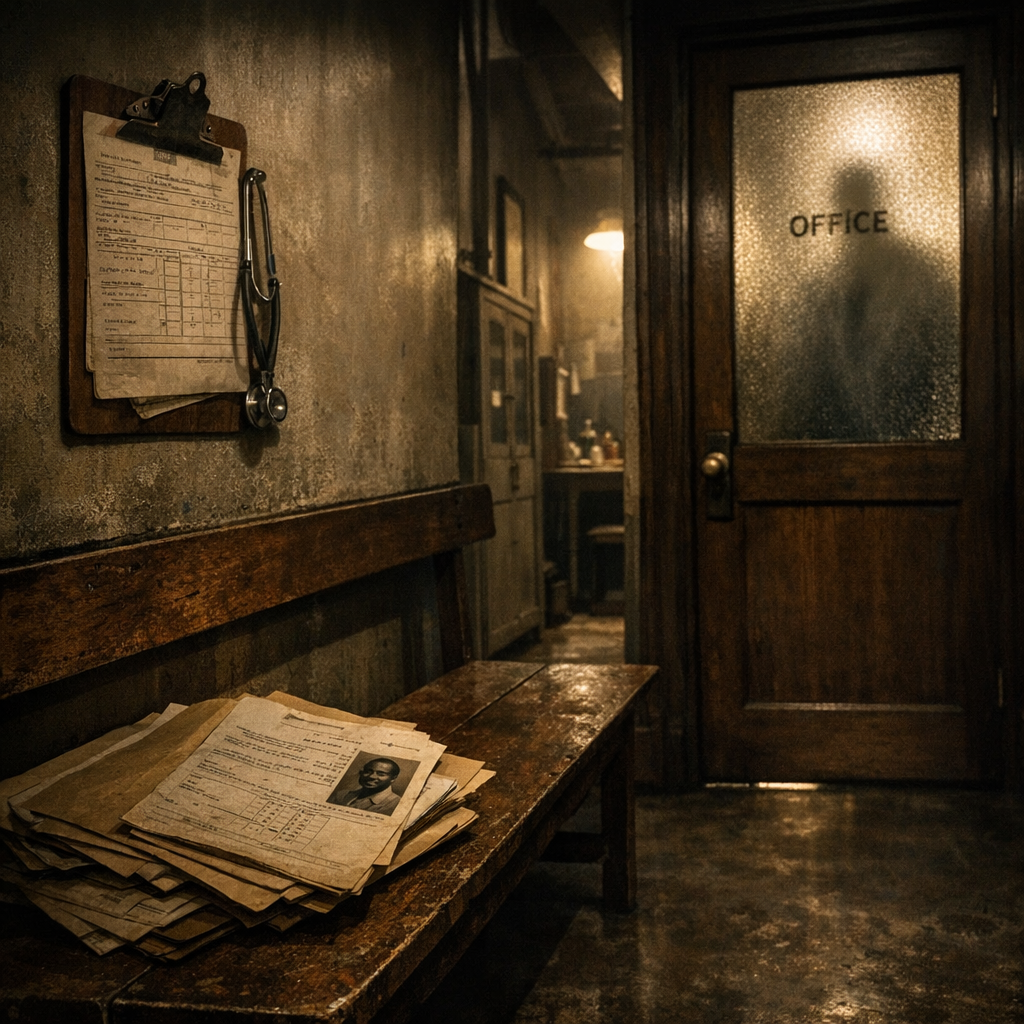
In the 1940s, a man in Alabama sat quietly in a doctor’s office, listening carefully as he was told he would be treated.
He trusted the people in front of him. They wore official uniforms. They spoke with confidence. They represented the government.
What he didn’t know was that the doctors had already made a decision.
🔎 Related Investigation:
They were not going to cure him.
They were going to watch.
What Happened
In 1932, the U.S. Public Health Service launched a study in Macon County, Alabama. The goal, at least on paper, was to observe the natural progression of untreated syphilis.
The men recruited into the study were poor Black men, many of them sharecroppers with little access to medical care. To them, this looked like an opportunity—free treatment from government doctors.
A total of 600 men were enrolled. Of those, 399 already had syphilis, while 201 did not and were used as a control group.
But there was one major problem from the very beginning.
🔎 Related Investigation:
The men were never fully told the truth.
Instead, they were told they were being treated for “bad blood,” a vague local term that could refer to fatigue, anemia, or other illnesses. It sounded harmless. It sounded routine.
But behind the scenes, the purpose was very different.
This was not a treatment program.
It was an observation.
The Turning Point No One Told Them About
For years, the study continued quietly. Doctors monitored symptoms, recorded physical decline, and documented the long-term effects of the disease.
Then, in the 1940s, everything changed.
Penicillin was discovered and quickly became the standard, highly effective treatment for syphilis. For most people, it turned a deadly disease into a curable one.
At that moment, the study should have ended.
The men should have been treated.
Instead, officials made another decision.
They continued.
Some of the participants were even told they were receiving special medical care. In reality, many were given placebos or ineffective treatments—while the real cure remained deliberately out of reach.
The study was no longer just unethical in its design.
It became something much worse.
A situation where help existed… and was intentionally withheld.
Why People Believe It
The Tuskegee study stands out because it isn’t based on speculation or rumor.
It is documented.
It involved government institutions, medical professionals, and decades of records that confirmed what happened.
That’s why it still carries weight today.
When people talk about medical conspiracies or government cover-ups, Tuskegee is often the example they point to. It proves that authority can be misused, that information can be hidden, and that vulnerable communities can be harmed under the guise of “research.”
That mistrust didn’t disappear when the study ended.
It spread.
And over time, it blended into other claims—some grounded in reality, and others far less supported, like stories surrounding secret experiments or projects that lack credible evidence.
Claims vs Evidence
Claim: The men were secretly infected with syphilis by the government.
Evidence: Official records and investigations show that the men in the study already had syphilis when they were recruited. The wrongdoing was not in infecting them, but in failing to inform them properly and withholding treatment once it became available.
Claim: This was just a minor mistake from a different era.
Evidence: The study lasted 40 years, from 1932 to 1972. By the time effective treatment existed, researchers still chose not to intervene. This was not a brief oversight—it was a sustained, institutional decision.
Claim: Nobody knew what was happening.
Evidence: While the participants themselves were kept in the dark, the study involved multiple agencies and medical professionals over decades. Public outrage only exploded after it was exposed by the press in 1972.
Reality Check
The truth about Tuskegee is disturbing enough without exaggeration.
The men were not secretly injected with disease.
They were something else entirely.
They were patients who trusted the system—and were quietly denied the care that could have saved them.
That distinction matters, because it reveals something deeper.
This was not a dramatic, hidden experiment carried out in secret labs.
It was a slow, visible process carried out through paperwork, policies, and deliberate inaction.
That’s what makes it harder to recognize—and, in many ways, more unsettling.
What Changed After
When the study was finally exposed in 1972, the reaction was immediate and intense.
Public outrage forced the government to shut it down.
Investigations followed. Lawsuits were filed. And eventually, reforms were introduced to prevent something like this from happening again.
New rules around informed consent were established. Research oversight became stricter. Ethical review boards became standard.
Decades later, in 1997, President Bill Clinton formally apologized on behalf of the United States government.
But policies can change faster than trust.
The damage done by Tuskegee didn’t end when the study stopped.
It left a lasting mark—especially in communities that had already been vulnerable.
Conclusion
The scariest part of the Tuskegee syphilis study isn’t that it happened in complete secrecy.
It’s that, in many ways, it didn’t.
The records existed. The decisions were made in offices. The study continued for decades without being stopped.
To the men involved, it looked like care.
In reality, it was something else entirely.
For CrackTheConspiracy, this story draws a clear line.
Some theories are built on fear.
Others are built on facts.
Tuskegee belongs in the second group.
And the truth behind it is powerful enough that it doesn’t need to be exaggerated—because what actually happened is already difficult to believe.
🔎 If this story stuck with you, you might want to explore these next: