
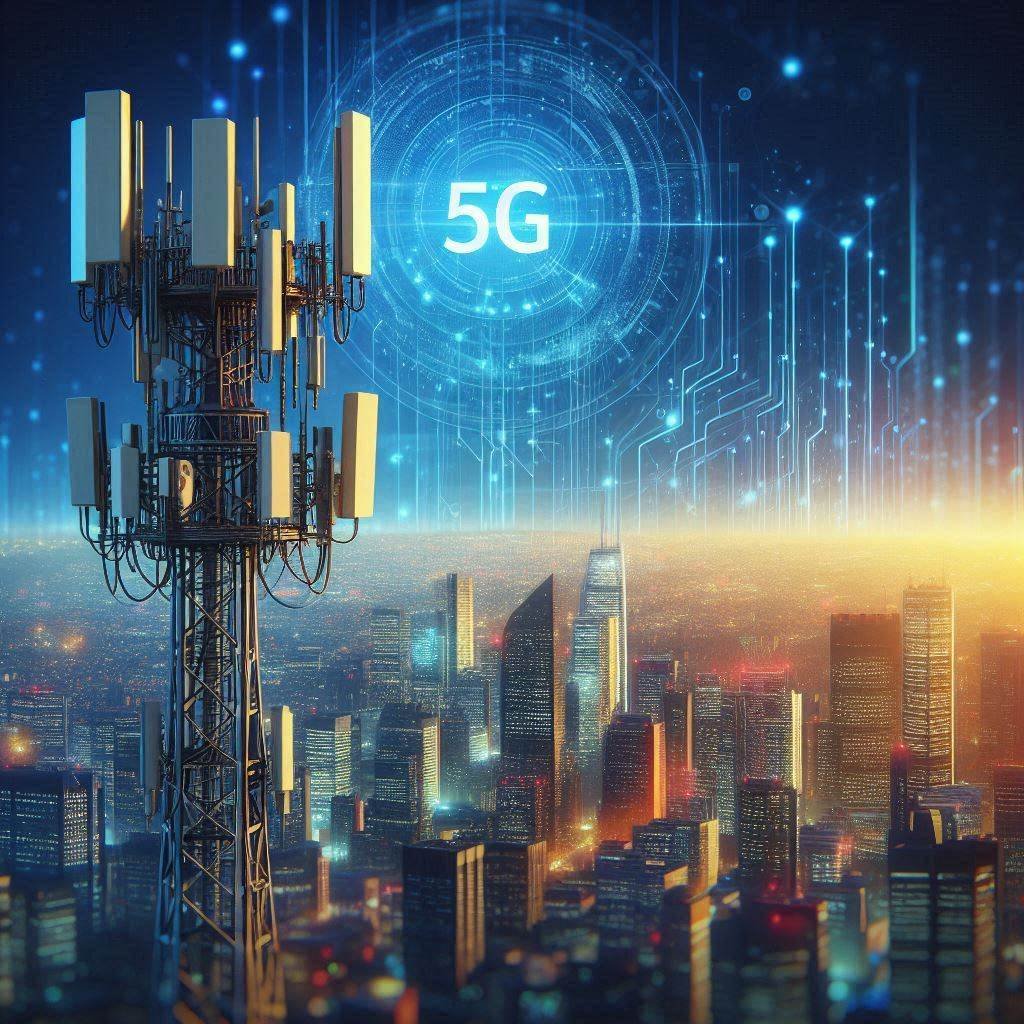
The tower looked ordinary. Just steel, wires, and blinking lights. But for some people, it represented something far more disturbing.
When 5G began rolling out around the world, it was marketed as the next big leap in wireless technology.
Faster downloads. Better connections. Less delay. A more connected future.
But almost as soon as the new towers started appearing, so did the warnings.
Posts spread online claiming 5G was dangerous. Videos said the radiation could damage the body. Some claimed it weakened the immune system. Others went much further, saying it was part of a larger cover-up about public health.
Suddenly, a technology most people barely understood had become the center of a modern conspiracy.
To some, 5G was just an upgrade.
To others, it was a threat hiding in plain sight.
And that is what made the theory so powerful.
—
What 5G Actually Is
Before looking at the claims, it helps to understand what 5G really means.
5G stands for “fifth generation” wireless technology. It is the next step after 4G, designed to carry more data more quickly and support more devices at once.
That is the practical side.
But the moment people heard the word “radiation,” the conversation changed.
Because radiation sounds frightening.
And that fear became the foundation of the entire story.
—
The Claims Behind the Fear
Over time, the conspiracy around 5G and health concerns settled into a few major ideas.
—
Claim #1: 5G Radiation Is Dangerous to Human Health
This is the most common claim.
The argument is that 5G towers and devices give off radiation that can harm the body, damage cells, or trigger illness.
—
Claim #2: The Public Was Never Told the Real Risks
Some believe governments and telecom companies already know 5G is dangerous but continue expanding it anyway.
In this version of the story, profits come before public safety.
—
Claim #3: 5G Is Different From Older Networks in a More Dangerous Way
Because 5G sounds newer and more powerful, many people assume it must also be more harmful than earlier wireless systems.
—
Claim #4: Illnesses Near Towers Prove the Danger
Some stories describe headaches, fatigue, sleep problems, or other symptoms appearing after new towers were installed nearby.
These stories are often shared as proof that the technology is causing real harm.
—
Why People Believe It
At first glance, the theory has emotional force.
It touches on three things people already worry about: health, corporate power, and invisible risks.
You can’t see radiofrequency energy. You can’t smell it. You can’t easily understand it without technical knowledge.
That makes it easy for fear to fill in the gaps.
And once fear enters the picture, every tower starts to look suspicious.
There is also a deeper human reason this theory spreads.
People are more likely to fear what they do not fully understand—especially when the thing they fear is all around them.
A cell tower in the distance becomes more than a piece of infrastructure. It becomes a symbol. A question mark. A possible threat.
That is how a technical upgrade turns into a public-health conspiracy.
—
The Human Moment
Picture a family driving through their neighborhood and noticing a new tower for the first time.
It wasn’t there before.
Now it is standing above the rooftops, impossible to miss.
Later that night, someone looks it up online.
One video leads to another. A post says 5G radiation is dangerous. Another says officials are hiding the truth. A comment section is filled with personal stories, warnings, and fear.
By midnight, the tower no longer feels like ordinary equipment.
It feels like a threat that arrived without permission.
That is how belief often starts—not with a scientific paper, but with uncertainty, anxiety, and a story that feels personal.
—
Reality Check: What the Science Actually Says
This is where the story needs to slow down.
Because when it comes to health fears, the difference between suspicion and evidence matters.
5G uses radiofrequency energy, which is a form of non-ionizing radiation.
That distinction is important.
Non-ionizing radiation does not have enough energy to damage DNA the way ionizing radiation—such as X-rays or gamma rays—can.
That does not mean all exposure questions disappear. It does mean the most dramatic claims often begin with a false comparison.
Major health organizations have reviewed the available evidence and have not concluded that 5G, under current regulated exposure limits, has been shown to cause the kinds of harms often described in conspiracy claims.
That does not make the topic fake or silly. It simply means the strongest claims have not been supported by solid proof.
—
Claim vs. Fact
Claim: 5G is a dangerous new kind of radiation.
Fact: 5G uses radiofrequency energy from the non-ionizing part of the electromagnetic spectrum, similar in broad category to earlier wireless networks, Wi-Fi, radio, and television signals.
Claim: Because 5G is more powerful, it must be more harmful.
Fact: “More advanced” does not automatically mean biologically more dangerous. The health question depends on frequency, power, exposure, and proven biological effects—not on the marketing label of the technology.
Claim: Symptoms people report near towers prove the towers are causing illness.
Fact: Symptoms are real experiences, but a real symptom is not the same as proven cause. To show causation, researchers have to rule out coincidence, stress, environmental factors, and expectation effects.
Claim: If officials say more research is needed, that means the danger is already known.
Fact: In science, “more research is needed” usually means exactly that. It is a normal part of studying long-term exposure questions, not automatic proof of harm.
—
Why “Invisible Danger” Stories Spread So Fast
5G health fears spread for the same reason many modern conspiracies spread.
They combine technical confusion with emotional urgency.
The claims are easy to repeat but harder to explain.
And because the topic involves health, people are less willing to take chances.
That emotional imbalance matters.
A short scary video can move faster than a careful scientific review. A dramatic personal story is easier to remember than a measured public-health statement.
In other words, the conspiracy has a storytelling advantage.
It offers a villain, a threat, and a hidden truth.
Science usually offers something less dramatic: uncertainty in some areas, strong evidence in others, and cautious conclusions overall.
—
The Bigger Pattern
The 5G panic also fits into a much older pattern.
Whenever a new technology appears, especially one connected to electricity, signals, or unseen energy, fear often follows.
That does not mean every concern should be ignored.
It means new technologies often become screens onto which people project older anxieties about control, health, and trust.
So the real question is not just, “Is 5G dangerous?”
It is also, “Why does this story feel so believable to so many people?”
The answer often has less to do with towers and more to do with trust.
When people do not trust institutions, official reassurance sounds weak. And when trust is low, even ordinary infrastructure can start to feel threatening.
—
The Truth Behind the Conspiracy
The 5G health conspiracy did not grow because a hidden danger was clearly exposed.
It grew because an invisible technology collided with public fear, online misinformation, and a deep lack of trust.
That combination is powerful.
But after looking at the claims and comparing them with the evidence, the picture becomes much less dramatic.
There is no solid, verified evidence showing that 5G, under current exposure standards, is causing the widespread health harms claimed in conspiracy theories.
That does not mean science should stop asking questions. It means the current evidence does not support the most alarming narratives.
—
Final Thoughts
In the end, the 5G story is not just about wireless towers.
It is about how people react to invisible systems they do not control and do not fully understand.
Because when a technology is hard to see, hard to explain, and tied to health, fear can spread faster than facts.
And sometimes, the most powerful part of a conspiracy is not the evidence behind it.
It is the feeling that something important is being hidden.
That feeling is real.
But in this case, the stronger evidence points somewhere less dramatic and far more ordinary:
Not a secret health attack—just a modern technology that became the perfect target for a very modern fear.
🔎 Want to explore more conspiracy theories and uncover what’s actually true?
Some of the most widely shared fears sound convincing—until you separate the claims from the facts.
- Anti-Vaccine Conspiracy — How One Claim Turned Into a Global Movement
- New World Order — Who Really Controls the World?
- JFK Assassination — The Mystery That Refuses to Go Away
Explore more here:
👉 Conspiracy Theories