
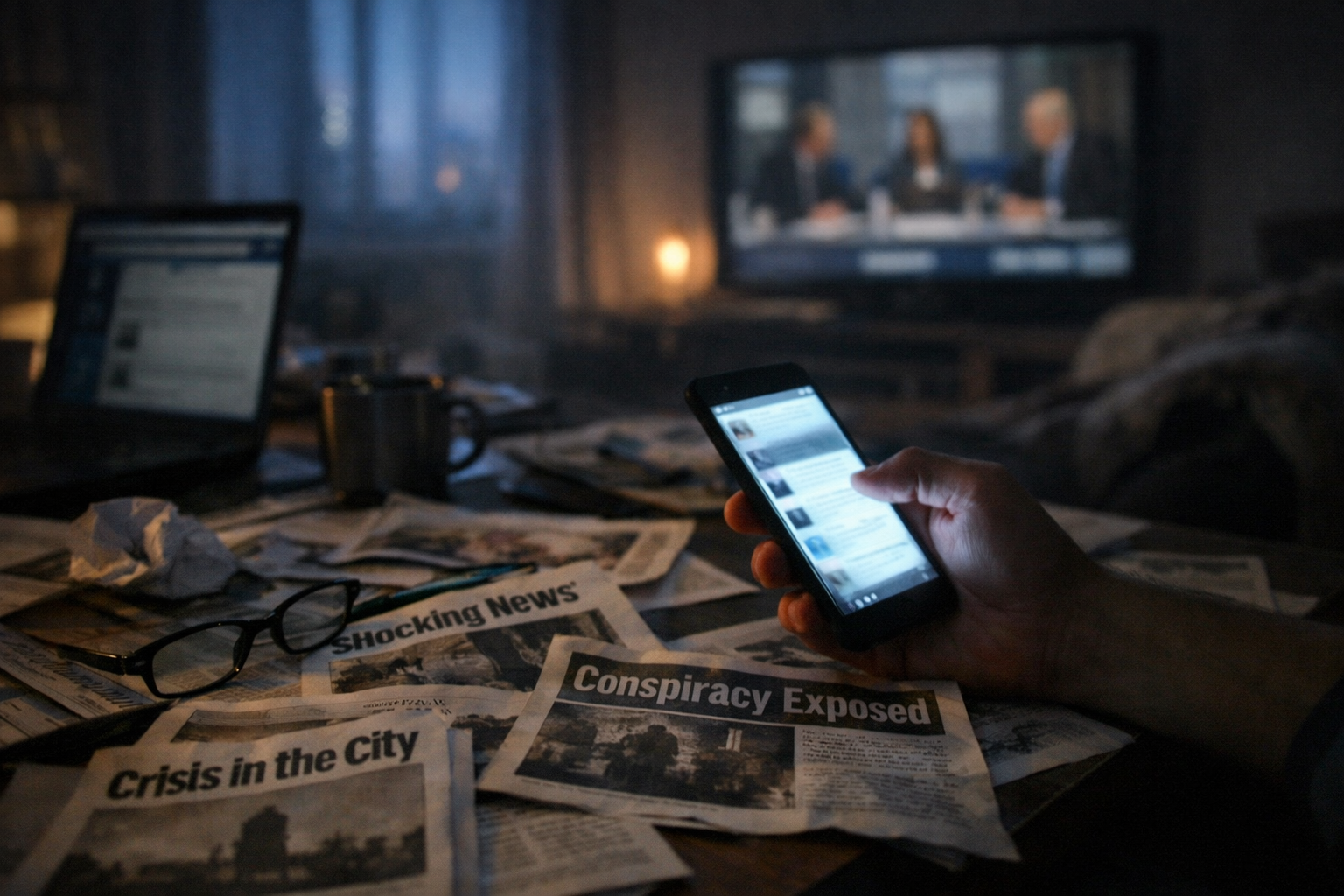
The post was only live for a few minutes before screenshots started moving faster than the correction ever would. In a dim apartment lit by a phone screen and a muted cable panel, fake news manipulation stops feeling like a media theory and starts feeling like a trap hidden inside the feed. If invisible hands can push a shaky claim into millions of homes before breakfast, how would anyone know where panic ends and coordination begins?
What Happened
The fear behind fake news manipulation grew out of a real change in how information moves. In the old model, a newspaper editor, TV producer, or radio station acted like a gatekeeper. In the digital model, a rumor can start with one account, get copied by dozens more, and reach the mainstream before anyone has time to verify the original claim.
That change made people feel as if the public story was no longer just being reported. It was being engineered. Supporters of the theory point to bot networks, troll farms, coordinated influence campaigns, paid content, partisan outlets, and recommendation systems that reward outrage over accuracy. In that environment, the line between organic spread and deliberate manipulation gets very hard to see.
There are documented reasons for that suspicion. Russian information operations around the 2016 U.S. election were real. State-backed propaganda efforts are real. Political groups, corporations, and activists all use coordinated messaging online. Platforms have also admitted that their systems can amplify false, emotional, and divisive content because those posts hold attention longer.
Picture the human moment that makes the theory stick. A person wakes up, scrolls half-awake through their phone, and sees the same dramatic claim from five different places. A headline says something shocking. A clipped video seems to prove it. Friends are already arguing in the comments. By lunch, the story feels true not because it was carefully checked, but because it appeared everywhere at once.
🔎 Related Investigation:
That is one reason modern fake news anxiety feels different from older propaganda fears. It is not just about one government office planting a story. It is about networks. A false claim can be spread by bad actors, boosted by algorithms, repeated by sincere people, and then picked up by larger outlets that fear being left behind.
Why People Believe It
The first reason people believe fake news manipulation theories is simple: real manipulation has already been exposed. Governments have used propaganda. Campaigns have used digital targeting. Platforms have removed coordinated inauthentic behavior. Once the public learns that some information operations are real, it becomes easier to suspect that larger hidden systems are real too.
The second reason is emotional experience. Many people have watched a weak claim spread farther than a later correction. They have seen viral clips trimmed to remove context. That repeated experience makes the media environment feel less like a marketplace of ideas and more like a battlefield where visibility itself is controlled.
Another reason is that institutional trust is already damaged. When intelligence agencies, major news outlets, platforms, and political operatives all issue statements about misinformation, some people hear a public warning. Others hear powerful institutions trying to define truth for everyone else.
There is also a logic shortcut that makes the theory emotionally attractive. A chaotic world is hard to tolerate. It feels cleaner to imagine hidden coordination than to accept that millions of users, flawed incentives, and engagement-driven platforms can create distortion on their own.
That same pattern appears in broader stories about hidden political influence. If readers already suspect entrenched systems in posts like Deep State Explained: Hidden Ruling Network or Just the Machinery of Government?, they are more likely to read fake news through the same lens. The question stops being “Is this story wrong?” and becomes “Who wanted me to see it this way?”
Claims vs Evidence
Claim: Fake news manipulation proves there is a single hidden authority controlling the entire public narrative.
Evidence: There is no confirmed evidence that one central command controls all major news, platforms, influencers, and public reactions at once. The information environment is too fragmented, competitive, and messy for that sweeping version to be strongly supported. Different actors push different agendas, often against one another.
Claim: Coordinated attempts to shape public opinion online are real.
Evidence: This claim has strong support. State-backed influence operations, bot amplification, troll campaigns, astroturf messaging, and platform gaming have all been documented. The public record shows that organized manipulation exists. The harder question is scale, reach, and whether separate efforts add up to one hidden system.
Claim: Algorithmic amplification can make false stories feel overwhelmingly true.
Evidence: Yes. Recommendation systems reward content that triggers strong reaction, repeat viewing, and fast sharing. That does not mean the algorithm has political intent of its own. It means the system can reliably boost sensational content, including falsehood, because outrage often performs better than caution.
Claim: Fact-checking and moderation prove elites are suppressing inconvenient truth.
Evidence: Sometimes moderation decisions are inconsistent or politically contested, which feeds suspicion. But inconsistency is not proof of a hidden censorship conspiracy. Some moderation can be biased without being evidence of a unified secret program.
Claim: Because fake stories spread in patterns, the pattern itself proves central coordination.
Evidence: Patterns can come from many sources. A false claim may spread because it is emotionally strong, easy to repeat, supported by partisans, and rewarded by platform design. Similar outcomes do not automatically prove a single planner.
🔎 Related Investigation:
Reality Check
The strongest reality check is that modern information distortion does not need to be centrally controlled to be dangerous. A platform can amplify low-quality content because its design rewards attention. Political actors can exploit that weakness. Traditional media can then repeat what is already trending. By the time the public sees the final wave, the result can feel choreographed even when it came from overlapping incentives instead of one hidden command room.
That matters because the simpler conspiracy version can actually make people less clear-eyed. If every bad story is treated as proof of one master manipulator, then the real mechanics disappear. You stop looking at bot networks, engagement incentives, ad models, partisan ecosystems, and platform design. You start looking for a single villain who can explain everything. That is emotionally satisfying, but analytically weak.
There is also a democratic problem here. People are right to worry about propaganda, covert influence, and narrative shaping. Those are not paranoid concerns. But if distrust expands until every correction looks suspicious and every conflicting report looks planted, then evidence loses its power. A person can become impossible to inform because any unwelcome fact can be dismissed as managed perception.
The most grounded conclusion is partial. Fake news manipulation is real in the sense that organized efforts, strategic messaging, and algorithmic amplification genuinely distort public understanding. What remains unproven is the grandest version of the theory: that one clean, hidden authority is secretly steering the whole information environment like a single machine. The evidence supports multiple manipulators, conflicting agendas, and systems that reward distortion. It does not clearly support one invisible hand behind everything.
In other words, the panic is not completely invented. It is built on real influence, real vulnerabilities, and real trust failures. But the strongest explanation is usually structural and networked, not cinematic and all-powerful.
Conclusion
Fake news manipulation endures because it grows from a modern fear almost everyone has felt: the fear that what rises into view is not what is most true, but what was most effectively pushed. In that sense, the theory touches something real. Public reality can be shaped. Stories can be amplified. Bad actors can game the system.
But once the evidence is separated from the larger myth, the picture becomes clearer. The threat is serious without becoming magical. We are not looking at a world where one hidden switch controls every headline. We are looking at a world where propaganda, incentives, technology, and distrust combine so well that manipulation can spread at industrial speed. That is less dramatic than a secret master plan. It is also more believable — and more useful to understand.
🔎 If this story stayed with you, the author suggests these real cases next:
- Operation Mockingbird: Did the CIA Really Shape the News?
- WikiLeaks Revelations: Transparency Breakthrough or Conspiracy Fuel Machine?
- Mass Surveillance State: How Much Does the Government Really See?
Explore more Political Conspiracies stories here: