
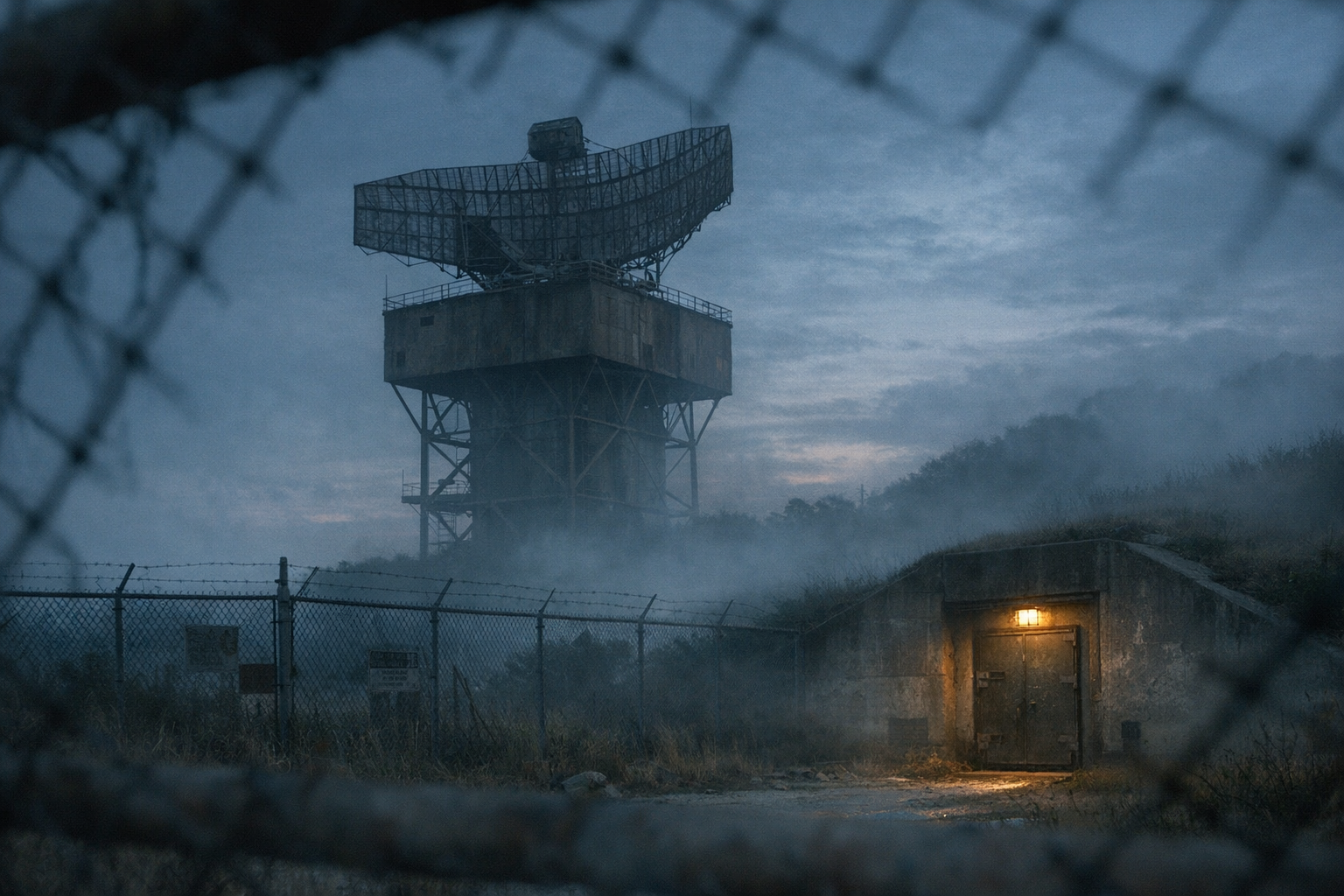
Behind a rusting fence at the edge of Long Island, where sea fog curls around an abandoned radar tower and concrete tunnels disappear into the dark, the Montauk Project myth begins with a place most people were never meant to enter. For years, stories claimed that hidden rooms under Camp Hero were used for mind control, psychological warfare, and even experiments that pushed far beyond normal science.
What Happened
The real setting is Camp Hero in Montauk, New York, a former military site that later became part of a state park. During World War II and the Cold War, the location was used for coastal defense and radar operations, which already gave it the right kind of military secrecy to attract suspicion.
The conspiracy story became much bigger in the early 1990s after Preston Nichols and Peter Moon published The Montauk Project: Experiments in Time. Their account described a hidden program tied to mind control, psychic research, abducted children, and time travel beneath the old base.
🔎 Related Investigation:
That story also connected Montauk to the older Philadelphia Experiment legend, which claimed the military once tried to make a naval ship invisible. By linking one strange tale to another, the Montauk narrative suddenly felt less like a local rumor and more like part of a buried secret history.
Camp Hero itself did have underground structures, military hardware, and restricted areas. That gave visitors something physical to point at. But a real military base is not the same thing as proof that the wildest claims happened there.
Why People Believe It
The Montauk story has all the ingredients conspiracy culture feeds on: a lonely government site, a giant radar tower, stories of recovered memories, and claims that official records do not tell the full story. Even before anyone checks the evidence, the visual setting does a lot of the work.
There is also a real historical reason people stay open to the idea of secret experiments. Government programs like MKUltra showed that officials did conduct unethical mind-control research in the twentieth century. That does not prove Montauk, but it makes the larger fear feel less impossible.
The story spread because it kept expanding. What may have started as claims about psychological warfare turned into teleportation, alien contact, and time tunnels. The more extreme the claims became, the more unforgettable the theory was online and in pop culture.
It also gained another life when people began linking it to Moon Landing Hoax-style distrust and broader fears about hidden power. Once a theory becomes part of a larger worldview, it no longer depends on one strong piece of evidence to survive.
Claims vs Evidence
Claim: The military used Camp Hero for secret mind-control experiments. Evidence: Camp Hero was a real military installation with real restricted infrastructure. But the public story of secret experiments mainly traces back to books and personal testimony rather than documents, court records, or verified witnesses with independent proof.
Claim: The Montauk Project grew out of the Philadelphia Experiment. Evidence: That connection comes from conspiracy literature, not established historical records. It joins two famous stories together, but the link is narrative, not demonstrated fact.
Claim: Hidden underground levels beneath the base were used for psychic and time-travel research. Evidence: The site does include military structures and bunkers, which helps the story feel plausible. But there is no verified public evidence showing a giant secret laboratory, mass abductions, or functioning time technology under Camp Hero.
Claim: The story rings true because governments have lied before. Evidence: That is partly fair. Real secrecy and real abuse can make later rumors easier to believe. But suspicion is not proof. Each claim still has to stand on its own evidence.
For a wider look at how secretive institutions fuel distrust, see Shadow Governments. For another case where hidden agendas are often assumed before the evidence is settled, see Weather Manipulation and HAARP.
Reality Check
The strongest part of the Montauk story is the atmosphere, not the proof. Camp Hero was real. The military history was real. Restricted spaces and abandoned equipment were real. Those facts created a perfect stage for a modern myth.
The weakest part is the evidence behind the biggest claims. The famous details about mind control, child abductions, psychic warfare, and time travel mostly come from self-reported accounts and books that blur the line between testimony, speculation, and science fiction.
That does not mean every question around the site is foolish. When a place carries real military history and limited public access, curiosity is normal. But the available record does not support the idea that Montauk is a proven government program on the scale conspiracy culture often describes.
The most reasonable conclusion is that Montauk became powerful because it mixed real secrecy with imaginative storytelling. Once that combination clicked, the legend no longer needed hard evidence to keep growing.
Conclusion
The Montauk Project remains one of those stories that feels true before it is ever proven. An isolated base, a towering radar dish, rumors of buried rooms, and a claim that powerful people crossed lines the public was never supposed to see – that is a hard story to forget.
But when the smoke clears, the case looks much more like a modern myth built on a real location than a verified mind-control operation. The site is real. The secrecy was real. The giant leap to time travel and hidden experiments still has not been backed by solid evidence.
If this story stuck with you, you might want to explore these next:
- Shadow Governments
- Weather Manipulation and HAARP
- JFK Assassination
- Moon Landing Hoax