
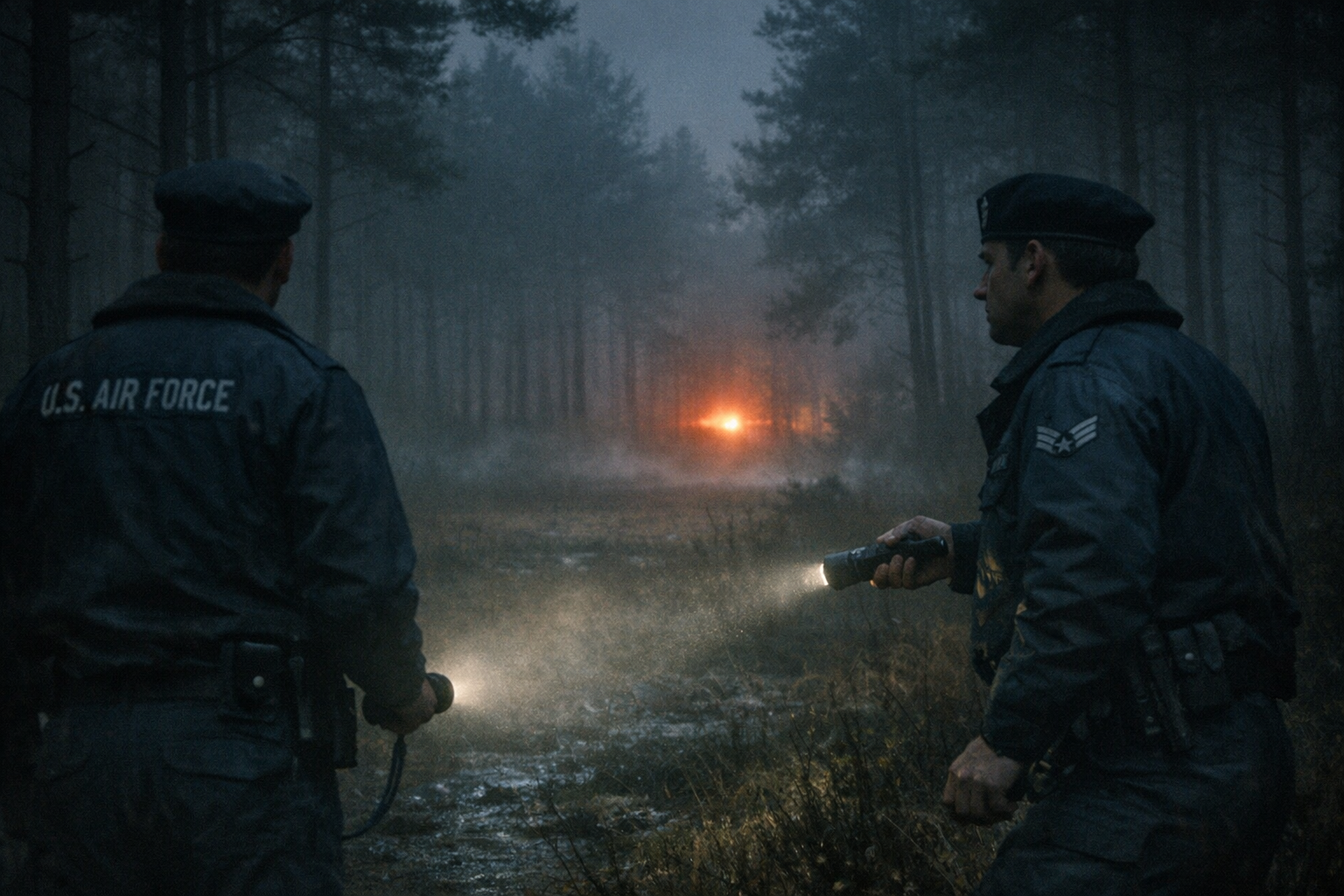
The call came from a dark gate beside a U.S. air base, just after midnight, when something bright seemed to slip into the trees beyond the fence. In the cold woods of Suffolk, trained servicemen walked toward a light they were not supposed to find, and the story that followed became the Rendlesham Forest incident—a case wrapped in military language, missing certainty, and just enough official paperwork to make people wonder what was kept in the dark.
What Happened
In late December 1980, U.S. Air Force personnel stationed at RAF Woodbridge and RAF Bentwaters in Suffolk, England, reported strange lights near Rendlesham Forest. The first major incident happened in the early hours of December 26, when security men near the east gate saw what looked like lights dropping into the forest. Because the bases were part of a Cold War military network, the situation felt serious from the start. If something had come down near the perimeter, it could have been an aircraft, a threat, or something harder to explain.
Several men went into the woods to investigate. Over the years, different witnesses described the scene in different ways, but the basic outline stayed the same: they saw unusual lights moving among the trees, and at least some of them believed they were approaching a structured object rather than a normal light source. One witness, Jim Penniston, later gave the most dramatic version, saying he got close enough to touch a craft. That claim became one of the reasons the story grew far beyond a routine military sighting.
By daylight, the mystery had shifted from the sky to the ground. Men returned to the area and pointed to small impressions in the clearing, marks on nearby trees, and broken branches. It was the kind of scene that invites imagination because it feels like evidence without fully behaving like evidence. A patch of disturbed earth in daylight can look ordinary or extraordinary depending on what you think happened there a few hours earlier.
Then, two nights later, Deputy Base Commander Lieutenant Colonel Charles Halt led another trip into the forest. This second visit matters because Halt later wrote the memo that turned the case into official history. He and the group took radiation readings, reported seeing a flashing light in the distance, and described star-like objects higher in the sky. Halt also recorded parts of the event on a handheld tape recorder, which gave the case something rare in UFO lore: a real-time audio trail instead of only later memories.
That combination of witnesses, military status, and surviving records is why Rendlesham is still often called Britain’s Roswell. It has the ingredients people remember: a tense location, trained observers, a written memo, and a story that seems bigger every time it is retold. If you have read our look at the Roswell UFO Crash, you will recognize the same pattern—an uncertain event becomes far more powerful once official language enters the picture.
Why People Believe It
People believe the Rendlesham story for a simple reason: this was not a random internet rumor or a single blurry photograph. The central witnesses were U.S. military personnel working near secure bases. For many readers, that instantly raises the credibility level. These were people trained to notice unusual activity, and they were operating in a place where unexplained lights would not be treated casually.
There is also a strong human moment at the center of the case. Imagine stepping into a wet, black forest after midnight, hearing strange noises from the trees, seeing a light that seems to move when you move, and knowing you are close to a base tied to nuclear-era tension. Even if every later explanation is correct, that first experience could still feel deeply unnatural. The emotional force of the case did not come from a newspaper headline. It came from a group of men who seemed genuinely unsettled by what they thought they saw.
The Halt memo gave believers something even more valuable: paperwork. A mystery becomes harder to dismiss when it leaves a written trail inside a military system. The audio recording made that effect even stronger. Listeners can hear confusion, urgency, and attempts to make sense of lights in real time. To many people, that sounds less like myth-making and more like a raw encounter before anyone had time to shape the story.
Rendlesham also survives because it sits at the crossroads of other long-running UFO questions. It happened after decades of secrecy around sightings, government reviews, and shifting official language. That background matters. Once people learned that states had studied unexplained aerial reports before, cases like this no longer felt isolated. They felt like fragments of a larger puzzle, which is one reason stories about Government UFO Programs keep feeding interest in older incidents.
Claims vs Evidence
Claim: Military witnesses encountered a landed craft or an intelligently controlled unknown object in Rendlesham Forest. Evidence: Multiple witnesses did report unusual lights, and Charles Halt documented later events in a memo and on tape. What the evidence does not confirm is an extraterrestrial craft. The strongest alien interpretation depends heavily on later retellings, especially claims that became more dramatic long after the original night.
Claim: The ground marks and tree damage showed that something landed. Evidence: Investigators did observe impressions and disturbed areas, but those marks were never established as proof of a landing. Police and local observers argued that the indentations could be animal scrapes and that the forest itself naturally contained broken branches and rough patches. In other words, there was physical trace material, but not trace material that clearly pointed in one direction.
Claim: Radiation readings proved something unusual was in the clearing. Evidence: Halt’s group took readings and noted slight differences, but the levels reported were close to background levels. That matters because “radiation detected” sounds dramatic until the numbers are compared to normal environmental variation. The reading exists as part of the record, but it is weak support for a landed craft.
Claim: The distant flashing light and later lights in the sky behaved in ways no normal source could explain. Evidence: Skeptics have long argued that the main distant light aligned with the Orfordness Lighthouse, whose beam flashed at a regular rate visible from that area. Bright stars, atmospheric effects, and the stress of watching from a dark forest also provide a grounded explanation for the later hovering lights. None of that proves every witness was wrong about everything. It does show that several dramatic details have plausible non-alien explanations.
Claim: The case was covered up. Evidence: There was clearly official hesitation and limited follow-up, and that absence helped the story grow. But a weak investigation is not the same thing as proof of a suppression campaign. In fact, one reason Rendlesham remains controversial is that the surviving public record looks less like a perfect cover-up and more like a messy mix of incomplete reporting, later myth-building, and Cold War suspicion.
Reality Check
What we do know is solid enough to make the case interesting. Something unusual was reported by real military personnel. A senior officer wrote a memo. An audio recording exists. The event was not invented from nothing. That alone separates Rendlesham from many weaker conspiracy stories.
But the leap from “strange event” to “alien landing” remains unproven. The problem is not that skeptics can explain every second perfectly. The problem is that the most extraordinary parts of the story are the least firmly supported at the time they were first recorded. Some details became larger, sharper, and more certain only years later. That pattern should make any careful reader slow down.
There is also a broader lesson here about military credibility. People often assume trained observers cannot make basic mistakes. In reality, training may make witnesses more serious, but it does not make them immune to darkness, distance, stress, expectation, or pattern-matching. A forest at night can distort size, direction, and movement in ways that feel convincing in the moment. When several uncertain signals happen together—a meteor, a lighthouse beam, stars near the horizon, nervous men in the woods—the mind naturally connects them into one coherent event.
That may be the most important thing about Rendlesham. It shows how mysteries grow when there is just enough evidence to resist dismissal, but not enough to settle the case. The result is a story that never fully dies. Believers can point to the memo, the tape, and the witnesses. Skeptics can point to the lighthouse, the fireball, background radiation, and the shifting testimony. Both sides keep finding material because the record contains ambiguity, not closure.
If there was a cover-up, the public evidence has not demonstrated it. If there was an alien craft, the public evidence has not demonstrated that either. What remains is a partially explained Cold War-era incident whose power comes from the gap between what was seen, what was documented, and what was later imagined around it.
Conclusion
Rendlesham Forest earned its reputation because it sits in the uncomfortable middle ground where conspiracy stories thrive. The witnesses were credible enough to keep the question alive, but the evidence was never strong enough to end the debate. That does not make the case worthless. It makes it useful.
It reminds us that some mysteries survive not because they are fully hidden, but because they are never fully resolved. The official record leaves room for doubt. Later testimony adds drama. Skeptical explanations remove some of the heat, but not all of it. In the end, the Rendlesham Forest incident is best understood not as proven alien contact or easy debunking, but as a real event that became larger in the dark than the evidence can cleanly support.
🔎 If this story stayed with you, the author suggests these real cases next:
- Roswell UFO Crash: What the Original Witnesses Claimed and What the Records Actually Show
- Pentagon UFO Videos: What the Navy Footage Confirmed — and What It Didn’t
- Alien Disclosure Timeline: Are We Seeing Revelation or Repackaged Secrecy?
Explore more Alien & UFO Theories stories here: