
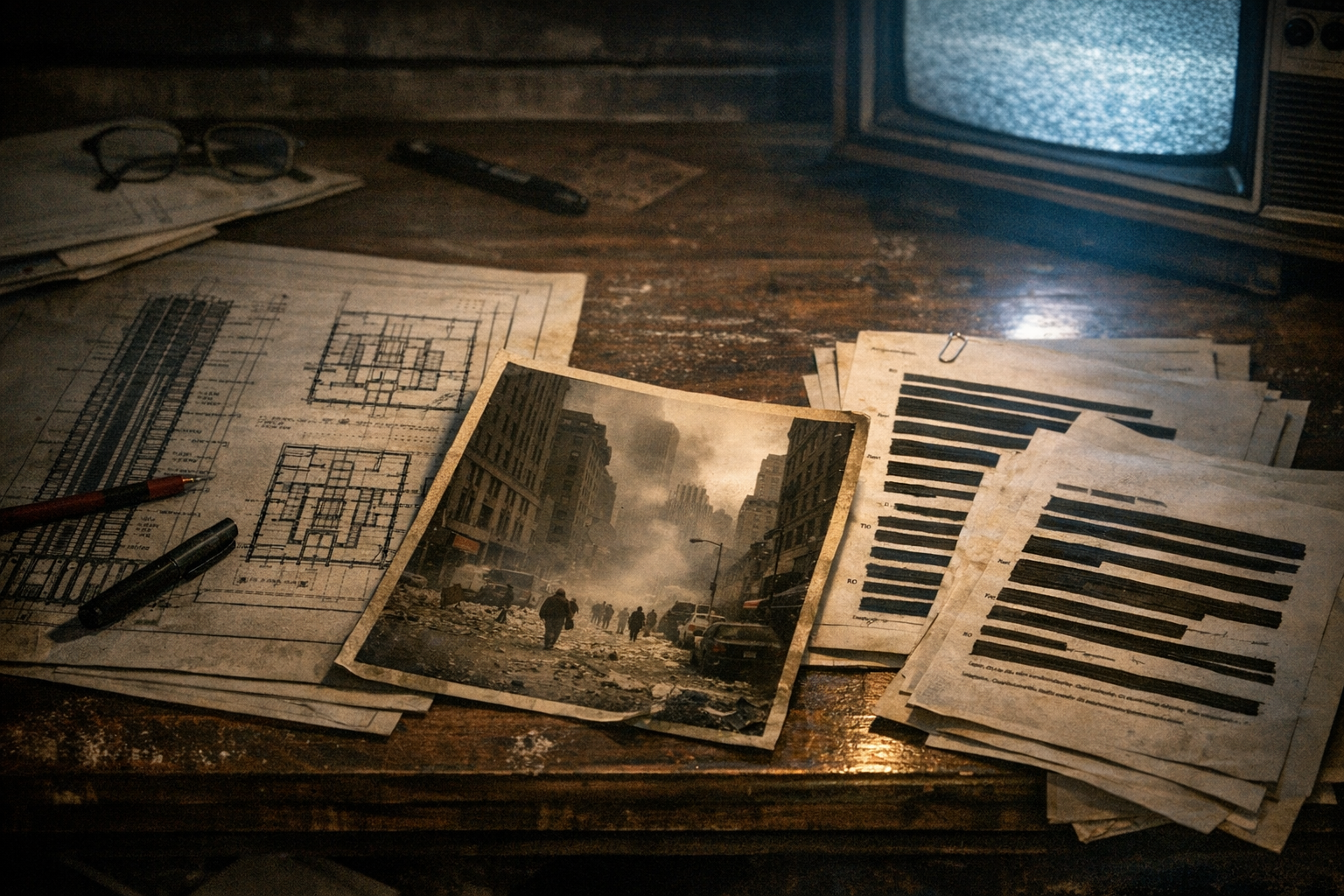
The footage was replayed so many times it stopped feeling real. Smoke rolled through lower Manhattan, paper drifted through the air like ash, and millions of people watched sealed-off streets, collapsing towers, and stunned officials trying to explain what had just happened. In that atmosphere, the 9/11 inside job theory took hold because some events feel too enormous, too organized, and too devastating for people to accept as simple failure.
What Happened
On September 11, 2001, 19 hijackers linked to al-Qaeda took control of four commercial airliners. Two planes struck the Twin Towers in New York. A third hit the Pentagon. A fourth crashed in Pennsylvania after passengers fought back.
Almost 3,000 people were killed. The attacks were recorded live, investigated for years, and remembered in painful detail. Even so, the scale of the day created space for another story to grow alongside the official one.
That alternate story was not just one theory. It became a bundle of claims about the collapses, intelligence warnings, air defense failures, and Building 7. In cases like False Flag Operations, real history shows that states have used deception before, which helps explain why later suspicion spread so easily.
People were not weighing those claims in a calm room with a stack of reports. They were watching dust-covered survivors, sealed streets, and missing-person posters. When a tragedy feels that large, many people refuse to believe incompetence could explain it.
Why People Believe It
The 9/11 inside job theory grew because it offered something emotionally cleaner than chaos. If powerful people caused it, then the event had a plan behind it. That can feel more satisfying than accepting that a small group of hijackers exploited real weaknesses in intelligence sharing, aviation security, and emergency response.
Distrust also mattered. The attacks happened before the Iraq War, but the years that followed made many Americans less willing to trust official claims. Bad intelligence about weapons of mass destruction, secrecy inside national security agencies, and long-running debates about government honesty all fed back into how people re-read 9/11.
Another reason is visual impact. The towers fell in a way many viewers thought looked like a controlled demolition. Building 7, which was not hit by a plane, also collapsed later that day. Once those images were paired with selective clips and dramatic online arguments, the theory became highly shareable.
There is also a pattern seen in other state-power theories, including pieces about the Deep State. When institutions are large, secretive, and slow to admit mistakes, many people stop asking whether a failure happened and start asking what was being hidden.
Claims vs Evidence
Claim 1: The Twin Towers fell like controlled demolitions.
Supporters of the theory point to the near-vertical collapse, the speed of the fall, and reports from some witnesses who said they heard explosions. They argue that jet fuel alone could not melt steel and that the buildings dropped too neatly for impact damage and fire to be the real cause.
What we do know is narrower. The official engineering explanation was not that jet fuel melted the steel. It was that the plane impacts stripped insulation, damaged columns, spread fires across multiple floors, and weakened the steel enough for the floors and structural system to fail. Once the upper sections began moving, the mass involved created a progressive collapse. Engineers can debate details, but there is no verified physical evidence that planted explosives were found in the towers.
Claim 2: Building 7 proves the attacks involved demolition.
This is one of the most persistent arguments because World Trade Center 7 was not hit by a plane. Supporters say its later collapse looked too sudden to be caused by office fires and damage from debris. For many believers, this is the part of the story that keeps the broader theory alive.
The official finding from NIST was that uncontrolled fires, combined with structural damage and the failure of a critical interior column, led to a progressive collapse. Critics reject that conclusion, and Building 7 remains one of the most debated parts of the day. But debate is not the same thing as proof. There is still no confirmed evidence showing demolition charges were installed or triggered.
Claim 3: The government had warnings and must have known more than it admitted.
This claim is partly rooted in real facts. There were intelligence signals before the attacks. Agencies held fragments of information about al-Qaeda and possible hijacking threats. The 9/11 Commission itself described serious communication failures, missed opportunities, and bureaucratic barriers between agencies.
That matters, because this part of the theory overlaps with reality. There really were failures. However, failure to connect warnings is different from proving a planned inside job. The confirmed record supports negligence, fragmentation, and missed detection far more strongly than coordinated internal orchestration.
Claim 4: NORAD and air defense responses were too slow to be innocent.
Believers argue that military aircraft should have intercepted the hijacked planes quickly. Early official statements added confusion because timelines changed as investigators learned more. Those changes fed suspicion.
Still, the context matters. The hijackings unfolded in a way the system was not prepared for. The planes turned off transponders, changed course, and were initially treated within a framework built for very different kinds of threats. The slow and confused response is documented, but documented confusion is not the same as evidence of planned stand-down orders.
Claim 5: The motive was war, surveillance, and political power.
This claim points to what happened after the attacks: wars in Afghanistan and Iraq, expanded surveillance powers, and a major reshaping of U.S. national security policy. Supporters argue the benefits were so large that motive becomes obvious.
But motive alone proves very little. History is full of leaders exploiting crises they did not create. The fact that officials used 9/11 to justify later policy does not by itself prove they engineered the attacks. It proves that governments often turn trauma into political opportunity, which is troubling enough on its own.
Reality Check
The strongest version of the 9/11 inside job theory is not that every official detail was false. It is that public distrust grew from real failures, changing timelines, and a trauma so large that many people felt a hidden hand had to be involved.
There is no confirmed evidence that the U.S. government planned the attacks, planted explosives in the towers, or staged the event from the inside. The evidence that does exist points to an al-Qaeda plot that succeeded because of intelligence breakdowns, aviation vulnerabilities, and a system that was not ready.
At the same time, calling every question irrational would miss the bigger lesson. Public distrust did not appear from nowhere. It was fed by real institutional failures, poor communication, and later government behavior that made official narratives harder to trust. The theory survived not because proof became overwhelming, but because trust never fully recovered.
Conclusion
The 9/11 inside job theory still fuels distrust because it sits at the crossroads of tragedy, institutional failure, and political consequence. It asks a question many people still carry: was this only a terrorist attack, or was it also a warning about how fragile truth becomes after mass trauma?
The most grounded answer is that 9/11 was a real al-Qaeda attack, not a proven government-engineered operation. But it was also the kind of event that made official mistakes look sinister, later policy choices look opportunistic, and unanswered questions feel larger with time. That is why the theory never fully disappears. It is powered less by hard proof than by the long shadow left when fear, grief, and distrust all arrive at once.
🔎 If this story stayed with you, the author suggests these real cases next:
- False Flag Operations: How Real Deception Fuels Bigger Political Theories
- CIA Assassination Plots: What Was Declassified — and What Got Added Later?
- Mass Surveillance State: How Much Does the Government Really See?
Explore more Political Conspiracies stories here: