
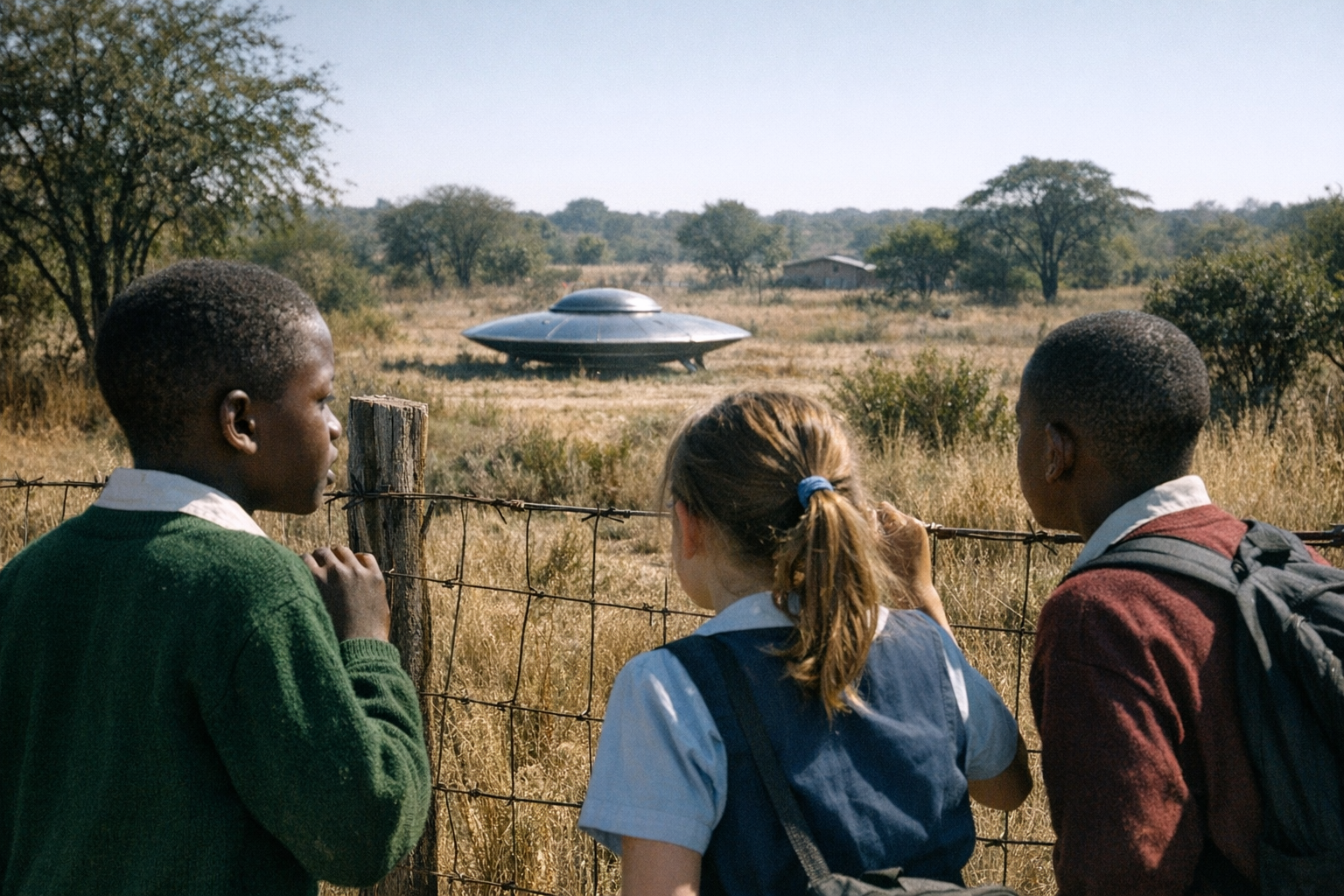
The children were outside for morning break when the ordinary noise of a schoolyard gave way to something they said should not have been there at all. Beyond the fence, near a patch of scrub and small trees in Ruwa, Zimbabwe, dozens of students later claimed a silver craft dropped low enough to feel close, silent, and wrong. For many people, the Ariel School UFO encounter still feels like forbidden knowledge hiding in plain sight: too many witnesses to dismiss casually, but too little hard evidence to settle.
What Happened
On September 16, 1994, students at Ariel School were outside during a mid-morning break while teachers were inside in a meeting. According to the most repeated version of events, 62 children between the ages of roughly 6 and 12 said they saw one or more strange objects near a field just beyond school grounds.
Many described a silver or shining craft. Some said it looked disc-shaped. Others focused less on the shape and more on how strange it moved. Several children also said they saw small beings dressed in dark clothing, with large eyes, moving near the object or toward the edge of the field.
The scene has stayed famous because it was not just one frightened child telling a lonely story after dark. It was broad daylight. It was a private school. And when the children were interviewed soon after, many of them sounded deeply shaken rather than playful. Some cried. Some drew what they said they saw. Some insisted for years that they were telling the truth.
There is also a human detail that keeps the case alive. When the children ran back with the story, many adults did what adults usually do in moments like this: they assumed imagination, panic, or copying. But by the next day, enough parents were concerned that the event spread beyond the school and reached local media.
BBC reporter Tim Leach interviewed children only a few days after the incident. UFO researcher Cynthia Hind also collected accounts and drawings. Months later, Harvard psychiatrist John Mack interviewed some of the witnesses, and that is when the story gained a larger international audience.
One part of the case remains especially controversial. Some witnesses later said the beings communicated a warning about technology, pollution, or environmental damage. That detail appears in later tellings and interviews, but skeptics note that not every early account emphasized it the same way.
For readers who have followed older cases like Roswell UFO Crash, the difference here is important. Ariel School is not a story about military debris or recovered wreckage. It is a witness case, and almost everything depends on how much weight you give to memory and consistency.
Why People Believe It
The strongest reason people believe the Ariel School story is simple: there were a lot of witnesses. A single strange report can be brushed aside. More than 60 children saying broadly similar things in the same place at the same time feels harder to ignore.
Believers also point to the age of the witnesses. Young children can invent stories, of course, but supporters argue they were not acting like kids chasing fame. Many sounded confused, frightened, and certain they had seen something real.
Another reason the case feels persuasive is the speed of the early interviews. This was not a story recovered decades later from faded memory alone. Parts of it were captured within days, along with drawings that gave the public something visual to hold onto.
Some former students have continued to stand by their accounts as adults. That does not prove an alien encounter happened, but it does make the case emotionally powerful. The setting helps too: broad daylight near a school feels less like folklore and more like ordinary life interrupted.
Cases explored in Government UFO Programs show how official secrecy can make public trust thinner. Ariel taps that same emotional current from a different angle. If governments have hidden things before, some readers ask, why should a mass witness event automatically be treated as impossible?
Claims vs Evidence
Claim: Dozens of children independently saw a strange craft and one or more non-human beings near the school.
Evidence: We do have multiple witness statements, drawings, and recorded interviews. That is real evidence in the sense that testimony exists and was documented. But it is testimonial evidence, not physical evidence. There is no confirmed craft, no radar record tied directly to the school event, no recovered material, and no photograph that settles the matter.
Claim: The consistency of the children’s stories proves they witnessed the same extraordinary event.
Evidence: Some details do repeat across accounts: a silver object, unusual movement, dark figures, large eyes, fear, and the location near the field. However, skeptics argue that children interviewed in groups can influence one another, especially after a startling event becomes the center of attention. Similarity can suggest truth, but it can also grow after discussion.
Claim: The environmental warning makes the event feel intelligent and purposeful, not random.
Evidence: This is one of the weakest parts of the case from a strict evidentiary view. The environmental message became one of the most memorable elements of the story, but critics point out that it is more vulnerable to suggestion, interpretation, and later retelling than the basic claim that something unusual was seen.
Claim: Other regional sightings around the same time support the Ariel case.
Evidence: There were reports of unusual lights in southern Africa days earlier, and one explanation for at least some of that wave is a rocket re-entry or fireball event. That does not automatically explain what the children reported at Ariel School, but it does show that the region was already primed for UFO talk. Context can help explain belief without fully explaining the event itself.
Claim: Because many witnesses still believe the story as adults, the original event must have been alien in nature.
Evidence: Sincere belief is not the same as verified fact. People can be honest and still misinterpret what they experienced. Adult certainty strengthens the mystery, but it does not close it.
Reality Check
The Ariel School case is compelling because it sits in the uncomfortable middle. There is too much testimony to laugh it away. There is too little hard evidence to call it proof of extraterrestrial contact.
The most grounded explanation is not that every child lied. It is more likely that at least some children experienced something unusual, then interpreted it through fear, conversation, and the social gravity of a shared moment. Once a dramatic story forms inside a group, memory can become sharper in emotion while growing less stable in detail.
That possibility does not make the witnesses foolish. It makes them human. A startling sight in a charged atmosphere can become a lasting, sincere memory even if the original trigger was more ordinary than it seemed.
Several non-alien explanations have been suggested over the years: misidentification, a prank, a staged performance, a dust-related visual event, or a wave of excitement fueled by recent reports of strange lights in the region. None fully satisfies believers. Still, the gap between “unexplained” and “alien” remains enormous.
What we do know is narrow but solid. On that morning, a large number of students reported a strange experience, and interviews and drawings were recorded soon after. What we do not know is exactly what triggered the reports, or whether the most dramatic details were present in the same form from the beginning.
So the fairest conclusion is not “case closed” in either direction. Ariel School remains one of the strongest witness-driven UFO stories on record, but it remains witness-driven all the same. That means it deserves attention, caution, and a clear line between what was reported and what was proven.
Conclusion
The Ariel School UFO encounter still works on people because it feels like a tear in ordinary reality that never got stitched back up. Children in daylight described something adults could not easily explain, and the memory of that moment has refused to disappear.
But mystery is not proof. The case is powerful because it forces two ideas to live side by side: many witnesses may have honestly seen something strange, and that still does not tell us with confidence that the source was extraterrestrial.
That is why the story survives. It offers neither a clean debunking nor a confirmed revelation. It leaves us where the strongest conspiracy and mystery cases usually leave us — staring at a real event, a pile of uncertain interpretations, and a question that remains just open enough to haunt people.
🔎 If this story stayed with you, the author suggests these real cases next:
- Roswell UFO Crash: What the Original Witnesses Claimed and What the Records Actually Show
- Travis Walton UFO Incident: The 5 Days That Turned a Logger Into a Legend
- Pentagon UFO Videos: What the Navy Footage Confirmed — and What It Didn’t
Explore more Alien & UFO Theories stories here: