
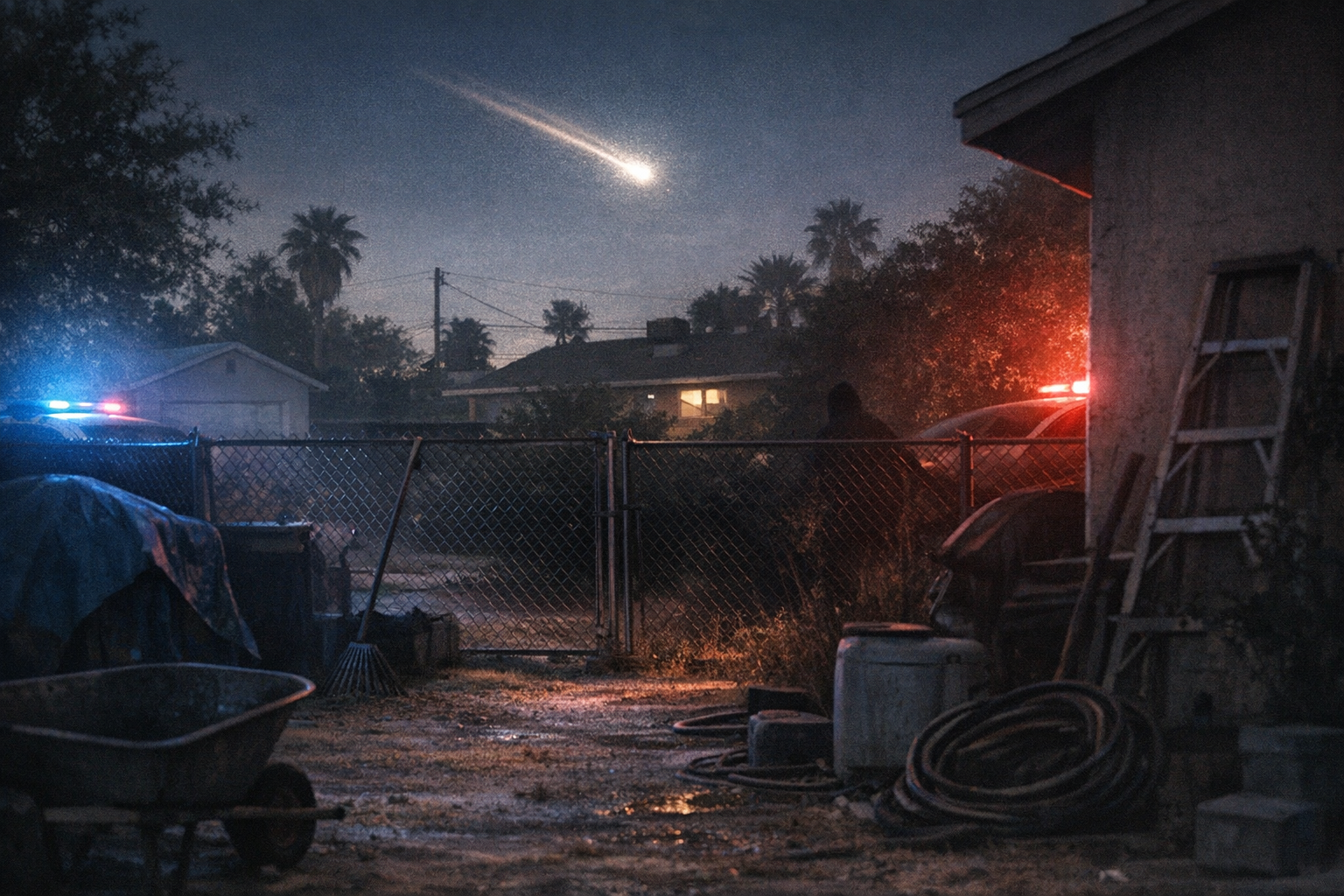
The call came in after dark, with a family speaking fast, a police bodycam recording fresh nerves, and a bright streak already turning into rumor before anyone had even agreed on what had landed. In a city built on spectacle, the most unsettling part was not just what people said they saw in that Las Vegas backyard — it was how quickly the internet stepped in and started seeing even more.
The Las Vegas alien case usually refers to a May 2023 incident in which a Las Vegas family called 911 after reporting tall beings in their backyard shortly after a bright object was seen crossing the sky. Supporters say it may have been a real alien encounter captured in real time through emergency audio, police response, and video. The more grounded reality is that the case became powerful because it mixed a real 911 call, a real police visit, shaky visual material, and intense online interpretation long before the evidence was settled.
What Happened
The angle here matters: this is not only a story about whether something strange was in a yard. It is also a story about how modern UFO cases now build themselves in public, piece by piece, while fear, screenshots, and enhancement videos race ahead of certainty.
On the night of May 1, 2023, Las Vegas police officers recorded a bright object streaking through the sky on bodycam footage. Around the same time, a local family called 911 and said something had crashed or landed in their backyard. One caller described seeing two very tall beings, around eight to ten feet, with large eyes. That description instantly gave the incident its shape.
There is also a very human moment at the center of it. Picture a family standing behind a fence at night, trying to explain what they think they just saw while the normal sounds of a neighborhood suddenly feel wrong. In that kind of moment, fear does not arrive as a clean fact. It arrives as fast breathing, half-finished descriptions, and the desperate need for someone official to show up and make sense of it.
From there, the visual evidence became the battlefield. Supporters pointed to backyard video and claimed shadowy figures or movement could be seen near equipment and fencing. Critics looked at the same footage and saw darkness, compression, suggestion, and the kind of visual noise that invites people to complete the picture themselves. That tension is familiar in UFO sightings more broadly: once a clip is unclear enough, belief often does the rest.
The case also spread because it did not stay local for long. News coverage amplified the timeline. Social media users began isolating frames, brightening shadows, circling shapes, and posting side-by-side breakdowns. Some viewers became more convinced the more they watched. Others became more skeptical for the same reason. By that point, the story was no longer just a police response. It had become a live internet investigation.
Why People Believe It
People believe the Las Vegas case for several overlapping reasons. First, the base event was not invented from nothing. There really was a 911 call. Police really did respond. A bright object really was recorded in the sky that night. Those facts gave the story a foundation strong enough to survive far longer than a normal rumor.
Second, the timing felt persuasive. To many people, the sky object and the backyard report seemed connected in a way that felt too neat to ignore. When two unusual things happen close together, the mind wants to join them into one explanation. That instinct is powerful even when the evidence linking them is incomplete.
Expectation also plays a major role. Once a viewer is told that a hidden figure is standing near a fence or crouching in the shadows, the clip changes. The brain starts hunting. Shapes begin to look more deliberate. Movement appears in places that might otherwise read as darkness, grain, or compression artifacts. That is one reason mass-witness stories like the Ariel School UFO encounter stay so complicated: testimony can be sincere while interpretation still evolves over time.
The internet made this worse and stronger at the same time. Enhancement culture gives viewers a sense that they are doing forensics when they are often doing something closer to visual storytelling. A circle on a freeze-frame feels like discovery. A slowed clip feels more revealing than it really is. Once thousands of people begin looking for the same hidden shape, the possibility itself starts to harden into apparent evidence.
That is why cases like this often become persuasive before they become clear. Belief does not wait for a lab result. It forms in the gap between anxiety and explanation.
Claims vs Evidence
Claim: A bright object fell from the sky and alien beings then appeared in a Las Vegas backyard.
What supports the claim: There was a real bright object visible over the area that night, and there was a real report from witnesses who believed they saw tall non-human figures afterward. The sequence is unusual enough to keep the story alive.
What limits the claim: A bright sky object does not by itself prove a landing, and a witness report does not by itself prove alien presence. Publicly available evidence does not clearly show a craft, bodies, or a direct link between the aerial object and the backyard claims.
Claim: The backyard video contains visible alien figures.
What supports the claim: Some viewers point to specific frames, shadows, and apparent movement patterns that they believe outline heads or bodies. Online analyses often present these moments with zoom, contrast changes, or tracing overlays.
What limits the claim: Those same methods can create confidence without creating clarity. Dark footage, heavy compression, awkward angles, and suggestion make it very easy to mistake noise, objects, or partial movement for a hidden figure. Public viewers are also usually working from reposted copies, not pristine original evidence.
Claim: The witnesses must have seen something real because the fear in the 911 call sounds genuine.
What supports the claim: The panic appears sincere. People under stress often sound different from people performing for attention, and many listeners believe that emotional authenticity counts for something.
What limits the claim: Sincere fear is not the same as accurate interpretation. People can be honestly frightened and still misunderstand what they are seeing, especially at night, under stress, and after a startling event.
Claim: Because police were involved, the case carries official weight.
What supports the claim: Police response makes the story feel more concrete than a rumor posted online. It means the event crossed into the real world enough for authorities to take a report.
What limits the claim: Police responding to a strange call is not the same as police verifying alien beings. Officers investigate many unusual claims without confirming the most dramatic explanation attached to them. This is similar to what happens with the Pentagon UFO videos: official involvement can confirm that an event was treated seriously without confirming the biggest public conclusion.
Reality Check
The strongest realistic conclusion is not that the Las Vegas case was proved real or proved fake. It is that the case shows how a modern UFO story can gain force from layers of partial reality. There was a visible object in the sky. There was a frightened report. There was police attention. There was footage that looked suggestive enough to invite repeated analysis. That combination is exactly what keeps the case alive.
But the public evidence still has clear limits. There is no confirmed public proof of alien beings in the yard. The videos most often cited are too ambiguous to settle the matter cleanly. And much of what made the case feel stronger over time came not from new verified facts, but from repeated reinterpretation by viewers who wanted the hidden answer to resolve into a visible shape.
That loop is worth paying attention to beyond this one case. Viral UFO stories no longer depend only on witnesses or officials. They depend on platforms, replay culture, frame-by-frame obsession, and the social reward of being the person who spots the hidden thing first. In that sense, the Las Vegas case is not just about aliens. It is about the mechanics of belief in the video era.
What we do know is enough to keep curiosity alive but not enough to justify certainty. Something unusual may have happened. Something frightening definitely happened for the witnesses. But the leap from a frightening event to confirmed extraterrestrial encounter is still much larger than the available evidence allows.
Conclusion
The Las Vegas alien case became famous because it arrived with everything a modern mystery needs: a real emergency call, an unnerving sky event, unclear footage, and an internet ready to turn every shadow into a debate. It felt immediate, which made it powerful.
So was it a real encounter or a viral story built on fear? Right now, it is much closer to a viral mystery built from real fear, real timing, and incomplete evidence than to a solved alien event. That does not make it boring. If anything, it makes it more revealing.
It shows how quickly modern UFO belief can form when emotion, ambiguity, and technology collide. And once that process starts, the story people think they see can become almost as important as whatever was actually there in the dark.
🔎 If this story stayed with you, the author suggests these real cases next:
- UFO Sightings: What People Are Really Seeing in the Sky
- Pentagon UFO Videos: What the Navy Footage Confirmed — and What It Didn’t
- Ariel School UFO Encounter: Mass Witness Event or Memory Shaped by Mystery?
Explore more Alien & UFO Theories stories here: