
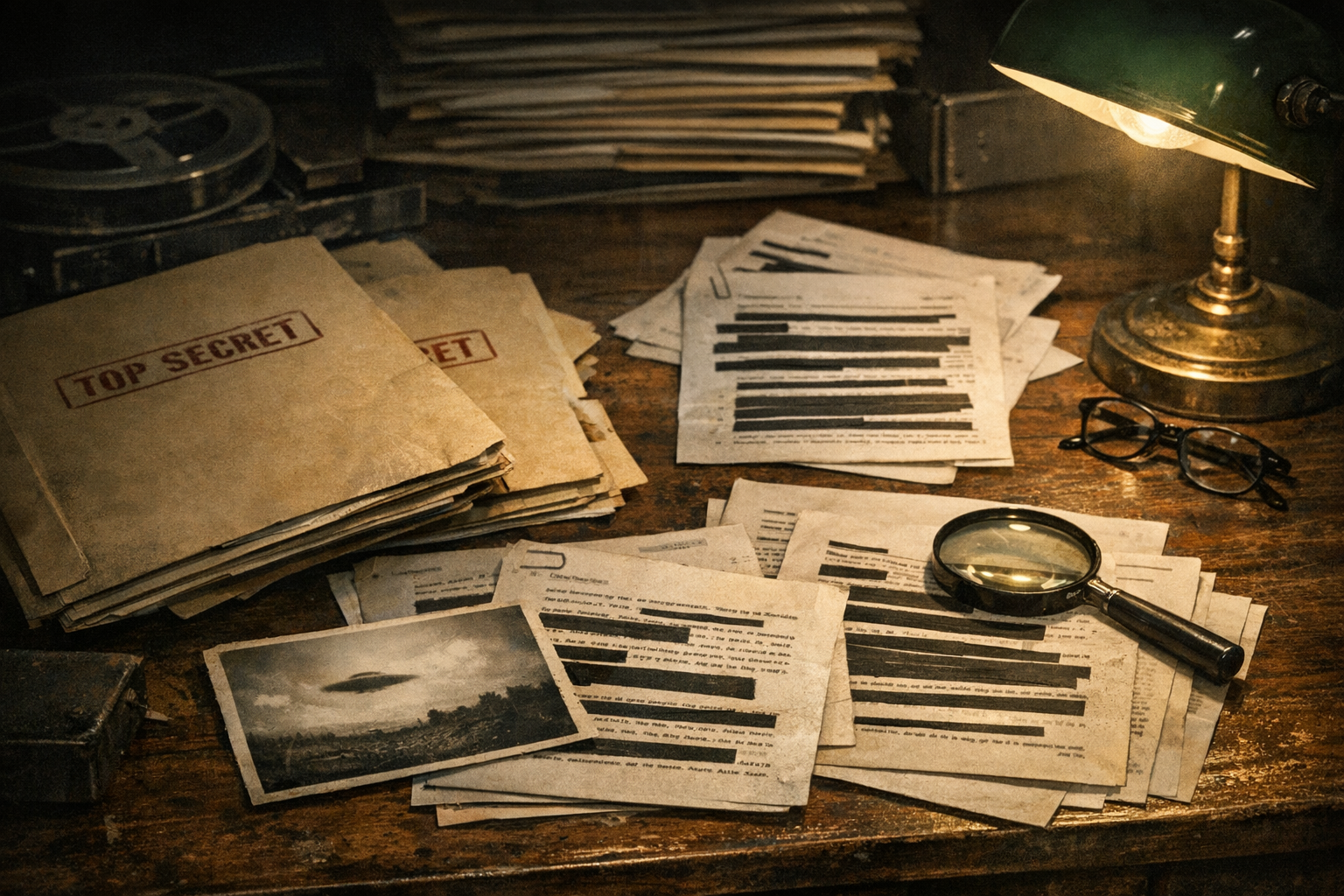
The folder always seems to arrive with the same aura. A few pages are blurred, a few names are blacked out, and somewhere in the middle is a sentence people swear was never meant to leave the room. Before anyone has time to prove where it came from, the internet is already treating it like a key slipped out of a locked vault.
UFO leaks explained means looking at what these files actually are, what people claim they prove, and why they almost never settle the case. Supporters usually see leaked papers, redacted memos, or anonymous document dumps as hidden confirmation that officials know more than they admit. The more likely reality is that leaks can be real, fake, partial, misread, or stripped of context — which is exactly why they keep the mystery alive instead of ending it.
What Happened
The modern UFO story is full of documents that seem to promise a final answer. Some look official because they use government language. Some feel convincing because they include redactions, dates, routing stamps, or references to classified programs. Others arrive through scans, screenshots, forum uploads, or unnamed intermediaries who say they are too close to the source to be identified.
This article’s angle is specific: it is not about one famous file. It is about the repeating pattern that makes leaked UFO material feel decisive long before anyone has verified it. The real story is that document dumps create the appearance of closure while usually delivering a new layer of uncertainty.
You can see that pattern across decades. A file appears. People rush to pull out the most explosive lines. Posts and videos reduce a complicated record to one screenshot. Then the slower questions arrive: Who first had it? Is it complete? Was it archived anywhere official? Is the language normal for the agency named on the page? Did later pages change the meaning of the first one?
That is the mini-scene hidden inside almost every UFO leak cycle. Someone is zooming in on a blurred scan at two in the morning, tracing a signature block like it is a fingerprint. Another person is posting a caption that says the truth is finally out. Meanwhile, the boring questions — provenance, chain of custody, missing pages, source history — are still sitting untouched on the table.
The reason this matters is simple. In the UFO world, documents feel stronger than testimony. Witnesses can be challenged. Memories can be doubted. But a page with bureaucratic formatting seems concrete. It feels like a piece of the machine speaking by accident.
That instinct is not irrational. Real governments do create hidden records. Real programs do exist behind classification walls. Real disclosures sometimes start with imperfect leaks. But once people jump from “this looks official” to “this proves the theory,” they often cross a gap that the evidence itself cannot carry.
That is why cases like MJ-12 Documents: Leaked UFO Files or One of the Most Persistent Hoaxes? keep resurfacing. The file becomes famous not only because of what it says, but because it teaches readers how powerful official-looking paper can be even when the verification fight never really ends.
Why People Believe It
People believe leaked UFO files because documents feel like backstage access. A sighting can be dismissed as confusion. A rumor can be dismissed as gossip. But a memo, briefing note, or archived report seems like something the public was never supposed to see. That alone creates tension and trust at the same time.
There is also a psychological shortcut at work. Most people do not spend their lives reading real government records, so when a page includes formal language, section numbers, and blacked-out lines, it looks authentic by default. The visual style does some of the persuasive work before the content is even tested.
Redactions are especially powerful. They suggest danger, sensitivity, and hidden depth. In practice, a redacted page can mean many things: genuine classified material, routine withholding, incomplete release, or a carefully edited excerpt that hides the parts needed for interpretation. Supporters often treat the black bars themselves as evidence. Usually, they are only evidence that someone wanted something concealed, not evidence of what the concealed material would prove.
Another reason belief spreads is that leaks seem to bypass the institutions people do not trust. If readers already think agencies minimize, delay, or blur the truth, then an unauthorized file feels more honest than an official statement. That is one reason Project Blue Book: Secret UFO Investigation or the Case That Taught America to Distrust Official Answers? still matters inside this cluster. It helped build the expectation that the public version and the private version may never fully match.
Leaked files also flatter the reader. They create the feeling that you are not just consuming news. You are decoding it. You are seeing around the edges of the official story. That is emotionally satisfying, especially in a topic where mystery is part of the attraction.
And then there is the rhythm of modern online culture. A document dump hits social media, gets clipped into threads, and turns into instant certainty before anyone has done archival verification. By the time the slower review begins, the public story has hardened. If later analysis shows the file was partial, altered, or misread, the correction never travels as far as the original thrill.
Claims vs Evidence
Claim: leaked UFO files prove the government has hidden knowledge about nonhuman craft, secret retrievals, or long-running cover-ups.
What the evidence sometimes supports: officials have tracked unexplained aerial incidents, produced internal reports, used classification systems, and kept some discussions out of public view. It also supports the broader idea that document trails exist around military, intelligence, and research activity related to unidentified incidents.
What it usually does not support on its own: that a specific leaked file is authentic, complete, correctly interpreted, and strong enough to prove the biggest claims attached to it.
The first test is provenance. Where did the file come from? Not where it was posted, but where it came from before that. A document without a clean origin story may still be genuine, but it starts life with a built-in weakness. If no one can establish when it was created, who handled it, and how it reached the public, the file remains suspended between possibility and proof.
The second test is completeness. Partial files are dangerous because they invite confident storytelling. One page can look explosive until a missing attachment, annex, or cover letter changes the meaning. A sentence about “retrieval” might refer to debris, equipment, rumor reporting, or something else entirely. Without the full set, interpretation becomes a game of projection.
The third test is language. Bureaucracies have habits. Real agencies tend to write in recognizable ways, use known formatting patterns, and place extraordinary claims inside ordinary administrative structure. Forged or embellished documents often fail here. They sound too cinematic, too tidy, or too eager to say exactly what believers want them to say.
The fourth test is corroboration. A leaked file gets much stronger if it matches independent records, known timelines, or multiple sources that did not coordinate. It gets weaker if it stands alone, appears late, or only makes sense when paired with assumption-heavy interpretation. That is part of what makes AARO UAP Report: Clear Answers or a Review That Left the Biggest Claims Open? relevant here. Official reviews often confirm that unexplained reports exist while refusing to confirm the more dramatic reading supporters attach to older documents.
The fifth test is inflation. This is where ordinary ambiguity turns into extraordinary certainty. A file may show that a government office took an unusual report seriously. Online retellings then turn that into “they admitted it was alien.” A mention of compartmented access becomes “they confirmed a reverse-engineering program.” A reference to unknown origin becomes “they said nonhuman.” The public story grows faster than the document can bear.
This is why the topic overlaps with Government UFO Programs: Why the Files Never Really Closed. Real records can reveal that a bureaucracy paid attention. They do not automatically settle what the bureaucracy actually found.
Reality Check
The reality check is not that all leaks are fake. That would be too easy, and it would ignore how secrecy really works. Some leaked records are authentic. Some partial releases later turn out to connect to real archival material. Some document dumps expose genuine confusion, real investigation, or a deeper layer of institutional concern than officials first admitted publicly.
But the stronger reality is that hidden files rarely end the mystery because they almost never arrive with the one thing needed most: complete, public, verifiable context. Instead, they arrive as fragments. And fragments are ideal fuel for theories because they let different readers build different endings.
That is the contradiction at the center of the leak culture. People treat documents as the cure for uncertainty, but the most famous UFO leaks often survive precisely because they preserve uncertainty. A fully verified file with a clear explanation would close discussion. A blurry, contested, half-explained file can stay alive for decades.
There is also a difference between leaked-looking material, official declassification, and rumor bundles that get dressed up as archives. Those categories are often collapsed into one dramatic narrative. They should not be. A formally released government record has a different evidentiary weight than an anonymous scan. A long thread of collected rumors has a different weight again. Once those distinctions disappear, the debate becomes impossible to sort cleanly.
That helps explain why even strong-seeming episodes keep circling back instead of landing. A new dump appears. It revives old claims. Someone connects it to hearings, black projects, or disclosure politics. Then readers discover that key pages are missing, the source trail is muddy, or the headline claim depends on a sentence stretched well beyond its plain meaning. The file does not die. It just changes form.
What we do know is narrower but still important. Governments keep records. Some records stay hidden for long periods. Public trust drops when institutions appear selective, evasive, or slow to release context. That environment makes leaked UFO material feel more plausible than it might in a higher-trust system. It also means real ambiguity gets amplified into sweeping certainty faster than the evidence deserves.
So the logical standard should stay strict. If a file lacks provenance, treat it as unresolved. If it lacks context, treat it as incomplete. If it confirms investigation, do not pretend it confirms conclusion. And if it says exactly what believers most hoped to read, that is the moment to slow down, not speed up.
Conclusion
UFO leaks and document dumps keep their power because they look like the threshold of revelation. They promise a glimpse behind the wall, a chance to read what was meant for insiders instead of the public. In a subject built on secrecy, that promise is hard to resist.
But that is exactly why they need careful handling. A hidden file can be meaningful without being decisive. It can be authentic without being complete. It can expose a real layer of government attention without proving the most extraordinary version of the story.
So if the search question is whether leaked UFO documents are real or fake, the honest answer is: sometimes real, sometimes not, and often impossible to settle quickly from the leak alone. If the deeper question is why hidden files rarely end the mystery, the answer is even clearer. They arrive looking like answers, but they usually function more like mirrors — reflecting what people already suspect, fear, or hope is true.
🔎 If this story stayed with you, the author suggests these real cases next:
- MJ-12 Documents: Leaked UFO Files or One of the Most Persistent Hoaxes?
- Project Blue Book: Secret UFO Investigation or the Case That Taught America to Distrust Official Answers?
- AARO UAP Report: Clear Answers or a Review That Left the Biggest Claims Open?
Explore more Alien & UFO Theories stories here: