
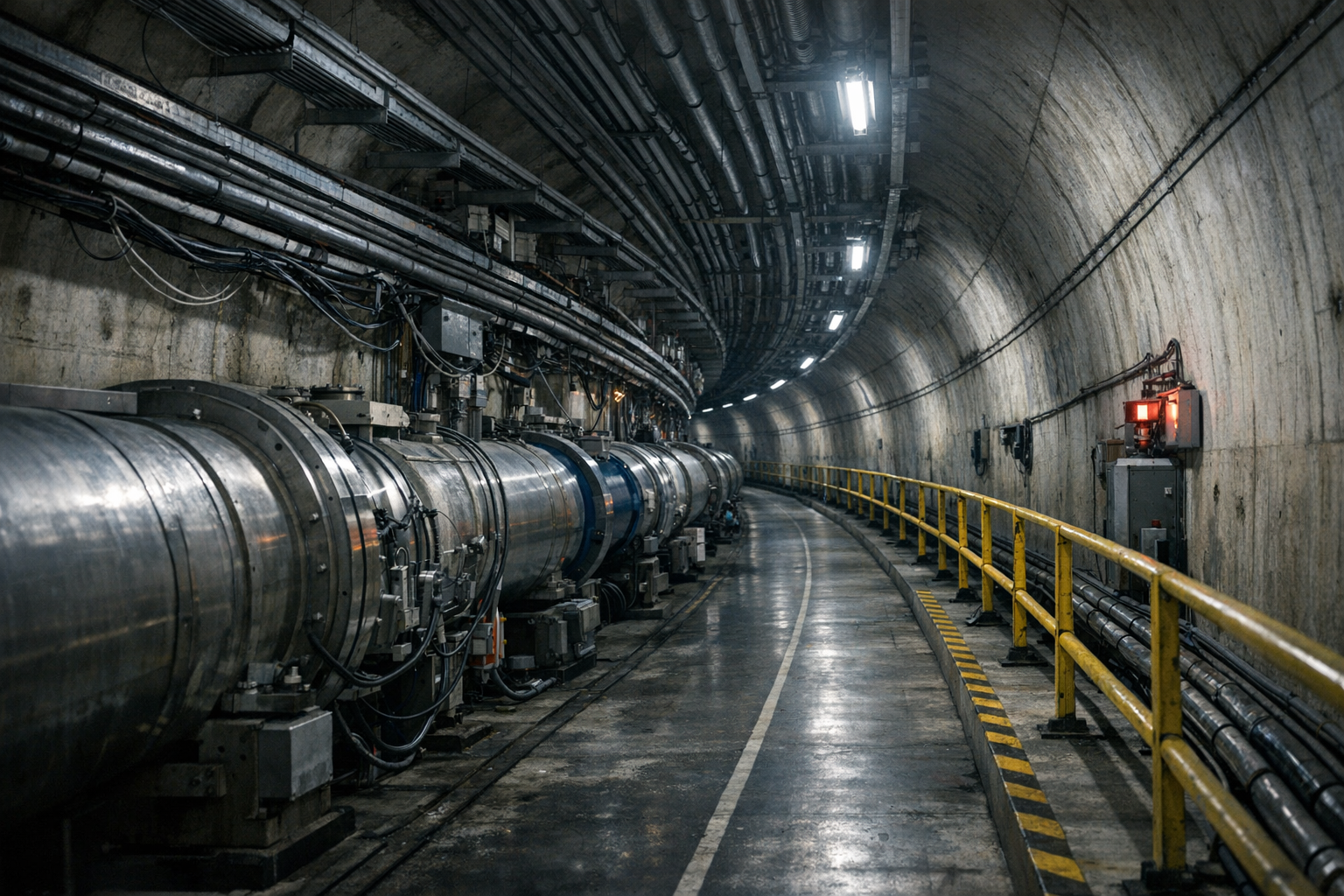
The tunnel sits deep under the French-Swiss border, sealed behind layers of access control, concrete, and steel. Inside, one of the most powerful machines ever built sends particles racing through the dark at nearly the speed of light—and for years, that image has fueled a forbidden-sounding question: did CERN portal theory begin because people misunderstood the science, or because the setting looked exactly like the kind of place where a door to somewhere else might open?
That tension is what made the rumor stick. A giant machine hidden underground, scientists speaking in technical language most people do not understand, and viral clips that seemed to hint at strange rituals and dangerous experiments gave the internet all the material it needed. What followed was not just a conspiracy theory. It became a modern myth built from real science, real secrecy, and a lot of online imagination.
What Happened
CERN, the European Organization for Nuclear Research, operates the Large Hadron Collider, or LHC, near Geneva. The collider is a massive ring-shaped machine designed to smash particles together at extreme energies so scientists can study the smallest known parts of matter. In 2012, work at the LHC helped confirm the existence of the Higgs boson, one of the most important discoveries in modern physics.
For scientists, that was the headline. For parts of the internet, the machine inspired a very different story. Posts, videos, and message-board threads claimed CERN might open portals to other dimensions, create black holes, tear holes in reality, or even trigger the end of the world. Some of those fears grew louder before major collider runs, when dramatic headlines spread faster than careful explanations.
A few moments helped push the myth along. One was a strange-looking mock ceremony tied to a Shiva statue outside CERN. Another was an old safety debate over whether the collider could create microscopic black holes. There were also clips online showing people joking about alternate dimensions, glitches in reality, or the so-called Mandela Effect. Piece by piece, the machine stopped looking like a research tool and started looking, to some viewers, like the center of a hidden experiment.
It is easy to see why the visuals mattered. Picture someone scrolling late at night, seeing a giant underground tunnel, hearing the words “particle collision,” and then watching a video claiming scientists may have “opened something.” That is not how physics works, but it is how modern folklore spreads.
Why People Believe It
The first reason is simple: CERN looks secretive, even when it is not trying to. It is a high-security scientific campus handling dangerous equipment, complex experiments, and restricted lab access. To scientists, that is normal. To outsiders, it can feel like hidden knowledge is being kept behind locked doors.
The second reason is that advanced physics is hard to explain in plain English. When people do not understand what a machine is doing, they often fill the gap with guesses. The same thing has happened with UFO programs, classified aircraft, and intelligence agencies. Real complexity creates room for unrealistic stories.
The third reason is that the internet rewards dramatic interpretations. “Scientists are studying particle interactions” is accurate but dull. “Scientists may have opened a gateway to another dimension” is irresistible clickbait. Once a striking claim appears in a video title or social post, it gets repeated by people who never check the source.
There is also a cultural layer. Modern conspiracy theories often grow where science-fiction imagery and distrust of institutions overlap. CERN became a perfect symbol for that mix. It was big, technical, international, and hard to explain. A similar pattern appears in stories about HAARP and weather control, where real technology becomes a magnet for far larger claims.
Finally, people believe the theory because some parts of the story contain a grain of truth. Scientists at CERN do study extreme conditions. Some theoretical physics discussions do include extra dimensions. There really was public concern about collider safety. But a grain of truth is not the same as evidence for a portal.
Claims vs Evidence
Claim: CERN could open a portal to another dimension.
Evidence: There is no confirmed evidence that the LHC has opened any portal, gateway, or tear in reality. The collider studies particle collisions under controlled conditions. In physics, “extra dimensions” usually refers to mathematical models, not a literal glowing doorway that people or objects can walk through.
Claim: The machine could create a black hole that swallows Earth.
Evidence: This fear was widely discussed before major LHC operations, but safety reviews concluded there was no credible threat. A key point is that Earth is constantly hit by cosmic rays with energies equal to or greater than those produced in particle collisions, and the planet is still here. If these kinds of interactions naturally happen in the universe without destroying Earth, that weakens the disaster scenario.
Claim: CERN’s ceremonies and symbolism prove occult or hidden intentions.
Evidence: Supporters of the theory often point to the Shiva statue and a viral “human sacrifice” clip. But the widely shared sacrifice video was a prank filmed by people on site, not proof of a secret ritual program. The statue itself was a cultural gift from India, not evidence of occult activity.
Claim: Strange events online, including “timeline changes,” are signs CERN damaged reality.
Evidence: These claims usually rely on anecdotes, memory errors, and internet pattern-making rather than testable proof. The same habit of linking unrelated details also fuels stories around the Mandela Effect, where strong shared memories can still be wrong.
Claim: Scientists are hiding the truth because the consequences would terrify the public.
Evidence: Large institutions can be bad at communication, and science agencies often speak in technical language that feels distant. But suspicion alone is not evidence. What we do know is that CERN publishes research, hosts public information, and has faced years of outside scrutiny. That is not how a clean cover-up usually looks.
Reality Check
The strongest part of the CERN portal story is not the evidence. It is the atmosphere. The theory feels believable because it borrows the mood of a great mystery: underground machines, restricted access, difficult science, strange symbols, and public imagination. But mood is not proof.
There is a deeper lesson here. People often assume that if something sounds too advanced to understand, it may also be too dangerous to trust. That instinct is human. It shows up whenever new technology arrives faster than public understanding can keep up.
At the same time, the public is not wrong to ask hard questions. Big institutions should explain what they are doing clearly. When they fail at that, conspiracy theories rush in to fill the silence. CERN did not create that pattern, but it fit it perfectly.
Still, the available facts point in a grounded direction. The collider is a machine for studying matter, energy, and the structure of the universe. It is not confirmed evidence of hidden gateways, trapped entities, or engineered reality glitches. The portal theory survives mostly because it turns complicated science into a story with villains, secrets, and cosmic stakes.
That story is emotionally satisfying. Reality is less cinematic, but more solid. CERN matters because it expands human knowledge, not because it has been shown to punch holes in existence. If anything, the internet did more to build the portal myth than the collider ever did.
Conclusion
The CERN portal theory says a giant underground machine may have opened something dangerous and hidden from the public. The evidence does not support that claim. What it does support is a simpler explanation: people saw a real, powerful, poorly understood scientific project and wrapped it in internet-era mythology.
That makes this story interesting for a reason that goes beyond CERN itself. It shows how conspiracy theories are often built. Start with a real place. Add restricted access, hard language, a few strange images, and a public already trained to distrust institutions. Then let the internet do the rest. By the time the myth hardens, the machine is no longer just a collider. It becomes a symbol for every fear people have about knowledge happening somewhere they cannot see.
So is CERN a portal machine? Based on the evidence available to the public, no. But it is a powerful example of how quickly science can turn into modern folklore when mystery outruns explanation.
🔎 If this story stayed with you, the author suggests these real cases next:
- Weather Manipulation and HAARP: Can Governments Really Control the Sky?
- Flat Earth Conspiracy: Why Some Still Believe the Earth Is Not Round
- 5G Health Concerns: The Theory That Turned Faster Internet Into a Global Fear
Explore more Science and Technology stories here: