
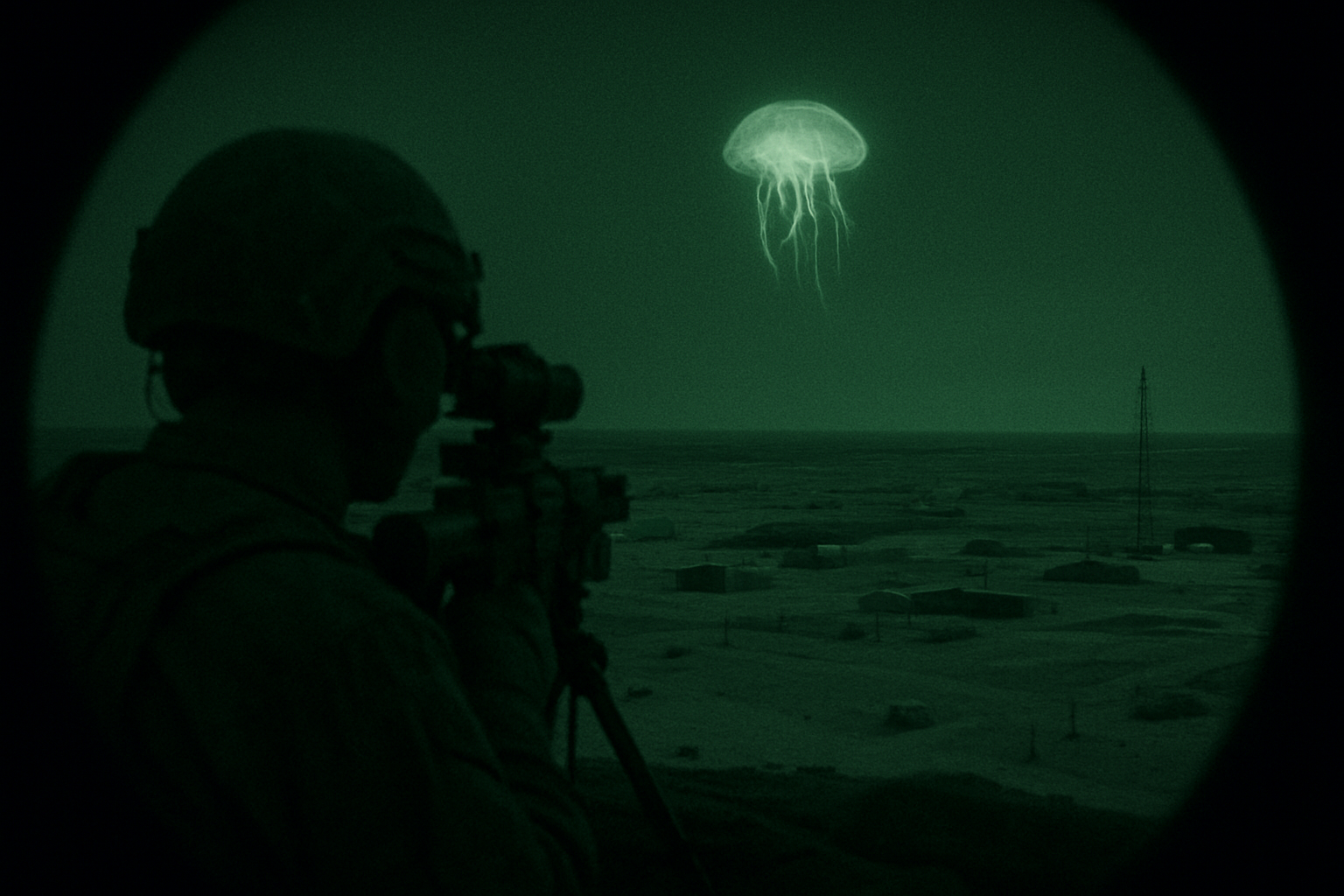
Long before anyone gave it the nickname, the clip already had the ingredients of a modern UFO legend: military-style footage, a strange dark shape, and just enough missing context to make people feel like they were watching something they were not supposed to understand. In the cold glow of infrared imagery, the object seems to drift across the screen like a living stain in the sky, and that single unsettling visual did most of the work before the facts ever caught up.
The jellyfish UFO video is a piece of military-style infrared footage that supporters say shows a truly unknown object moving over Iraq in a way that does not fit an ordinary explanation. The big claim is that the object looks too bizarre to be a balloon, drone, bird, or camera artifact. The more grounded reality is that the clip is intriguing precisely because it is ambiguous: without full sensor data, distance, speed, altitude, and chain-of-custody context, viewers can easily read certainty into footage that may still be far less clear than it first appears.
What Happened
The clip that became known online as the Jellyfish UFO spread widely after journalist Jeremy Corbell shared it and tied it to a 2018 military surveillance context in Iraq. On first watch, it is easy to see why people locked onto it. The object appears dark, oddly shaped, and hard to compare to anything familiar. It seems to float through the frame with hanging extensions beneath it, which is exactly the kind of silhouette that invites a name before it invites a careful analysis.
That naming matters more than it seems. Once people started calling it a jellyfish, they were no longer just watching a blurry target on an infrared feed. They were watching a creature-shaped mystery. A nickname can quietly turn uncertainty into a story, and stories travel faster than raw evidence.
Picture the scene from the viewer’s side. Someone clicks play on a grainy military-looking clip late at night. There is no full briefing packet. No public sensor report. No long chain of verified measurements. Just a shape sliding across a black-and-white image while the mind starts racing ahead of the data. Before the clip ends, many viewers have already decided whether it is proof of hidden technology, proof of a cover-up, or proof that officials are still keeping the public at arm’s length.
That pattern is familiar across modern UAP culture. A short clip appears, the atmosphere of secrecy fills in what the footage does not explain, and the lack of immediate clarity makes the material feel even more important. That is part of why the Jellyfish clip quickly got pulled into the same conversation as the Pentagon UFO Videos and later debate about official review bodies such as AARO.
But the crucial point is simple: the public did not receive a complete case file. It received a clip. And a clip, by itself, is a dangerous thing to overread.
Why People Believe It
The unique angle here is interpretation risk. The Jellyfish footage is not powerful because it proves too much. It is powerful because it leaves just enough room for almost any conclusion a viewer already wants to reach.
First, the object really does look strange. That may sound obvious, but it matters. People often believe extraordinary footage because the visual impression hits before the reasoning does. The shape seems to have a body and dangling parts. It does not look like the clean outline people expect from an aircraft. In a culture already primed by UFO hearings, leaked videos, and decades of hidden-program suspicion, weird-looking footage does not stay neutral for long.
Second, military-style imagery carries its own authority. Even when the public does not know exactly what sensor is being used, the look of infrared footage suggests seriousness. It feels technical. It feels official. That makes viewers more likely to assume the image itself is precise, even though infrared and zoomed surveillance footage can create confusing silhouettes, flatten depth, and hide ordinary details. People trust the machine before they understand its limits.
Third, the online environment pushes certainty faster than caution. A post saying “interesting but unresolved” rarely goes as far as a post claiming “this is non-human” or “they caught something impossible.” The internet rewards the strongest interpretation first. By the time a slower analyst asks basic questions about angle, parallax, sensor bloom, wind drift, or missing telemetry, the emotional verdict has often already been delivered.
There is also a deeper trust problem underneath all of this. Many people no longer treat official silence as neutral. They treat it as suggestive. If authorities do not explain a clip quickly, some viewers see that as evidence that the explanation must be explosive. That is one reason modern UAP stories link so easily with wider disclosure narratives, including the broader push-and-pull explored in UFO disclosure debates.
In other words, people believe the Jellyfish story not only because of what is visible in the frame, but because of everything already loaded into the public imagination before the frame even starts.
Claims vs Evidence
Claim: The object is too oddly shaped to be anything ordinary.
Evidence: Odd shape alone is not enough. Infrared footage can distort familiar objects in surprising ways, especially when resolution is limited and the viewer does not know the exact distance, angle, or sensor behavior. A cluster of balloons, an object with hanging material, a drone-like platform with attachments, debris, or even image effects can all look much stranger in thermal-style footage than they would in daylight.
Claim: The object moves in a way that proves it is not a balloon or simple drifting target.
Evidence: Public viewers do not have the full movement data needed to make that call confidently. A camera platform may be moving. The object may be nearer or farther than assumed. Wind behavior at altitude may differ from what people expect from ground level. Without full telemetry, what looks controlled, deliberate, or impossible in the frame may actually be an artifact of perspective.
Claim: Because the footage came from a military context, the object must have survived serious analysis and remained unexplained.
Evidence: Military origin does not automatically equal confirmed mystery. Governments collect huge amounts of imagery, much of it incomplete or routine. Some clips remain unresolved because the data is weak, not because the object is extraordinary. That same distinction appears in cases like the Tic Tac UFO incident, where unusual testimony and limited public evidence keep the debate alive without settling every claim.
Claim: The object’s nickname reflects what it really is: a structured, creature-like craft or entity.
Evidence: The nickname is part of the problem. Human beings are pattern-finding machines. When we see something vague, we compare it to something familiar. Once a label sticks, every later viewer inherits that suggestion. “Jellyfish” makes the shape feel more specific than the underlying data really is.
Claim: Since no clean ordinary explanation has won public agreement, the extraordinary explanation becomes stronger.
Evidence: That is not how evidence works. A weak ordinary explanation does not automatically prove a strong extraordinary one. Sometimes the real answer is simply that the clip is too limited to support a confident conclusion either way.
Reality Check
The most useful way to read the Jellyfish UFO video is not to ask, “What do I want this to be?” but “How much does this clip actually allow me to know?” Once you ask that question, the case becomes less cinematic and more disciplined.
There are at least three live possibilities. One is that the object was ordinary but visually distorted by infrared imaging, distance, compression, or platform movement. Another is that it was man-made but unfamiliar to the public, which would make it secretive without making it alien. A third possibility is that it remains genuinely unresolved because the released material is too thin to settle the question. What matters is that these are not equal claims. Some require much less evidence than others.
This is the misunderstood detail many viewers miss: ambiguous footage becomes most convincing when it looks technical but arrives stripped of the technical context needed to test it. That gap creates a certainty machine. People project confidence into the empty space where the missing data should be.
The contradiction is hard to ignore. The modern UAP era is supposed to be more evidence-rich than the old rumor era. There are more cameras, more leaks, more hearings, and more public conversation. Yet that abundance often produces less clarity, not more. Why? Because fragments travel better than full case files. A striking image is shareable. A careful chain of sensor limitations is not.
That is also why this clip fits so neatly beside newer online mysteries like the drone swarm conspiracy. In both cases, the public encounters visual material that feels loaded with meaning before the evidence is mature enough to carry that weight. Mystery arrives first. Interpretation hardens second. Verification limps in later.
None of this means the Jellyfish clip is worthless. It means the opposite. It is valuable because it shows how modern conspiracy thinking forms around ambiguous evidence in real time. The footage may or may not capture something unusual. But the public reaction definitely captures something real: a deep hunger to force a conclusion from fragments, especially when those fragments look like they came from behind a curtain.
So is the Jellyfish UFO real? In the narrow sense, yes, there is a real clip and a real object or image event behind it. But if the question means “does this footage prove a non-human craft or something beyond ordinary explanation,” the answer is no. At least not from the public evidence available so far.
Conclusion
The Jellyfish UFO video became famous because it sits right at the pressure point of the modern UFO era. It looks strange, appears connected to military observation, and arrives with just enough secrecy to make viewers feel that an important answer is being withheld.
But that is exactly why caution matters here. The strongest lesson of this clip is not that it proves aliens, hidden craft, or a breakthrough in disclosure. The strongest lesson is that ambiguous military-style footage can become a certainty machine online long before the underlying data is established.
What we honestly know is limited. The footage is visually unusual. The public context is incomplete. The interpretations are running far ahead of the evidence. Until better data appears, the most rational conclusion is also the least dramatic one: the Jellyfish clip is interesting, unresolved, and highly vulnerable to overreading.
🔎 If this story stayed with you, the author suggests these real cases next:
- Pentagon UFO Videos: What the Navy Footage Confirmed — and What It Didn’t
- Tic Tac UFO Incident: Best Military Evidence or a Story Bigger Than the Data?
- AARO UAP Report: Clear Answers or a Review That Left the Biggest Claims Open?
Explore more Alien & UFO Theories stories here: