
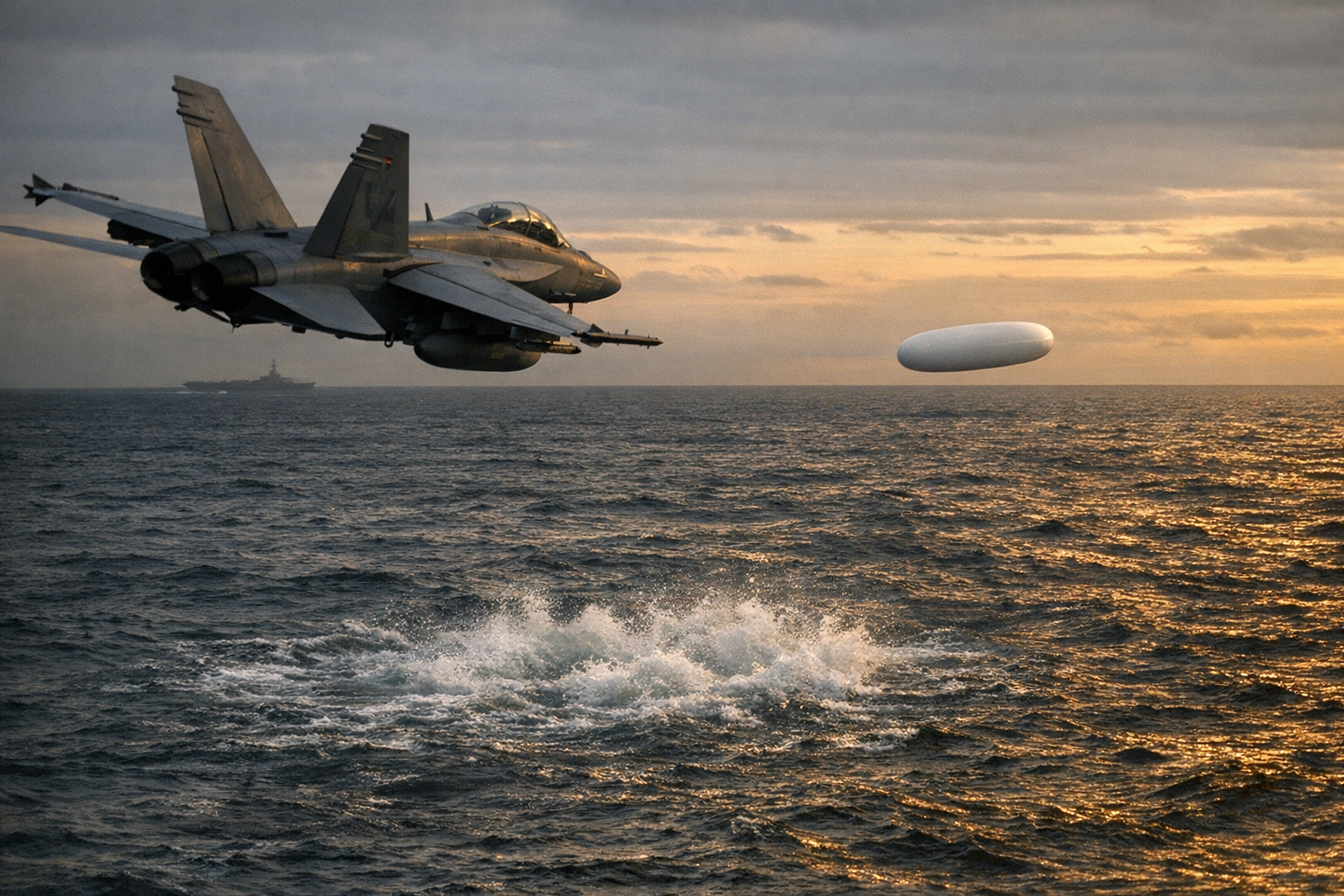
The pilots were sent toward a patch of ocean that looked wrong before anyone ever said the word UFO. Below them, the water was churning like something huge had just slipped under the surface, and above it hung a white object with no wings, no rotors, and no clear way to explain what it was.
The Tic Tac UFO incident usually refers to a 2004 U.S. Navy encounter near the USS Nimitz strike group off Southern California. Supporters see it as the strongest modern military UFO case because it combines pilot testimony, radar tracking, and infrared video. The more grounded reality is narrower: the event is serious and still debated, but the public evidence is incomplete, which is exactly why the story keeps growing.
What Happened
The angle here matters: this is not just another UFO sighting story. This case became famous because many people now treat it as the best modern military evidence, so the real question is whether the public record actually earns that status.
On November 14, 2004, aircraft from the USS Nimitz carrier strike group were operating in training areas off the coast of Southern California. According to later accounts, the guided missile cruiser USS Princeton had been tracking unusual radar returns for days. Operators said some objects appeared at very high altitude, dropped rapidly, and then behaved in ways that did not fit an easy training-range explanation.
Commander David Fravor and Lieutenant Commander Alex Dietrich were among the pilots directed to investigate. When they arrived, the story took on the kind of detail that sticks in people’s minds for years. The sea below looked disturbed, as if something large were just under the surface. Above that patch of water, witnesses described a smooth white object, roughly Tic Tac shaped, moving sharply and unpredictably.
One of the reasons this case became legendary is that it has a human moment at its center. Fravor has described circling downward toward the object while it seemed to react to him. For a few seconds, the encounter stops sounding like a rumor and starts feeling like a scene: fighter jets banking over empty water, radio chatter tightening, trained observers staring at something that does not match the normal picture.
The object was later gone. Another crew, including weapon systems officer Chad Underwood, captured infrared footage now widely known as FLIR1. That clip became part of the small set of Navy videos that pushed modern UFO discussion into the mainstream. It also connects naturally to the Pentagon UFO videos, because the Tic Tac case is one of the most important reasons those clips still matter.
From there, the incident left the training range and entered public culture. It became a key reference point in later debates about secrecy, military reporting, and the larger disclosure era discussed in UFO Disclosure: Hearings, Whistleblowers, and the Proof Gap. But by then, the event was no longer just a case file. It had become a symbol.
Why People Believe It
Believers do not treat the Tic Tac case as strong because of one spooky quote. They treat it as strong because several kinds of authority seem to point in the same direction. There were trained military witnesses. There were radar operators. There was video. And unlike older cases that live mostly in memory, this one arrived during a period when the Pentagon eventually confirmed related footage was authentic military material.
That combination matters. Most UFO stories rely heavily on either testimony or imagery, but not both in a way that feels institutional. The Tic Tac incident appears to offer a chain: sensors noticed something unusual, pilots were sent to intercept, one crew reported an extraordinary visual encounter, and another later captured footage. To many readers, that sounds less like folklore and more like a case study.
The story also grew because it fits a deeper modern fear: that the most important facts are always just beyond public reach. If advanced radar saw more than the public can see, if military witnesses know more than the public has heard, and if some of the data remains classified or unavailable, then the missing pieces begin to feel almost more persuasive than the visible ones. That psychology is one reason the case keeps feeding larger arguments about hidden programs, official review, and whether the evidence gap is accidental or managed.
There is also a status effect. When people call the Tic Tac case the gold standard, that label starts doing work of its own. New audiences arrive assuming the evidence must already be overwhelming, because otherwise why would this case have that reputation? The phrase comes first, then the review of the actual material comes later, if it comes at all.
Claims vs Evidence
The strongest claim is simple: the Tic Tac object performed in ways no known human craft could match. Supporters often point to reported sudden acceleration, lack of visible propulsion, unusual maneuvering, and the fact that experienced aviators found it deeply abnormal. If those performance claims were fully documented with synchronized sensor data, they would be extremely important.
What is verified is more limited. We have public witness testimony from military personnel, a widely discussed infrared clip, and the broader fact that the U.S. military has treated some unidentified encounters as worth serious review. We also know the case has remained central enough to modern UAP debate that it keeps reappearing in news coverage, hearings, and public discussion.
But the public dataset has real gaps. The famous FLIR1 video is not the whole encounter, and it is not a complete proof package by itself. Radar data discussed in interviews has not been publicly released in the form many independent analysts would want. The timeline between the original visual contact and the later video evidence is often blurred in casual retellings. And many dramatic performance claims are carried through witness descriptions rather than through a complete public release of sensor records.
That does not mean the witnesses are lying. It means the case most people talk about is partly a fusion of several evidence layers: memory, military credibility, partial instrumentation, later reporting, and a public hunger for one clean modern answer. Once those layers merge, the story can sound more unified than the surviving public evidence really is.
This is where the case starts to resemble broader patterns seen in UFO evidence in America. A serious incident occurs. Some facts are strong enough to keep the mystery alive. Other facts are missing, disputed, or inaccessible. The result is not closure but a durable loop of argument.
Reality Check
If the question is whether something unexplained happened, the safest answer is yes. Multiple military witnesses have consistently said the encounter was unusual, and nothing in the public record has reduced it to a clean, universally accepted misidentification. That is enough to keep the case important.
If the question is whether the public evidence proves extraordinary technology, the answer is no, not yet. The best public version of the Tic Tac story still depends on combining testimony with incomplete supporting data. That can justify curiosity. It cannot, by itself, settle the biggest conclusions people want to draw.
This is the contradiction that makes the case so powerful. It is probably too substantial to dismiss with a shrug, but it is also too incomplete to carry the full weight believers place on it. In other words, the Tic Tac incident may be one of the strongest modern military UFO stories and still be a story where the legend is bigger than the released evidence.
That distinction matters because it protects the case from two bad habits at once. One bad habit is automatic debunking, where every anomaly must secretly have a boring answer. The other is evidence inflation, where every unresolved detail becomes proof of something revolutionary. The Tic Tac case sits in the uncomfortable middle. It is significant precisely because it resists both shortcuts.
It also helps explain why military pattern stories keep returning, including reports of UFOs over nuclear bases. People pay attention when the witnesses are trained, the setting is sensitive, and the response systems are real. But seriousness is not the same thing as final proof. That line is where the whole debate lives.
Conclusion
The Tic Tac UFO incident became the gold-standard modern case because it offers exactly what most UFO stories lack: credible witnesses, a military setting, and enough technical context to feel bigger than rumor. But the same case also shows how quickly a powerful story can outgrow the evidence the public can actually inspect.
So was it the best military evidence or a story bigger than the data? Right now, it is both. It remains one of the most important modern UAP incidents because it deserves serious attention. It also remains unresolved because the strongest version of the case still lives partly in missing records, remembered details, and the space between what happened and what the public can prove.
If this story stayed with you, these related cases are worth reading next:
- Pentagon UFO Videos: What the Navy Footage Confirmed and What It Didn’t
- Government UFO Programs: Why the Files Never Really Closed
- UFOs Over Nuclear Bases: Security Threat or the Pattern That Won’t Go Away?
Explore more Alien & UFO Theories stories here: