
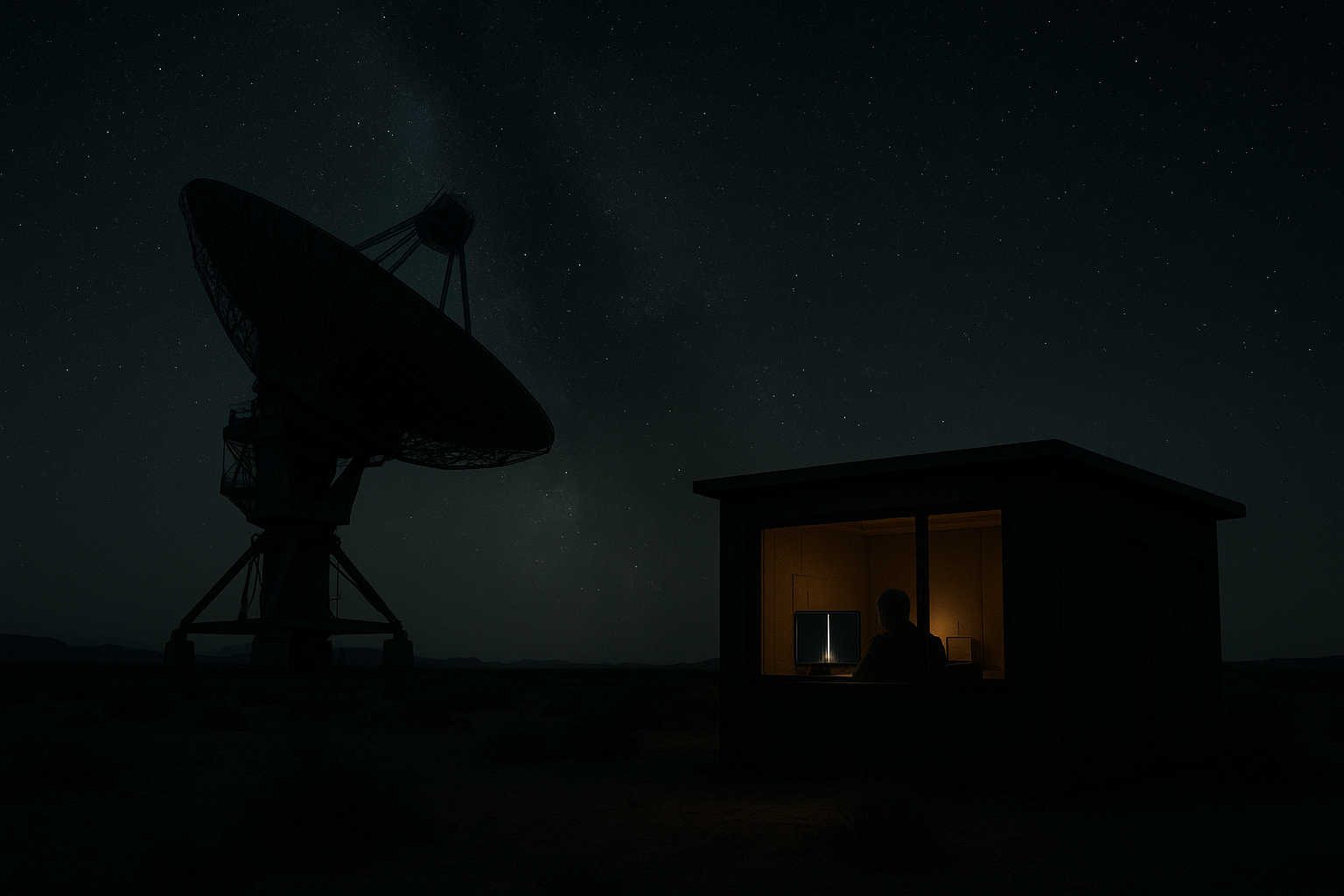
A machine listening to the sky catches a burst that should not be there, a scientist circles the printout, and for a moment the oldest question in the cosmos feels uncomfortably close. That is why stories about alien signals from space keep surviving. They do not need a flying saucer or a body on a table. They only need one pattern that looks just a little too precise to dismiss.
Alien signals from space usually refers to unusual radio detections such as the Wow! signal or fast radio bursts that people wonder might be artificial. Supporters claim some of these signals could be evidence of intelligence beyond Earth or proof that scientists are overlooking something extraordinary. The likelier reality is narrower but still fascinating: a few detections were genuinely unusual, some remain imperfectly explained, but no confirmed public evidence shows they were alien messages.
What Happened
The most famous case in this corner of UFO culture is still the Wow! signal from 1977. Ohio State University’s Big Ear radio telescope recorded a strong narrowband signal that stood out enough for astronomer Jerry Ehman to circle the computer printout and write “Wow!” in the margin. That moment did not prove contact. What it did prove was that one real observation looked unusual enough to survive for decades as a scientific puzzle and a conspiracy magnet at the same time.
The reason the case lasted is simple. The signal appeared to fit the sort of pattern SETI researchers cared about, came from a plausible part of the sky, lasted long enough to seem meaningful, and then never cleanly returned. If the event had repeated under controlled conditions, the history of the subject might look very different. Instead, the story hardened around absence. The signal was interesting enough to remember, but not stable enough to settle.
Later discoveries kept the category alive. Fast radio bursts, or FRBs, are real astronomical events: brief, powerful radio flashes arriving from deep space, sometimes repeating, sometimes appearing as one-off detections. To the public, that sounds like the Wow! signal upgraded for the modern age. Better instruments, stranger data, deeper sky. But better instruments also brought better natural explanations. In several cases, astronomers linked repeating FRBs to magnetars and other extreme astrophysical sources rather than intelligent transmitters.
That is where this topic fits into the site’s UFO cluster. It is not primarily about visual encounters like UFO Sightings: What People Are Really Seeing in the Sky. It belongs more naturally in the part of the archive where people ask whether evidence might arrive as data instead of craft, and whether institutions would recognize that evidence honestly if it did. The strongest cluster fit is not generic mystery content. It is the overlap between unexplained signals, disclosure-era trust issues, and the public habit of treating uncertainty like a hidden admission.
So the real history here is more disciplined than the myth. Scientists detected unusual signals. Some were never fully repeated in the same form. New radio mysteries appeared later. Natural explanations improved. The central question remained alive not because astronomy proved alien contact, but because it occasionally produced anomalies dramatic enough to make people imagine contact as the missing answer.
Why People Believe It
People believe in alien-signal stories because radio evidence feels cleaner than eyewitness testimony. A sighting in the sky can be dismissed as a mistake, a hoax, or a trick of distance. A signal sounds clinical. It comes from an instrument, not an excited witness. That gives the idea a different kind of authority, even before anyone proves what caused the event.
There is also a strong emotional pull in one-time anomalies. A signal that appears once, looks meaningful, and vanishes seems almost designed to haunt people. It creates the exact gap conspiracy culture feeds on: just enough evidence to feel serious, not enough to become boring. That is part of why the Wow! signal never disappeared from public imagination. The mystery sits in a narrow band between evidence and story, and that is where these theories breathe best.
Belief grows even faster when the signal story is woven into broader distrust. Once readers have moved through pages like Government UFO Programs: Why the Files Never Really Closed or AARO UAP Report: Clear Answers or a Review That Left the Biggest Claims Open?, they are primed to ask a second question: if institutions can be selective or incomplete about strange aerial cases, why would the public assume total openness about possible extraterrestrial evidence from astronomy? That suspicion may go too far, but it is easy to understand.
Then there is the imagination problem. Signals feel like the perfect form first contact would take. No invasion, no spectacle, no Hollywood landing. Just a pulse hidden in the noise. Popular culture trained people to expect intelligence to arrive as a pattern in data long before they expected it to step onto a lawn. So when a real anomaly hits the news, the cultural script is already waiting.
Another reason belief persists is that this topic links naturally to questions of motive. Once someone accepts that a strange signal might be artificial, they start asking what message, warning, or mission could sit behind it. That is where this page brushes against stories like Alien Agenda Theory: Why Do So Many Stories Assume a Hidden Mission?. The leap from “unusual transmission” to “intentional communication” is emotionally smooth, even when the evidentiary jump is huge.
Claims vs Evidence
Claim: The Wow! signal was too narrow, too strong, and too well-positioned to be natural. Evidence: It was unusual enough to trigger lasting scientific interest, which is why people still talk about it. But unusual is not the same as artificial. Because the signal was never independently repeated or verified in a way that allowed deeper testing, the evidence stopped at anomaly rather than moving into confirmation.
Claim: Fast radio bursts are basically modern alien beacons. Evidence: FRBs are real and, at first glance, do sound like the kind of event people imagine as communication. But the longer astronomers studied them, the stronger natural models became. Repeating bursts do not automatically imply intention. In several cases they fit extreme astrophysical environments better than a hidden sender.
Claim: Scientists refuse to call these signals alien because the truth would be destabilizing. Evidence: There is no solid public evidence for a coordinated suppression effort in radio astronomy. In fact, anomalous detections are scientifically valuable precisely because they attract scrutiny. If a signal showed repeatable artificial structure, the pressure to investigate would be global and intense. Suspicion survives mostly because no final answer exists, not because a confirmed answer was clearly buried.
Claim: If a signal remains unexplained, that is basically evidence of intelligence. Evidence: This is the most common mistake in the whole subject. “Unexplained” only tells us that current data or models did not produce a confident answer. It does not tell us what the answer must be. That same discipline matters across the wider UFO cluster too, including disclosure stories such as Alien Disclosure Timeline 2026: New Phase or the Same Story in New Packaging?, where unresolved questions often get inflated into stronger conclusions than the record can support.
Claim: Several mysterious signals together create a pattern of extraterrestrial contact. Evidence: Grouping different anomalies together can make the story feel stronger than it is. The Wow! signal, FRBs, and other odd detections do not come from one source, one era, or one type of evidence. Some are one-off curiosities. Some are active research topics with improving natural explanations. Treating them as one continuous message stream oversells what the evidence actually shows.
The strongest evidence here supports a narrower conclusion. Space really does produce radio events that can surprise experts. Some detections remain puzzling for long stretches. A few became famous because they looked oddly suggestive. But there is still no confirmed public case where scientists demonstrated that a radio signal from space carried verified extraterrestrial intelligence.
Reality Check
The most grounded way to read this topic is to separate scientific mystery from conspiracy momentum. Scientific mystery is real. Telescopes do sometimes capture signals or bursts that are hard to explain immediately, and astronomy is full of edge cases where understanding arrives slowly. Conspiracy momentum begins when people treat that lag as evidence that an extraordinary answer is already known and merely being withheld.
That distinction keeps this article on the right scale. The goal is not to turn this into an oversized history of SETI, every radio observatory, or every exotic astrophysical theory. The goal is to answer the actual search intent clearly. If someone asks whether strange radio bursts suggest intelligence, the honest answer is no confirmed case has crossed that line yet. If they ask why people keep thinking the answer might still be yes, the answer is that a few anomalies looked just provocative enough to keep the door open.
There is also a subtler reality check. The better science gets, the less many anomalies look like hidden messages. That does not kill wonder. It just changes its shape. A magnetar powerful enough to produce bizarre radio behavior is not less interesting because it is natural. It is simply interesting for a different reason. Conspiracy culture often treats natural explanation as disappointment. Real inquiry should treat it as progress.
At the same time, total dismissal would be too easy. The universe is huge, and the possibility of future artificial detection remains real in principle. But possibility is not evidence. That is the line worth protecting. Curiosity belongs here. Certainty does not.
Conclusion
Alien-signal stories survive because they sit in the perfect pressure zone between evidence and imagination. The Wow! signal was real. Fast radio bursts are real. Some detections were strange enough to make scientists look twice and ordinary readers suspect much more. That part of the mystery is legitimate.
But when the claims are separated from the facts, the picture stays narrower. We have unusual signals, incomplete explanations, and a long human habit of turning open questions into intentional messages. We do not have confirmed proof that a radio burst from deep space was an alien hello.
So if someone asks whether strange radio bursts really suggest intelligence, the clean answer is this: they suggest that the universe still produces surprises, and a few of those surprises have looked interesting enough to keep the extraterrestrial question alive. For now, though, the mystery is real and the message is not confirmed.
🔎 If this story stayed with you, the author suggests these real cases next:
- AARO UAP Report: Clear Answers or a Review That Left the Biggest Claims Open?
- Government UFO Programs: Why the Files Never Really Closed
- Alien Disclosure Timeline 2026: New Phase or the Same Story in New Packaging?
Explore more Alien & UFO Theories stories here: