
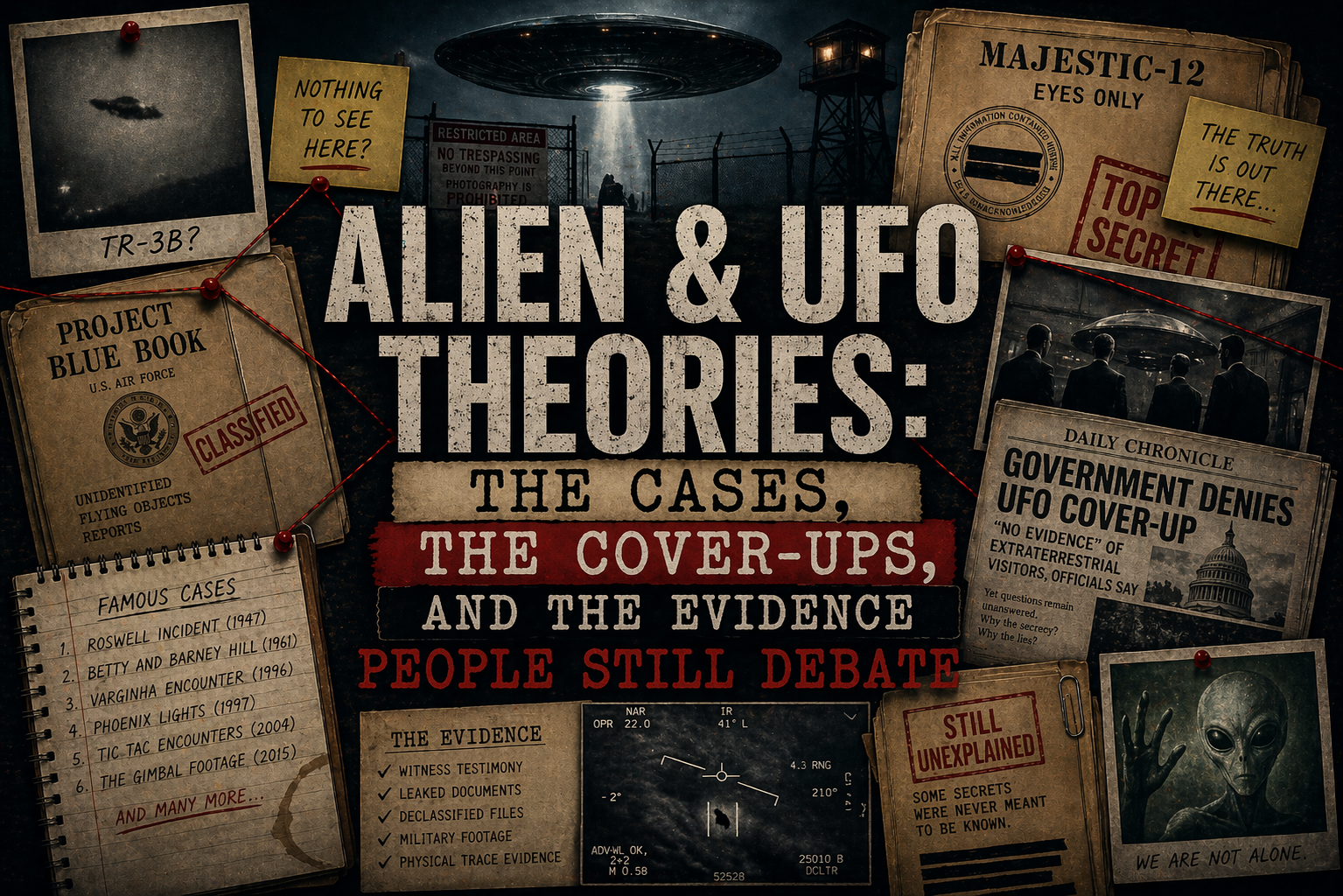
The UFO file was never one clean mystery. It was a stack of strange sightings, military footage, crash rumors, black-budget speculation, whistleblower claims, and official statements that always seemed to stop one sentence short of a final answer.
Alien and UFO theories are not built around one perfect case. They are built around a pattern: people see something unusual, institutions investigate or classify parts of it, and the public is left trying to decide whether the missing pieces point to ordinary confusion or hidden knowledge. The reality is mixed: some famous claims collapse under evidence, some remain unresolved, and government interest in unidentified objects is real even when proof of aliens is not.
What Happened
The modern UFO story grew from several different kinds of evidence being pulled into the same public mystery. There are crash legends, like Roswell, where secrecy and changing explanations helped turn a local incident into a national symbol. There are military encounters, like Pentagon UFO videos, where pilots, sensors, and official releases created a harder question than a normal hoax story.
There are also institutional cases. Government interest in unusual aerial reports is not imaginary; programs, reviews, hearings, and record releases have shown that officials have studied unexplained sightings for decades. That is why broad explainers like Government UFO Programs, UFO Evidence in America, and UFO Disclosure: Hearings, Whistleblowers, and the Proof Gap matter inside this category.
But the category is bigger than government paperwork. Personal accounts such as the Travis Walton UFO incident and broader alien abduction stories add a human layer. Base rumors like Area 51 alien rumors, intimidation folklore like Men in Black stories, and signal mysteries like alien signals from space expand the subject from sightings into a whole culture of secrecy.
Why People Believe It
People believe UFO cover-up claims because the official record is messy enough to leave room for suspicion. Governments have misled the public before. Military agencies do classify real programs. Pilots and radar operators are not random internet commenters. When credible witnesses describe objects moving strangely, the easy answer does not always satisfy readers.
The strongest emotional fuel is the gap between acknowledgment and explanation. Officials may say an object was unidentified, but that does not mean it was alien. Still, to many readers, the phrase ?unidentified? sounds like a door left open. When the public sees edited footage, redacted documents, vague hearing answers, and cautious language, it becomes easy to suspect that someone knows more than they are saying.
There is also a pattern problem. One case can be dismissed as a mistake. Hundreds of cases, across decades, feel different. A single sighting might be a balloon, drone, aircraft, sensor error, or misread light. But when sightings, leaks, whistleblower allegations, and declassified studies stack together, the mystery starts to feel less like one claim and more like an archive.
Claims vs Evidence
Claim: UFO evidence proves aliens are visiting Earth. Evidence: Public evidence does not prove that. It shows that some sightings were hard to identify, that official agencies have investigated the subject, and that some witnesses gave serious accounts. That is not the same as confirmed extraterrestrial craft.
Claim: The government has hidden crashed alien technology. Evidence: This is one of the most persistent claims, especially around Roswell, reverse-engineering stories, and modern whistleblower allegations. Articles like Alien Technology Reverse Engineering help separate the idea of secret aerospace development from the much stronger claim that recovered non-human craft have been proven in public.
Claim: Military videos are the smoking gun. Evidence: Some footage is genuinely interesting because trained observers, sensor systems, and official release history make it harder to wave away. But video alone rarely gives enough data to prove origin, speed, distance, or intent. A strange object on military footage can be important without being conclusive.
Claim: Whistleblowers changed everything. Evidence: Whistleblower testimony can matter, especially when it pushes institutions to answer questions in public. But testimony still needs documents, physical evidence, named programs, and verifiable chains of custody. Without that, the claim may be worth investigating while still falling short of proof.
Claim: Every debunked UFO case weakens the whole subject. Evidence: Not exactly. Many cases do fall apart, and that matters. But the category survives because it contains different evidence types: witness memory, photos, videos, military reports, historic files, cultural myths, and official ambiguity. Weak cases should be discarded without pretending the entire archive becomes meaningless.
Reality Check
The clearest reality is that UFOs are real as a category of reported unidentified objects. That does not mean aliens are confirmed. It means people, including trained observers, sometimes report things they cannot immediately explain, and some of those reports become serious enough for institutions to review.
The second reality is that secrecy makes the subject harder to close. Classified aviation, military testing, intelligence collection, and national security caution can all create silence without requiring an alien explanation. Sometimes the hidden thing may be a sensor capability, a military platform, or a foreign object rather than a spacecraft from another world.
The third reality is that the public proof gap remains. The UFO category contains real questions, but it also contains exaggeration, folklore, misidentified objects, recycled rumors, and claims that outrun the evidence. That is why the best way to read this subject is not ?believe everything? or ?mock everything.? It is to sort cases by what can actually be verified.
That sorting is the purpose of this hub. Crash stories, disclosure hearings, reverse-engineering claims, witness accounts, NASA rumors, radar cases, and abduction narratives do not all deserve the same weight. Some are mostly cultural mythology. Some are unresolved but thin. Some are serious enough to keep investigating. The useful question is not ?are UFOs real?? but ?what exactly has been shown, and what is still only claimed??
Conclusion
Alien and UFO theories keep returning because they sit at the intersection of secrecy, wonder, mistrust, and incomplete evidence. The government has studied unusual aerial reports. Some witnesses are credible. Some videos and files deserve attention. But the public record still does not prove alien visitors, recovered spacecraft, or a confirmed hidden disclosure program.
The strongest version of the UFO mystery is not the loudest one. It is the careful one: many famous claims are weaker than believers think, but the archive is too persistent to dismiss as nothing. That tension is why the subject keeps rebuilding itself, and why the best UFO coverage has to separate documented facts from the stories people build around the gaps.
?? If this story stayed with you, the author suggests these real cases next:
- UFO Evidence in America: The Cases, the Gaps, and Why the Mystery Keeps Rebuilding Itself
- UFO Disclosure: Hearings, Whistleblowers, and the Proof Gap
- Alien Technology Reverse Engineering: Secret Breakthroughs or Stories Built on Fragments?
Explore more Alien & UFO Theories stories here: