
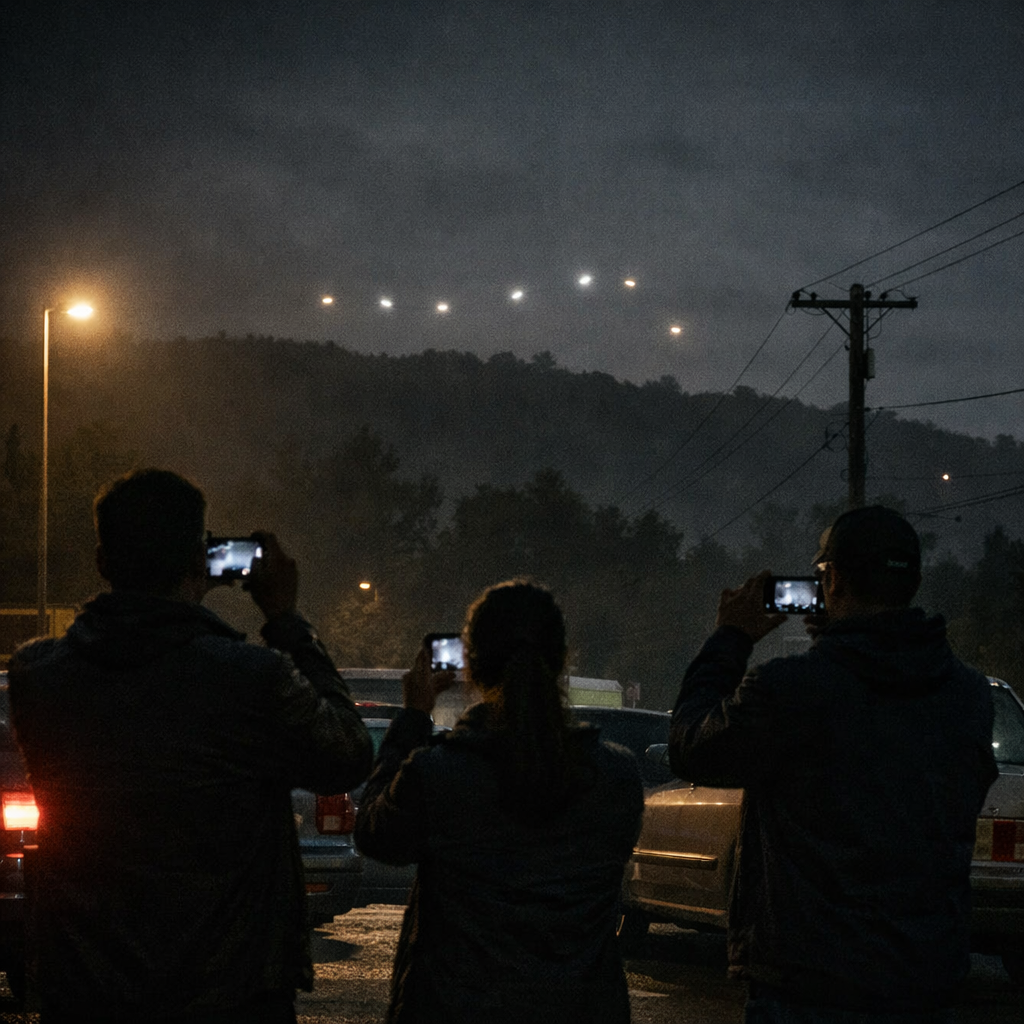
The videos always start the same way: a dark sky, a shaking phone, and a voice that sounds half excited and half afraid. A few lights move where they should not, someone says the area has been restricted, and within minutes the internet is treating the scene like a leak from a hidden world.
The drone swarm conspiracy is the idea that clusters of strange lights in the sky are not just hobby drones or ordinary aircraft, but signs of secret testing, hidden surveillance, or even UFO activity. Supporters point to confusing flight patterns, official silence, and clips that seem too strange to be normal. The more grounded explanation is that modern drone incidents sit in a messy space where consumer devices, military secrecy, bad visibility, and viral misidentification can all look far more mysterious than they really are.
What Happened
In the last few years, reports of “mystery drones” and moving lights have spread fast whenever a local sighting catches national attention. A cluster appears over a town, near open land, or close to a sensitive site. People film it from different angles. The lights seem to hover, split apart, or move in patterns that feel wrong. Before long, the story leaves the neighborhood and becomes a wider question: what exactly is flying up there?
That is where the modern angle matters. Older UFO scares usually centered on one witness, one case file, or one famous event. Drone-swarm stories are different. They happen in a world where almost everyone has a camera, almost no one has the full picture, and social media rewards the most dramatic interpretation first. By the time investigators, local police, or aviation officials make any statement, the mystery already feels larger than the evidence.
Imagine standing in a cold parking lot after sunset, watching five or six lights drift over a ridge line. One appears to stop. Another blinks in a way that looks deliberate. Someone next to you says a nearby road was closed earlier in the day. Another person says this has to be military. A third says the lights are too quiet to be planes. In that moment, uncertainty does not feel like uncertainty. It feels like a hidden answer is being kept from you.
That is why these incidents often slide into the same conversation as broader UFO evidence debates in America, even when the objects may be completely man-made. The emotional pattern is familiar: something is seen, officials seem vague, and people fill the gap with the theory that best matches their fears.
Why People Believe It
Modern drone incidents blur the line between UAP fear, secret military tech suspicion, and viral misidentification. That blur is not accidental. It comes from the fact that all three ideas are plausible enough to stay alive for a while.
First, consumer drones really do exist in huge numbers now. That means it is easier than ever for ordinary people to encounter unusual lights that are low, quiet, and able to hover. A person who has never seen a drone at night may honestly believe they just witnessed something far stranger.
Second, the public already knows governments test aircraft and other systems without explaining every detail in real time. That is not a conspiracy theory. It is a normal feature of defense and intelligence work. Because of that, when people see objects near bases, restricted areas, or infrastructure, suspicion quickly jumps toward black-project thinking. That connects naturally to the site’s own piece on government black projects, where secrecy is real, but the public often stretches that secrecy into bigger claims than the evidence supports.
Third, UFO culture has trained people to treat unexplained aerial behavior as possible proof of something non-human. The problem is that “unexplained” is not a final category. It is just a temporary label. A light can be unexplained because the witness had a bad angle, because the video lacks reference points, because multiple devices were in the air at once, or because no agency released enough information to settle the question.
There is also a strong trust problem. If officials say too little, people assume a cover-up. If they say too much, people assume the explanation was scripted. In that atmosphere, the theory that survives is often the one that feels emotionally complete, not the one best supported by evidence.
Claims vs Evidence
Claim: A swarm of strange lights must be UFOs because the movement does not match normal aircraft.
Evidence: Night sightings are famously hard to judge. Distance, speed, size, and sound become unreliable once the sky is dark and the viewer has no stable reference point. Small drones can look distant. Aircraft can look stationary when flying toward an observer. Multiple ordinary objects seen from one angle can appear coordinated when they are not.
Claim: If authorities cannot explain the sighting immediately, the objects must be advanced secret technology or something non-human.
Evidence: A delay in explanation is not proof of an extraordinary cause. Officials may not have enough data, may be waiting on radar review, may be protecting unrelated operations, or may simply not see the event as urgent enough to address quickly. Silence creates suspicion, but silence is not the same thing as confirmation.
Claim: The lights moved in formation, so they had to be controlled as a group.
Evidence: Sometimes that may be true. Coordinated drones exist. But “formation” is also one of the easiest impressions to create by accident in low-light footage. Similar blinking intervals, perspective compression, and partial video clips can make separate objects look connected. What seems like one organized swarm may actually be a mix of drones, planes, helicopters, or bright stars sitting behind the main action.
Claim: Mystery drone incidents prove that UFO panic is really about hidden technology the government will not admit to.
Evidence: This is where the theory becomes more interesting but also more slippery. Secret testing is possible in some cases. Governments do test systems, and some flight activity is intentionally obscure. But jumping from “some secrecy exists” to “this incident proves a secret program” still requires evidence: records, confirmed tracking, recovered hardware, or credible on-the-record testimony. Without that, the theory stays in the zone between suspicion and proof.
That same gap appears in many military-UAP debates, including cases like the Tic Tac UFO incident, where the public has enough unusual material to stay fascinated, but not enough verified data to settle every claim people want to make from it.
Reality Check
The cleanest way to understand the drone swarm conspiracy is to separate three buckets that often get mixed together.
Bucket one: ordinary but misread. These are sightings explained by hobby drones, commercial drones, aircraft, helicopters, stars, planets, or camera distortion. They feel mysterious because night observation is weak and online retelling makes the details sharper than they were in real life.
Bucket two: man-made but not public. This includes possible law-enforcement activity, defense testing, contractor flights, or restricted operations. These cases can stay unresolved longer because the people with the answer may have no reason to share it quickly. That does not make them alien. It makes them secretive.
Bucket three: genuinely unresolved. Some incidents remain open because the footage is limited, the witnesses disagree, and the available data never adds up to a confident conclusion. This is the smallest and most frustrating category, because it invites every theory at once. But even here, unresolved is not a shortcut to extraterrestrial.
This is the contradiction at the heart of modern drone scares: the more technology fills the sky, the easier it becomes for mystery to grow, not shrink. Cheap drones, advanced sensors, restricted zones, and instant video sharing should make identification easier. Instead, they often produce more noise. People see fragments, not the whole event. Then the internet stitches those fragments into a story.
That is why this topic matters beyond one viral clip. It shows how conspiracy thinking forms in real time. A sighting becomes a thread. The thread becomes a claim. The claim absorbs older fears about UFO secrecy, state surveillance, and hidden defense programs. Once that happens, the question is no longer just “what were those lights?” It becomes “what are they hiding from us?”
Sometimes that bigger question is worth asking. Real secrecy has a long history of feeding public distrust. But if every unclear light is treated like proof of a hidden program, the result is not better investigation. It is a permanent panic loop where uncertainty itself becomes the evidence.
Conclusion
The drone swarm conspiracy is compelling because it sits exactly where modern anxiety lives: between visible technology and invisible authority. People are not just reacting to lights in the sky. They are reacting to the feeling that important systems operate above them, around them, and beyond explanation.
What we do know is simple. Some mystery drone stories are probably ordinary misidentifications. Some may involve real but undisclosed human technology. And a few may remain unresolved because the evidence is too thin to close the case. What they do not automatically become is proof of UFOs, proof of a massive cover-up, or proof that every strange light belongs to one hidden plan.
The smartest conclusion is also the least dramatic one: modern drone incidents are a perfect machine for manufacturing uncertainty. They blur just enough lines to keep every theory alive. But until stronger evidence appears, unexplained lights are still just that — unexplained lights.
🔎 If this story stayed with you, the author suggests these real cases next:
- Tic Tac UFO Incident: Best Military Evidence or a Story Bigger Than the Data?
- AARO UAP Report: Clear Answers or a Review That Left the Biggest Claims Open?
- Alien Disclosure Timeline: Are We Seeing Revelation or Repackaged Secrecy?
Explore more Alien & UFO Theories stories here: