
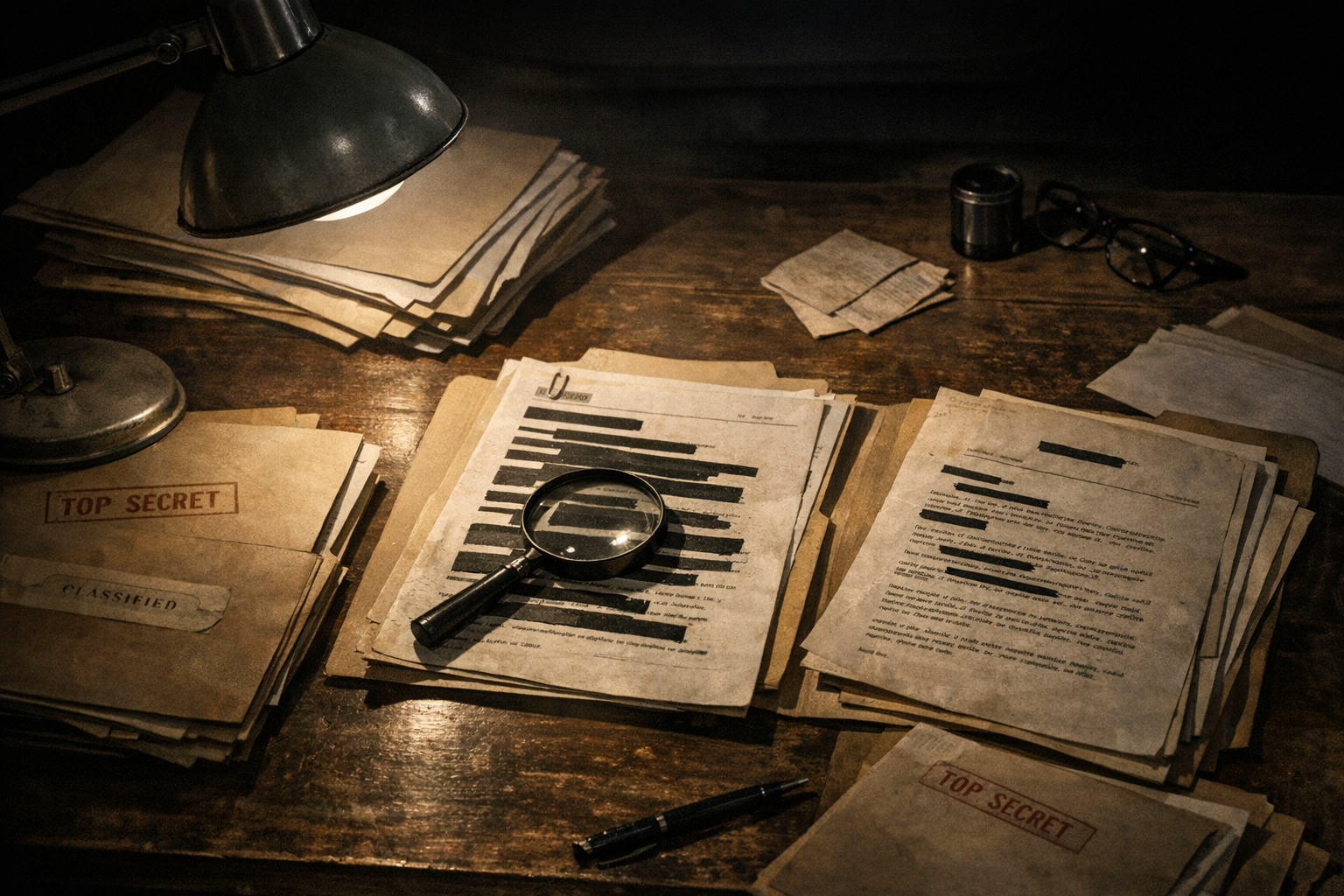
The papers looked like the kind of thing the public was never supposed to see: typewritten lines, official-sounding names, and a chain of secrecy that seemed to lead straight into America’s deepest UFO lore. That is why the MJ-12 documents have held people for decades. They appeared to offer something conspiracy culture rarely gets — a paper trail that seemed to confirm the hidden story in black and white.
The MJ-12 documents are a set of disputed papers that claim a secret group called Majestic 12 was created to manage UFO crash evidence and extraterrestrial knowledge after Roswell. Believers treat them as leaked proof that the government hid the truth about recovered craft. The more grounded reality is that the documents became famous because they looked official and landed in an already suspicious UFO culture, but their origin, formatting, and chain of custody remain deeply disputed.
What Happened
This article’s angle is simple and specific: not whether UFO secrecy exists in the abstract, but whether the MJ-12 papers themselves deserve to be treated as real evidence. The story matters because these documents did not just add to UFO folklore. They changed how many people thought proof might look.
The basic claim is dramatic. In the 1980s, documents surfaced that appeared to describe a highly secret committee called Majestic 12, or MJ-12. According to the papers, this group included top military, intelligence, and scientific figures who were supposedly brought together to handle the aftermath of crashed flying saucers, recovered materials, and the national security problem created by alien contact.
To someone encountering them for the first time, the effect is powerful. You are not looking at a blurry light in the sky or listening to a secondhand witness years after the fact. You are staring at pages that seem bureaucratic, controlled, and official. In UFO culture, that feels like a different level of evidence.
The timing helped too. Roswell had already become a cultural force. Suspicion around military secrecy had deep roots. And readers already understood that governments really do keep major programs hidden for long periods. So when documents appeared to confirm a hidden UFO management structure, they landed in fertile ground.
There is also a human moment at the center of the story. Imagine opening an envelope, sliding out copied pages, and reading names you recognize from national security history under a title that sounds too perfect to be fake. For a believer, that kind of moment does not feel like theory. It feels like a locked room opening just a few inches.
That is also why MJ-12 connects so naturally to stories like Roswell UFO Crash: What the Original Witnesses Claimed and What the Records Actually Show. Roswell provided the legendary event. MJ-12 seemed to provide the paperwork that could explain how the event was contained.
Over time, the papers became one of the most persistent artifacts in UFO history. Even people who do not fully trust them still reference them because they sit at the crossroads of several big themes: Roswell, classified recovery claims, hidden programs, and the idea that the real story survives not in speeches but in internal files.
Why People Believe It
People believe in the MJ-12 papers for a reason that is both simple and powerful: documents feel harder to dismiss than stories. A witness can forget. A rumor can spread. But a memo, briefing paper, or executive-style summary seems concrete, especially when it uses the language of official secrecy.
Another reason is that the documents solve a structural problem inside UFO belief. Many conspiracy claims depend on missing evidence. The story says the proof exists, but the proof is hidden. MJ-12 appears to close that gap. It gives believers something they can point to and say, “There. That is the hidden record.”
The names matter too. The papers refer to serious institutional power: presidents, military officials, scientists, intelligence-linked circles. Even before anyone proves authenticity, that level of detail creates a feeling of realism. The reader starts thinking not just about aliens, but about who would handle the secret if the secret were real.
There is also a pattern-recognition effect. Once readers already believe there may have been a concealed crash or long-running retrieval effort, the papers seem to fit the missing piece. They do not enter a neutral landscape. They enter a story world already shaped by Roswell, black projects, and later ideas explored in pieces like UFO Crash Retrieval Claims: Hidden Recovery Program or Testimony Without Proof?.
And then there is the deeper psychological pull: restricted information feels more valuable. A stamped page, a formal tone, a reference to briefing authority — all of it triggers the feeling that the public has wandered near something real. Even people who stay cautious can feel that pull. The documents seem to offer access to the backstage area of the UFO story.
That helps explain why MJ-12 still matters even after years of dispute. The papers became more than a yes-or-no authenticity debate. They became a model for how hidden knowledge is imagined. In the UFO world, they are not just documents. They are a template for secrecy.
Claims vs Evidence
Claim: The MJ-12 documents are leaked government records proving that a secret committee managed recovered UFO evidence and controlled knowledge of extraterrestrial contact.
What supports that claim: the papers exist, they look intentionally official, they reference real historical figures, and they fit neatly into long-running suspicions about Roswell-era secrecy. Their tone is not casual. It is administrative, which makes them feel like the kind of paperwork a secret program would actually produce.
What weakens that claim: the core problem is provenance. Where exactly did the documents come from, who handled them first, and how can their path be verified? That chain-of-custody issue matters because extraordinary records do not become trustworthy just because they are dramatic. If the source history is unstable, the document cannot carry the burden people want to place on it.
There are also questions about form and detail. Critics have pointed to formatting issues, dating questions, and whether some elements look more like a crafted retro-document than a naturally preserved classified record. That does not automatically prove forgery, but it does mean the papers cannot simply be accepted at face value.
A misunderstood detail here is the difference between “contains real names” and “is therefore authentic.” A skilled forgery often becomes persuasive by mixing true context with uncertain claims. If someone knows enough history to use plausible officials, agencies, and Cold War timing, the result can feel convincing without being genuine.
Another contradiction sits at the center of the MJ-12 story. The papers are often presented as the breakthrough proof of hidden UFO management. Yet if they were truly that decisive, they likely would have resolved the debate rather than extending it for decades. Instead, they became a permanent argument object — cited by believers, attacked by skeptics, and never fully stabilized as accepted evidence.
That is why the documents fit into a broader pattern visible in Government UFO Programs: Why the Files Never Really Closed. Real government attention to unusual aerial cases gives disputed artifacts like MJ-12 a stronger atmosphere. But atmosphere is not authentication. A real history of secrecy can make a false or uncertain document feel more credible than it really is.
So the evidence picture stays narrow. The documents are culturally important. They are central to the mythology of UFO secrecy. But “important to the story” is not the same thing as “verified as true.” That distinction is the whole case.
Reality Check
The cleanest reality check is this: the MJ-12 papers matter because they seem to answer a question people badly want answered. If Roswell happened the way believers think it did, who took control? Who wrote the briefings? Who kept the files sealed? MJ-12 offers a tidy answer. That is exactly why people hold onto it.
But the reality likely sits in a harder place. There is no broad expert agreement that the papers are authentic government records. Their disputed origin is not a small technical flaw. It is the central problem. When a document’s path into public view is murky, every other detail becomes harder to trust.
That does not mean the documents are meaningless. In fact, they are useful for understanding how conspiracy belief works. They show how a persuasive artifact can shape a field for decades even when authenticity remains unresolved. Once a document feels like forbidden proof, it can keep generating belief long after the first excitement fades.
They also show the danger of documentary gravity. A paper with official styling can pull the conversation toward certainty faster than the evidence allows. Readers start from the emotional conclusion — this looks real — and only later work backward into the problems. By then, the feeling of discovery is already doing half the argument.
What we do know is more limited. Governments classify information. They hide sensitive programs. They sometimes keep major facts from the public for years. Those realities make the idea of a secret UFO file system plausible in the abstract. What they do not do is authenticate the MJ-12 papers by themselves.
The best question is not “Could such a committee have existed?” Maybe. The better question is “What independent evidence confirms that these specific papers are genuine?” That question keeps the burden where it belongs: on verification, not on mood, design, or wishful fit.
In plain terms, the MJ-12 documents may be the most famous UFO paperwork ever circulated. They are also a reminder that a document can become legendary long before it becomes reliable.
Conclusion
The MJ-12 papers have survived because they sit exactly where UFO belief is strongest: between secrecy that we know is real and proof that remains just out of reach. They look like the kind of files many people always imagined must exist somewhere behind locked doors. That alone gave them enormous staying power.
But their lasting cultural power should not be confused with settled authenticity. The unique angle here is the documents themselves, and on that point the answer stays cautious. They are compelling, influential, and central to UFO history — yet still burdened by disputed provenance and unresolved credibility.
That may be the clearest lesson MJ-12 offers. In conspiracy culture, uncertain documents do not just support belief. They can build entire belief systems around themselves. The papers still matter, not because they proved the case once and for all, but because they showed how the promise of hidden paperwork can keep a mystery alive for generations.
🔎 If this story stayed with you, the author suggests these real cases next:
- Roswell UFO Crash: What the Original Witnesses Claimed and What the Records Actually Show
- UFO Crash Retrieval Claims: Hidden Recovery Program or Testimony Without Proof?
- Government UFO Programs: Why the Files Never Really Closed
Explore more Alien & UFO Theories stories here: