
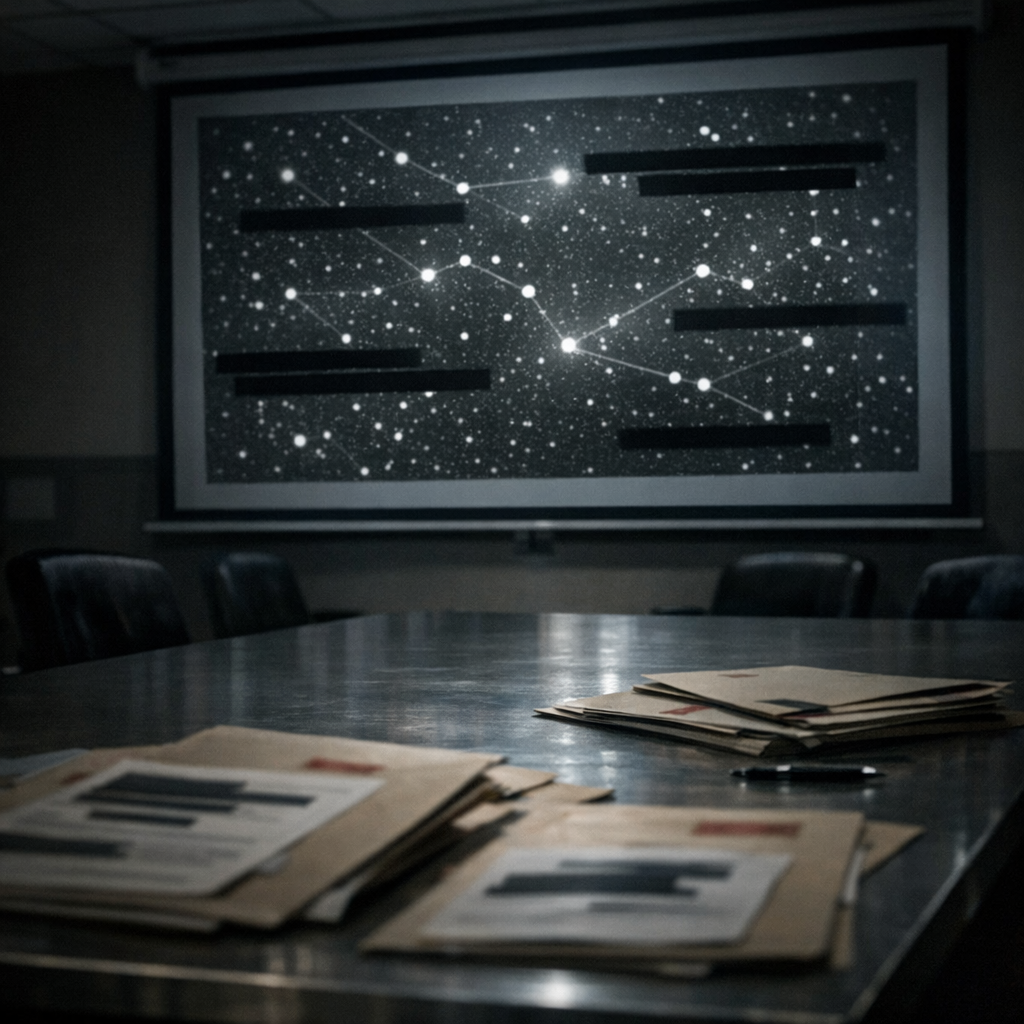
The phrase sounded like something pulled from a classified binder under fluorescent light — polished, official, and just secret enough to feel dangerous. Once the name Immaculate Constellation entered the UFO conversation, it did what powerful names often do: it made an unproven idea feel like hidden knowledge waiting behind a locked door.
Immaculate Constellation is an alleged secret UAP program name that circulated in the modern UFO disclosure debate. Supporters treat it as possible evidence of a hidden effort to collect or manage information about unexplained craft. What reality likely shows, at least in public, is something narrower: a striking label attached to claims that still have not been backed by released documents, direct public records, or independently testable proof.
What Happened
The modern UFO debate changed after 2017, when military videos, official statements, and congressional hearings pushed the subject out of the fringe and into mainstream political conversation. Since then, readers have been trained to listen for one thing above all else: the name of a program. A real-sounding title suggests budgets, offices, chains of command, and paperwork. It makes a story feel less like folklore and more like infrastructure.
That is where Immaculate Constellation entered the picture. The name began circulating as part of claims that some hidden government structure may be handling sensitive UAP information behind the scenes. For people already following stories about government UFO programs, the phrase landed with immediate force. It sounded specific. It sounded polished. And most importantly, it sounded like the kind of thing the public was never supposed to hear.
Imagine the scene for a moment. A viewer is up late, half-listening to an interview or hearing clip. Someone serious, maybe a former insider or a lawmaker, mentions a named program instead of speaking in vague terms. The room in your mind changes instantly. You stop picturing internet rumors and start picturing folders, SCIFs, briefing slides, and officials speaking in careful fragments. That emotional jump matters because it changes how people judge the claim before any evidence is even examined.
But the public problem starts there too. A dramatic program name is not the same thing as a released memorandum, a budget line, a chain of custody, or a document set that can be checked by outside researchers. In the public record, the claim has drawn attention mainly because of how official it sounds and how neatly it fits the larger disclosure-era story that something important is being hidden in plain sight.
That is why this topic overlaps with posts like David Grusch UFO Claims: What Was Alleged, What Was Verified? without becoming the same article. Grusch pushed public attention toward testimony and alleged hidden programs. Immaculate Constellation pushes attention toward something even more psychologically powerful: a specific name that seems to give the hidden-program idea concrete shape.
Why People Believe It
People do not respond to names neutrally. A label can carry authority all by itself. When a theory includes a phrase that sounds like it came from internal bureaucracy, many readers instinctively assume there must be a structure behind it. That is not irrational. Real government projects often do have memorable or strange names. The problem is that the brain starts treating the presence of a name as if it were a piece of evidence, when really it may be only the beginning of a claim.
Belief also grows because the disclosure era created a new baseline of plausibility. Twenty years ago, many people would have dismissed a hidden-UAP-program story almost instantly. Now there are official hearings, public testimony, admitted UAP tracking, and a long trail of public debate. Posts like Alien Disclosure Timeline: Are We Seeing Revelation or Repackaged Secrecy? help explain why readers now approach these claims with less automatic disbelief.
There is also a storytelling effect at work. Vague secrecy is frustrating. Named secrecy is gripping. “Something is hidden” can feel abstract. “A hidden office called Immaculate Constellation exists” feels cinematic and legible. It gives the mystery walls, doors, and a title plaque. That makes the claim easier to remember, easier to repeat, and much easier to believe.
Another reason belief sticks is pattern matching. People who already accept broader theories about retrieval programs, buried evidence, or compartmentalized access tend to slot a name like this directly into an existing map. If you already think secret fragments of the story sit behind the public version, then a phrase like Immaculate Constellation does not feel random. It feels like the missing label on a drawer you suspected was there all along.
And then there is distrust. Many conspiracy-adjacent stories survive because the public has seen real secrecy before. Classified programs exist. Sensitive reviews happen behind closed doors. Some major government actions have stayed hidden for years. That history does not prove this claim. But it does make people more open to the idea that a hidden UAP-related structure could exist, especially when the subject already sits inside a culture of partial disclosure and incomplete answers.
Claims vs Evidence
Claim: Immaculate Constellation is or was a secret UAP-related program, database, or compartmented effort used to collect, manage, or protect highly sensitive information.
Evidence: Publicly, the claim has attracted attention because it has been discussed in disclosure circles and because the name itself carries the feel of institutional reality. But a compelling label is not enough. The core weakness is that the public has not been shown a clear package of confirming material such as released directives, staffing records, budget documents, or records that independently establish the program’s status and purpose.
Claim: The very specificity of the name makes the story more credible than older UFO rumors.
Evidence: Specificity can help credibility, but it can also create an illusion of credibility. A claim becomes easier to trust when it contains a proper noun, a date, or an office name. That does not mean the underlying claim is false. It means the form of the claim can feel stronger than the proof behind it. This is the exact gap that also shapes debates around UFO crash retrieval claims and alien technology reverse engineering: a story can become detailed long before it becomes verified.
Claim: If the public lacks proof, that may only show how deeply hidden the truth is.
Evidence: That argument is emotionally powerful, but logically tricky. Sometimes missing evidence really does result from secrecy. Other times, missing evidence is simply missing evidence. A theory becomes hard to test when every gap is treated as confirmation. Once that happens, the absence of proof starts doing the work that proof is supposed to do.
Claim: The emergence of a named program marks a major breakthrough in the disclosure story.
Evidence: It may mark a new stage in rhetoric more than a new stage in evidence. The public conversation has clearly evolved from broad UFO mystery toward narrower claims about oversight, retrieval, reverse engineering, and hidden compartments. That shift matters. But a more developed vocabulary is not the same as a more developed record.
Reality Check
The most grounded way to view Immaculate Constellation is as a high-impact claim in a low-proof state. It deserves attention because it reflects where the UFO debate has moved. People are no longer just asking whether unusual objects exist. They are asking whether a hidden administrative system exists around them. That is a more serious question, and it naturally attracts more serious scrutiny.
Still, there is an important distinction to keep clean. “No public proof yet” does not automatically mean “false.” But it also does not mean “probably true.” It means unresolved. That middle category frustrates almost everyone because it denies both the thrill of confirmation and the comfort of dismissal.
This is where the naming-and-proof angle matters most. A title like Immaculate Constellation can make the story feel one document away from being solved. It creates the impression that the mystery has already hardened into an official shape. But unless the public gets records that can be checked outside the rumor loop, the name remains a pointer, not a conclusion.
There is also a wider lesson here. Modern disclosure culture often rewards escalation. First comes footage. Then comes testimony. Then comes the suggestion of hidden files. Then, eventually, comes a proper program name that seems to tie it all together. Each stage feels more authoritative than the last. But the evidence does not always rise at the same speed as the story.
That is why the best skeptical reading is not cynical. It is disciplined. Maybe the claim points to something real. Maybe it is a distorted version of a real internal term. Maybe it is a label that spread faster than the evidence supporting it. What we do not have, in public, is enough hard material to move confidently beyond those possibilities.
For readers who want a clean answer, this is probably unsatisfying. But it is also honest. The strongest conclusion today is not that Immaculate Constellation proves hidden UFO truth, and not that it can be waved away as nonsense. The strongest conclusion is that a powerful name has entered the public debate before the public evidence has caught up.
Conclusion
Immaculate Constellation matters less because of what the public has proven about it and more because of what it reveals about the current UFO era. The debate has become sharper, more official-sounding, and more focused on hidden systems instead of just strange sightings. That makes the stories more compelling — and also easier to overread.
If the claim is ever supported by documents, records, or independently testable evidence, it could become a major piece of the disclosure puzzle. Until then, it sits in a familiar and uncomfortable category: detailed enough to grip the imagination, but not documented enough to settle the case.
And maybe that is the real reason the phrase has spread so quickly. It offers exactly what the modern conspiracy audience wants most: not proof, not closure, but the feeling that a locked door finally has a name.
🔎 If this story stayed with you, the author suggests these real cases next:
- David Grusch UFO Claims: What Was Alleged, What Was Verified?
- UFO Crash Retrieval Claims: Hidden Recovery Program or Testimony Without Proof?
- Alien Disclosure Timeline: Are We Seeing Revelation or Repackaged Secrecy?
Explore more Alien & UFO Theories stories here: