
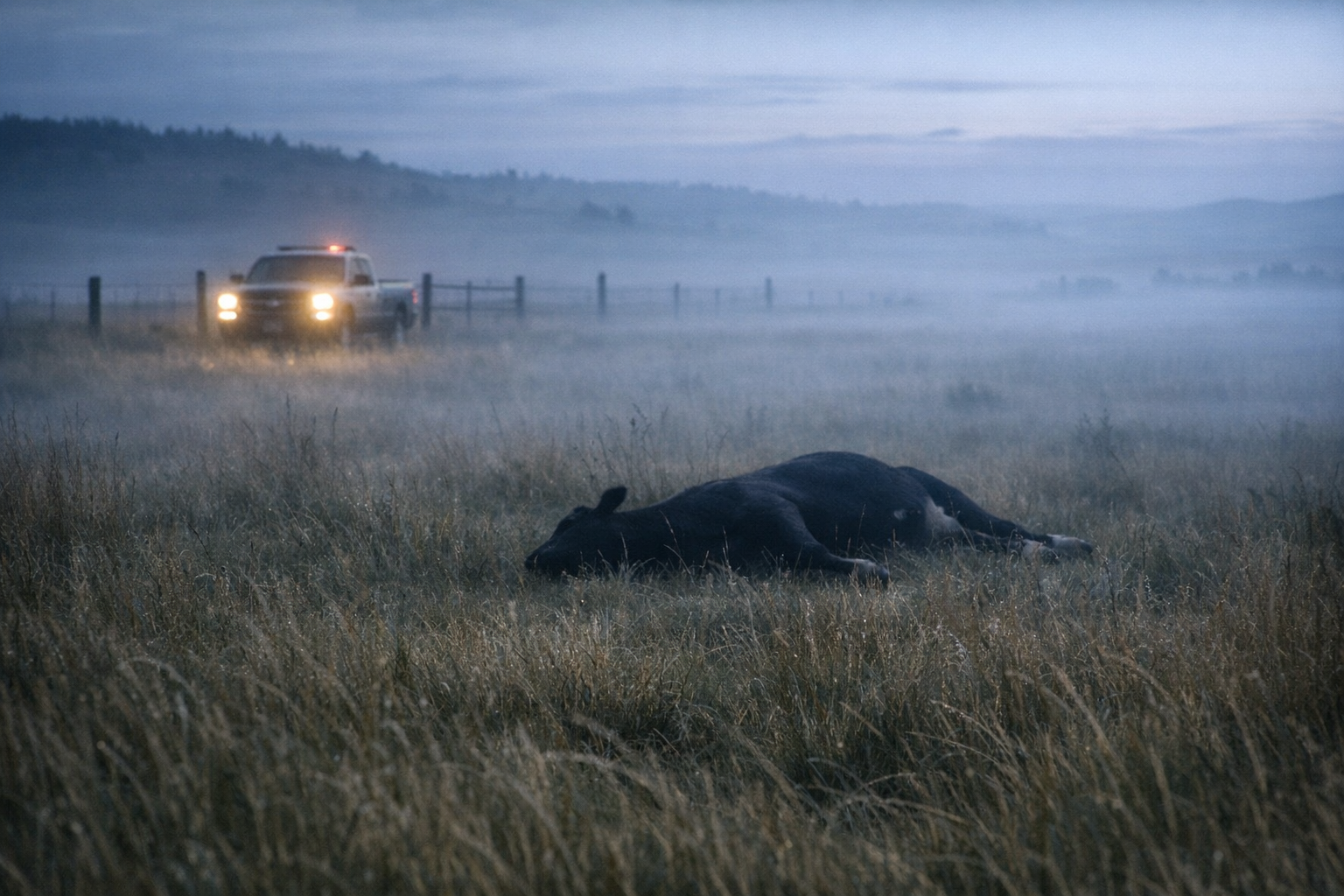
By the time the rancher reached the field, the sun was just starting to burn through the morning haze, and the silence felt wrong. One of his cows was lying still in the grass, cut in ways that looked too clean, too precise, and too strange to match the violence people expect from nature.
Cattle mutilation mystery refers to reports of dead livestock found with unusual wounds, missing tissue, and little visible blood at the scene. Believers often claim these cases point to UFO activity, secret government testing, or some hidden force operating in remote places. The more grounded reality is that the pattern mixes real unexplained details with decomposition effects, scavenger activity, weak scene preservation, and a human tendency to see design before natural processes are fully understood.
What Happened
The phrase “cattle mutilation” became famous in the 1970s, when ranchers across parts of the American West began reporting dead cows and horses with oddly specific injuries. Ears were missing. Tongues were gone. Soft tissue around the eyes, mouth, or genitals appeared removed. In some stories, there were no obvious tracks, very little blood, and no clear sign of a normal predator attack.
That combination mattered. A dead animal in an open field is common enough on large ranches. But a dead animal with wounds that look surgical is something else entirely. Once those stories started spreading, each new case felt less like a local livestock problem and more like evidence of a hidden pattern.
You can almost see why the theory stuck. A rancher finds an expensive animal dead in the early morning light. The hide is still cool. The cuts look sharp. The ground nearby seems quiet. In that moment, before a veterinarian arrives or scavengers have been studied, the scene can feel staged. It can feel like someone was there during the night and did not want to be seen.
Over time, the mystery attached itself to UFO culture. Reports of strange lights in rural skies were already part of American folklore, and cattle cases gave people something they thought UFO stories often lacked: physical evidence. That is one reason cattle mutilation still appears in conversations about hidden recovery programs and physical UFO evidence, even though the two topics are very different.
The cases also spread beyond one clean explanation. Some people blamed extraterrestrials. Others suspected military experiments, disease surveillance, cult activity, or covert biological sampling. The same dead animal was used to support several theories at once, which is often a clue that fear is running ahead of proof.
Why People Believe It
cattle mutilation survives because it feels like a forensic puzzle, not just a campfire story. People do not only hear that something strange happened. They hear that the evidence itself looks wrong. That changes the emotional weight of the claim.
There are a few reasons the theory remains powerful. First, the locations are usually isolated. Remote ranchland naturally creates uncertainty because scenes are not immediately secured, weather changes fast, and many hours may pass before anyone sees the animal. In a city, a suspicious scene might draw police, cameras, and witnesses. In a field, there may be only one observer and a lot of open questions.
Second, the injuries seem specific. Missing tongues, lips, udders, and reproductive tissue sound deliberate because those are soft parts of the body. But that detail can mislead people. Soft tissue breaks down faster and is easier for insects and scavengers to consume, which means a selective-looking pattern can appear without a human or alien hand guiding it.
Third, the lack of blood makes the story feel impossible. Many believers describe carcasses as “drained.” That word is powerful because it suggests a process. But death in an open environment does not always leave dramatic pools of blood where people expect them. Blood can settle internally, clot, dry, seep into the ground, or become less visible after time and weather exposure.
And finally, cattle mutilation connects with older distrust. If you already believe governments hide test programs, or that UFO cases are quietly buried, then a damaged carcass in a remote pasture does not feel random. It feels like a clue from the same world as secret bases, sealed files, and stories that never quite go away. That is why some readers jump from these ranch cases to broader narratives like alien disclosure and official secrecy even when no direct evidence ties them together.
Claims vs Evidence
Claim: The wounds are too precise to be caused by predators or natural decay.
Evidence: Investigators and veterinarians have repeatedly noted that decomposition can tighten skin and create edges that look cleaner than people expect. Scavengers also tend to target soft openings first, producing tissue loss around the mouth, eyes, anus, and genitals. What looks “surgical” in a shocked first impression may look different after a proper forensic review.
Claim: The animals are completely drained of blood.
Evidence: There is no solid body of verified proof showing a mysterious external blood-removal process across these cases. After death, blood settles, coagulates, and changes appearance. Internal pooling and breakdown can make a carcass seem strangely bloodless, especially to non-specialists examining it hours later in poor field conditions.
Claim: No tracks or signs of struggle prove that ordinary predators were not involved.
Evidence: Absence of visible tracks is not the same as evidence of impossible activity. Wind, dry ground, frozen soil, later contamination, and delayed discovery all affect what can be seen. Some animals also die from illness, birthing complications, poisoning, or injury before scavengers ever arrive, which changes the scene from the start.
Claim: The same pattern happens too often to be natural.
Evidence: Repeated pattern does deserve attention, but repeated pattern is not the same thing as proven cause. Large grazing animals die in similar environments and decompose in similar ways. If scavengers and insects follow similar biological paths, repeated-looking wounds are exactly what we should expect to see across multiple cases.
Claim: Because no explanation fits every case, a hidden actor must be involved.
Evidence: This is one of the biggest logical jumps in the entire mystery. Some cases may involve natural death plus scavenging. Others may be poorly documented. A few may involve human interference. A small number may remain genuinely unresolved because the scene was never studied well enough. None of that automatically points to UFOs, and it does not rule in secret programs either.
This is where cattle mutilation starts to resemble other durable mystery engines, including cases that stay alive because every unanswered detail keeps the larger legend fed. Once a theory develops a reputation for being unsolved, each new case arrives carrying the old mythology with it.
Reality Check
The strongest way to understand cattle mutilation is to treat it as a forensic-evidence problem. That means asking boring but necessary questions before jumping to dramatic ones. When was the animal last seen alive? How long was it exposed? What was the temperature? Were insects active? Was a veterinarian called immediately? Were photos taken before the body was moved? Was toxicology performed? In many famous cases, those answers are incomplete or missing.
That matters because a weak chain of evidence gives imagination room to take over. If a carcass is found late, examined casually, discussed emotionally, and passed from rumor to rumor, it stops being a clean case file and becomes a cultural artifact. People no longer argue about one cow in one field. They argue about what the cow symbolizes.
There is also a contradiction at the heart of the theory. Believers often say the wounds are highly advanced and precise, suggesting sophisticated actors. But the broader evidence around many cases is often messy, inconsistent, and badly documented. If the proof for an extraordinary operation mostly survives as scattered anecdotes and contaminated scenes, the evidentiary base is much weaker than the story sounds.
That does not mean every witness is mistaken or dishonest. It means the mystery is probably being held up by a mix of real shock, natural postmortem processes, and the human habit of connecting unexplained details into one intentional pattern. Some cases may remain unsolved in the ordinary sense. Yet “unsolved” is not a hidden category of evidence. It is simply the point where information ran out.
The most reasonable conclusion is not that cattle mutilation is fake, and not that it proves UFO intervention. It is that unusual carcass conditions can look deeply unnatural, especially in remote settings, and that this appearance has fueled decades of speculation far beyond what the evidence can securely support.
Conclusion
Cattle mutilation remains one of the most persistent mysteries on the edge of UFO culture because it seems to offer something tangible. There is a body. There are wounds. There is a place, a morning, a witness, and a feeling that something hidden passed through during the night.
But when the story is examined closely, the case becomes less about one secret answer and more about how people interpret damaged evidence under uncertainty. The forensic angle is what makes this topic compelling. It is also what keeps the conclusion grounded. Strange wounds are real. Fear is real. Confusion is real. Yet none of those, by themselves, prove extraterrestrials, covert harvesting, or a buried operation.
What cattle mutilation really shows is how fast mystery hardens into meaning when scenes are incomplete and trust is already thin. And that may be the most important clue of all.
🔎 If this story stayed with you, the author suggests these real cases next:
- UFO Crash Retrieval Claims: Hidden Recovery Program or Testimony Without Proof?
- UFO Sightings: What People Are Really Seeing in the Sky
- Alien Disclosure Timeline: Are We Seeing Revelation or Repackaged Secrecy?
Explore more Alien & UFO Theories stories here: