
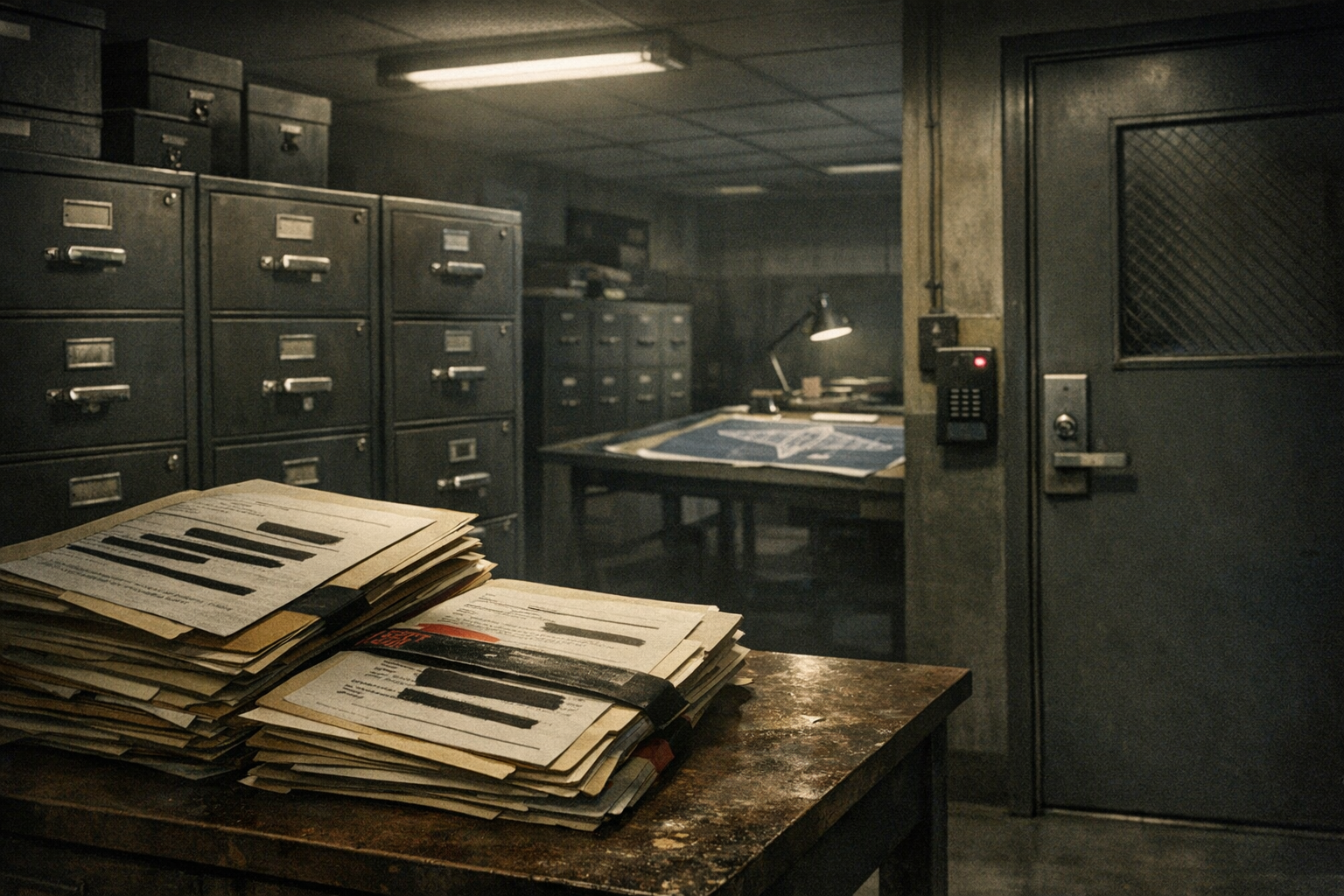
The door is closed, the room number means nothing to you, and the file you want is hidden behind layers of labels that were designed to reveal almost nothing. That atmosphere of restriction is exactly why special access programs UFO theories feel so convincing to so many people: the secrecy looks real long before the bigger claim is proven.
Special Access Programs, usually called SAPs, are highly restricted government programs with tighter controls than normal classified work. In UFO discussions, people claim those compartments could hide crash retrievals, reverse-engineering efforts, or sensitive witness reports. The more grounded reality is that SAPs are real, secrecy systems are real, and compartmentalization can hide information — but that still does not prove a hidden alien program exists inside them.
What Happened
This article’s angle is not another Roswell retelling or another broad disclosure recap. It is about the machinery of secrecy itself: the part of the UFO debate where acronyms, clearances, and hidden compartments start doing a lot of the storytelling.
In ordinary conversation, people often use “black program” as a catch-all phrase for anything secret. But in the national security world, secrecy has structure. Some work is merely classified. Some work is tightly compartmented. Some work falls under Special Access Programs, where access is limited far beyond a normal security clearance. That distinction matters because it gives UFO secrecy claims a plausible framework.
Supporters of hidden-program theories often point to that framework and say: if the government can bury aircraft projects, intelligence tools, or advanced weapons inside narrow compartments, then it could also bury something far stranger. That idea has floated through decades of speculation, from whispers about crash debris to modern claims about retrieval and reverse engineering.
The scene people imagine is easy to picture. A contractor badge opens one corridor but not the next. A person knows one piece of a project but not the full purpose. A briefing happens inside a windowless room, and what leaves that room is not evidence but rumor. In that environment, even honest fragments can start growing into something larger.
That is one reason secrecy posts connect so naturally to pieces like Government UFO Programs: Why the Files Never Really Closed. Once readers see that governments really have studied unusual aerial events at different times, the next question is almost automatic: if some programs were public, could deeper ones still be hidden?
Modern UFO disclosure debates pushed this idea even further. Public testimony and media coverage introduced terms like compartments, contractors, access barriers, and waived oversight to a much wider audience. Suddenly, the mystery was not just a light in the sky. It was an organizational chart nobody could see.
Why People Believe It
The SAP angle is persuasive because it sounds technical, and technical language often feels like evidence. “Special Access Program” is not vague folklore. It is a real government term. The minute it enters a UFO story, the story feels less like myth and more like inside knowledge.
There is also a strong logic behind the belief. If a secret program truly existed, it would not be filed in an open cabinet. It would be hidden behind restricted access, contractor walls, and need-to-know barriers. In other words, the secrecy model seems to fit the claim. That fit gives the theory a powerful sense of realism.
Another reason belief grows is that compartmentalization is hard for outsiders to understand. Many people assume that if something important existed, lots of officials would know about it. But highly compartmented work does not operate that way. One person may know a budget line. Another may know a technical component. Another may only know a cover story. When the public hears that no single person can easily see the whole picture, that sounds exactly like the architecture of a cover-up.
There is a psychological effect too. Acronyms flatten uncertainty. Once a theory is wrapped in terms like SAP, SCI, waived access, or contractor compartment, the language can make the story feel more complete than the public evidence really is. The vocabulary becomes part of the proof feeling.
That is why this topic overlaps with discussions in UFO Crash Retrieval Claims: Hidden Recovery Program or Testimony Without Proof?. Crash retrieval stories often lean on secrecy architecture to explain why no clean public paper trail has emerged. The hidden-program theory starts sounding stronger not because documents are shown, but because people can imagine why the documents would stay hidden.
There is also a cultural memory at work. People know the government has kept real secrets before. Stealth aircraft, surveillance programs, and covert operations did not begin as public knowledge. That history creates an opening for the UFO argument: secrecy has hidden major things before, so maybe it is hiding this too.
But that leap is where careful analysis has to begin. The existence of a hiding place is not the same as proof that a specific object is hidden there.
Claims vs Evidence
Claim: Special Access Programs provide the exact mechanism needed to hide UFO crash retrievals, reverse-engineering programs, or non-human technology from the public and even from much of the government.
What supports that claim: SAPs are real. Compartmented security is real. Contractors can hold sensitive material. Access can be limited to very small circles. Oversight can become difficult when work is split across institutions and hidden behind need-to-know rules. All of that makes concealment possible in principle.
What that does not automatically prove: that a UFO-related SAP actually exists, or that any hidden compartment contains alien craft rather than ordinary but highly secret military or intelligence work.
This is the central misunderstanding. A secrecy mechanism explains how something could be hidden. It does not confirm what is hidden. That gap matters more than almost any other detail in this topic.
A useful mini-scene is the classic contractor puzzle. Imagine an engineer working on a material analysis process, a logistics officer tracking secure shipments, and a security official limiting access to records. None of them may be lying. None of them may even understand the full context. If rumors start later, each fragment can look suggestive. But fragments are not the same thing as a verified whole.
That is one reason names and labels become so important in this space. A title can spread fast. A rumored program name can sound explosive. Yet the case of Immaculate Constellation: Hidden UAP Program or Another Name Without Public Proof? shows how far a label can travel before the public gets firm confirmation of what, if anything, sits behind it. The name itself can create momentum.
Another weak point is the assumption that maximum secrecy points toward maximum significance. Sometimes it does. Sometimes the most restricted work involves sensor capabilities, nuclear command systems, stealth signatures, or other advanced but entirely human technologies. When outsiders see the wall, they may project something more dramatic onto it.
There is also a contradiction inside many UFO secrecy arguments. Believers often say a hidden program is so effectively compartmented that it has avoided exposure for decades. Yet the same story usually depends on recurring leaks, repeated insider claims, public hearings, media reporting, and broad internet discussion. That does not mean the claims are false. It does mean the theory is not as neat as it first sounds.
And there is a final evidence problem: testimony about secrecy often becomes a substitute for direct evidence. “I know where the answers are, but I cannot show them publicly” may be understandable in a classified environment. It still leaves the public with an unresolved burden of proof.
Reality Check
The reality check is simple but important. Special Access Programs are real administrative structures, not imaginary cover words. They do show that governments know how to wall off information. That part of the UFO argument is grounded.
Where the argument becomes shaky is the next step, when a real secrecy structure is treated as if it already verifies a specific UFO conclusion. It does not. A hidden compartment can contain an aircraft signature study, a collection method, a sensor platform, or something deeply routine to the defense world but invisible to the public. Secrecy narrows access. It does not identify the hidden object for us.
That is why the SAP discussion works best as a framework, not as a verdict. It helps explain why hidden-program stories persist. It helps readers understand why people can sincerely believe that answers are locked away. But it cannot carry the whole evidentiary burden by itself.
What we do know is narrower. Sensitive projects can be distributed across agencies and contractors. Classification barriers can prevent public scrutiny. Bureaucratic fragmentation can make oversight messy. Those are real conditions. They make UFO secrecy claims plausible enough to investigate, but not proven enough to conclude.
The better question is not “Could a SAP hide something?” Of course it could. The better question is “What specific evidence shows that a UFO-related SAP exists, what does that evidence actually confirm, and what part remains inference?” That shift keeps the analysis honest.
It also protects readers from a common trap. Once an acronym becomes a mystery engine, every redaction starts to feel like confirmation. Every access barrier starts to look like proof. Every missing document starts to feel intentional. At that point, the theory can become self-sealing. The less the public sees, the more certain some people become. That is a warning sign, not a conclusion.
In plain terms, SAPs explain how secrecy works. They do not prove what secrecy is hiding. For a topic this charged, that difference is everything.
Conclusion
Special Access Programs sit at the heart of the modern UFO secrecy story because they offer a believable map of concealment. They show how information can be split apart, locked down, and kept away from ordinary oversight. That alone gives hidden-program claims a level of realism broad conspiracy talk usually lacks.
But the most important line to hold is the line between mechanism and proof. A real system of secrecy can make an extraordinary claim feel more credible without actually verifying it. That is why the SAP debate matters so much: it is where administrative reality and speculative certainty get mixed together.
If readers understand that one point, they understand the heart of this topic. The machinery of secrecy may be genuine. The deeper UFO claim still has to earn its case with evidence, not just with acronyms that sound like locked doors.
🔎 If this story stayed with you, the author suggests these real cases next:
- Government UFO Programs: Why the Files Never Really Closed
- UFO Crash Retrieval Claims: Hidden Recovery Program or Testimony Without Proof?
- Immaculate Constellation: Hidden UAP Program or Another Name Without Public Proof?
Explore more Alien & UFO Theories stories here: