
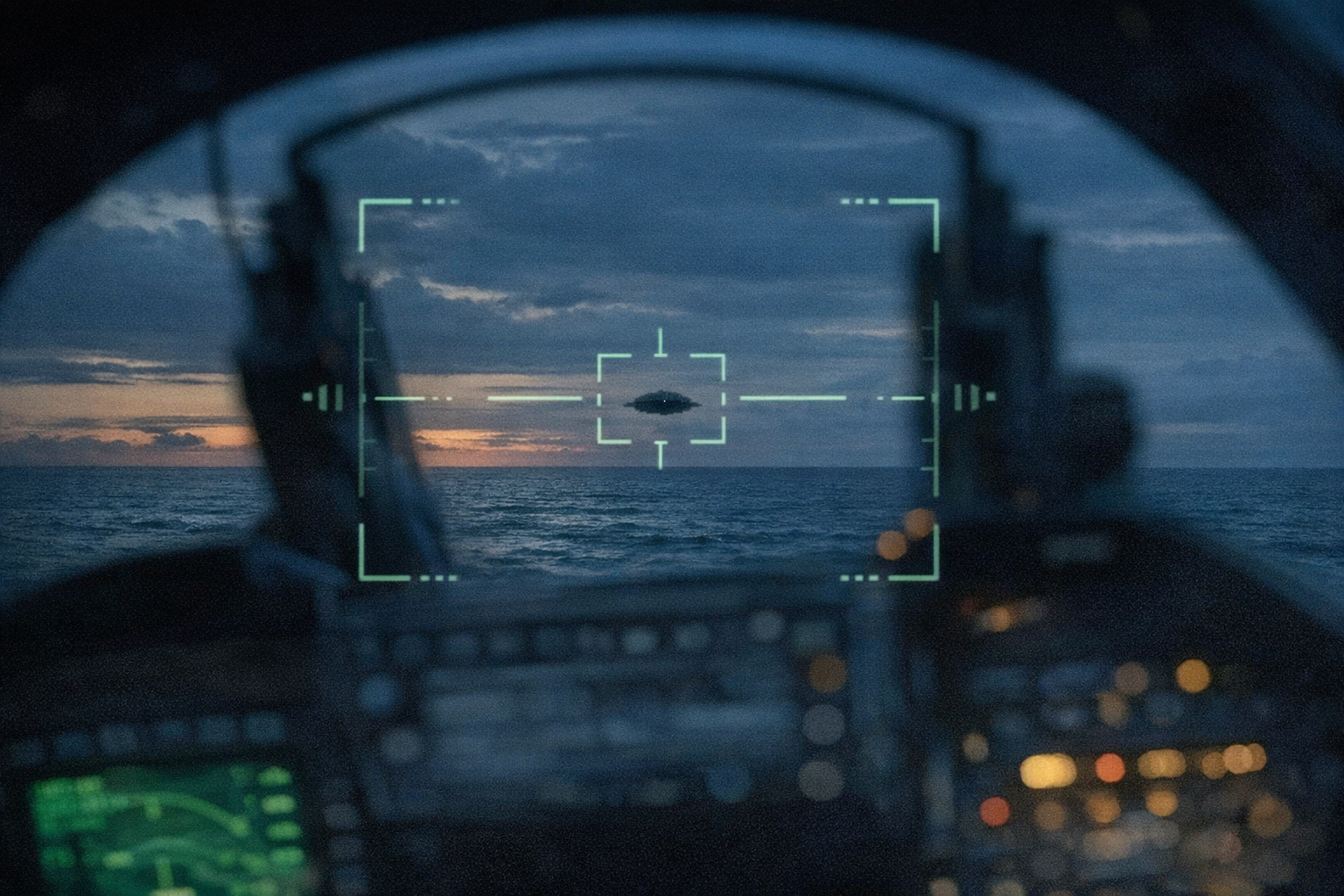
The clip was never meant to feel ordinary. A dark shape skims over a flat gray ocean, pilots react in real time, and for a few seconds the GoFast UFO video looks like restricted proof that something impossible slipped into public view. That sense of hidden access is exactly why this short Navy clip has stayed so powerful: it feels less like a rumor and more like a secret that escaped.
The GoFast video is one of the Navy clips released and later confirmed as authentic military footage, which means the recording itself is real. What people claim is that it shows an object moving at extraordinary speed just above the water. What reality likely shows is something more limited: a genuine unidentified target on camera, but one whose apparent speed may be exaggerated by viewing angle, tracking data, and the way the footage is framed.
What Happened
The GoFast clip entered public debate as part of the same wave of interest that pushed the Pentagon UFO videos into mainstream conversation. Unlike a blurry backyard recording or a secondhand story, this one came with the weight of military sensors and pilot voices. That changed the feeling immediately. People were not just watching a mystery. They were watching equipment they assumed should know exactly what it was seeing.
In the footage, a small object appears ahead of the aircraft over the ocean. The targeting system locks onto it while the pilots react with surprise. One of the reasons the clip hit so hard is simple: it looks fast. Really fast. The object seems to tear across the waterline while the camera struggles to hold it, creating the impression of a craft doing something beyond ordinary aviation.
Imagine the human moment inside that cockpit. A pilot is scanning a screen, trying to understand a tiny moving point while flying at high speed over open water. There is radio chatter, pressure, and no perfect wide-angle view to calm the scene down. In that kind of environment, even a few seconds of unclear motion can become unforgettable. That is part of why these clips carry so much emotional force long after the flight ends.
Supporters of the mystery often place GoFast beside the Tic Tac UFO Incident and later cases like the USS Omaha UFO Video. But GoFast stands apart for one reason: its center of gravity is not shape or dramatic maneuvering. It is speed perception. The whole case lives or dies on what viewers think they are seeing on that screen.
Why People Believe It
People believe in the strongest version of the GoFast story because the clip seems to solve a problem most conspiracy material cannot solve. It appears to offer direct evidence. There is no anonymous source, no leaked memo with missing pages, no witness recalling events decades later. There is a video, a military platform, and trained personnel reacting live. For many viewers, that already feels like a major jump from theory to proof.
There is also the visual trap built into the footage itself. When an object stays low against a huge empty ocean, the eye wants to compare it to the surface below. If it seems to cross that surface quickly, the brain concludes it must be moving at extreme speed. The video is short, tense, and stripped of ordinary reference points. That makes the object feel more dramatic than a fuller set of flight data might support.
Another reason belief grows so easily is that the clip arrived in a culture already primed for a bigger UFO story. By the time many people watched GoFast, they had already heard years of discussion about secret programs, withheld evidence, and unexplained military encounters. A clip like this does not land in a vacuum. It lands inside a narrative that says, at last, the curtain is lifting.
And once that story frame locks in, ordinary uncertainty starts to look suspicious. If analysts disagree about speed, some readers do not hear “the data is limited.” They hear “someone is downplaying what this really shows.” That is how a short sensor clip becomes bigger than the clip itself.
Claims vs Evidence
Claim: The object in GoFast was racing just above the ocean at impossible speed.
What the evidence shows: The footage captures a real target being tracked by military equipment, but the apparent speed seen on-screen is not the same thing as measured extraordinary speed. A camera viewing a distant object at an angle can make lateral motion look more dramatic than it really is.
This is the misunderstood detail that matters most. Viewers naturally watch the object against the water and assume its movement across the screen reflects true speed over the surface. But targeting footage does not work like a simple handheld video. Angle, altitude, aircraft motion, zoom, and line of sight all change the visual impression. If the object is farther away than people assume, the “it is blasting over the waves” conclusion becomes much less certain.
Claim: Because trained pilots were surprised, the object must have been extraordinary.
What the evidence shows: Pilot surprise is meaningful, but it is not the same as technical proof. Trained observers can still face ambiguous sensor pictures, limited perspective, and incomplete situational awareness. A pilot reacting in real time tells us the event was unusual to the crew. It does not automatically tell us the target broke known physics.
Claim: Since the Pentagon acknowledged the clip, the government effectively admitted it captured something beyond explanation.
What the evidence shows: Government acknowledgment confirmed authenticity of the recording, not the nature of the object. That distinction is critical. “This is genuine footage” means the video came from a real military system. It does not mean “this footage proves an extraordinary craft.” The gap between those two statements is where much of the public confusion lives.
That same gap shows up again and again in the official review process. The AARO UAP Report takes these cases seriously as reporting and analysis problems, but seriousness is not the same thing as confirmation. The strongest public evidence still tends to show unknowns, not clear proof of exotic technology.
Reality Check
The cleanest way to think about GoFast is this: the mystery may be real, but the most dramatic interpretation may not be. An unidentified object on military video is already interesting. We do not need to inflate it into a physics-defying craft to admit that the clip deserves attention.
If the object was moving more slowly and at a different distance than many viewers assume, the case changes shape immediately. What looked like impossible low-altitude speed could instead be a less dramatic target seen through a confusing geometry. That does not make the clip fake. It makes it a lesson in how easily perception outruns certainty.
This is also why GoFast should not be treated as a standalone smoking gun. Compared with cases built around witness timelines, radar claims, or longer chains of corroboration, GoFast is narrow. It gives us a short window, a strong emotional impression, and limited public data. That is enough to keep the debate alive, but not enough to close it.
The contradiction at the center of the clip is what keeps people hooked. It feels like hard evidence because it comes from military systems. Yet the closer you look, the less the video proves on its own. That tension is not a flaw in the story. It is the story.
Conclusion
The GoFast video matters because it shows how modern UFO belief often forms. Not from wild claims alone, but from official footage that looks decisive before it is fully understood. The clip is real, the target was unidentified in the moment, and the pilot reaction was genuine. But none of that automatically means the object was moving in an impossible way.
If you watch GoFast as a mystery about perception, it becomes more interesting, not less. It reveals how a few seconds of tense footage can turn uncertainty into conviction, especially when secrecy and military technology are already part of the frame. What the video clearly proves is limited. What it powerfully suggests is why this debate is still far from over.
🔎 If this story stayed with you, the author suggests these real cases next:
- Pentagon UFO Videos: What the Navy Footage Confirmed — and What It Didn’t
- Tic Tac UFO Incident: Best Military Evidence or a Story Bigger Than the Data?
- USS Omaha UFO Video: What Did the Navy Footage Actually Show?
Explore more Alien & UFO Theories stories here: