
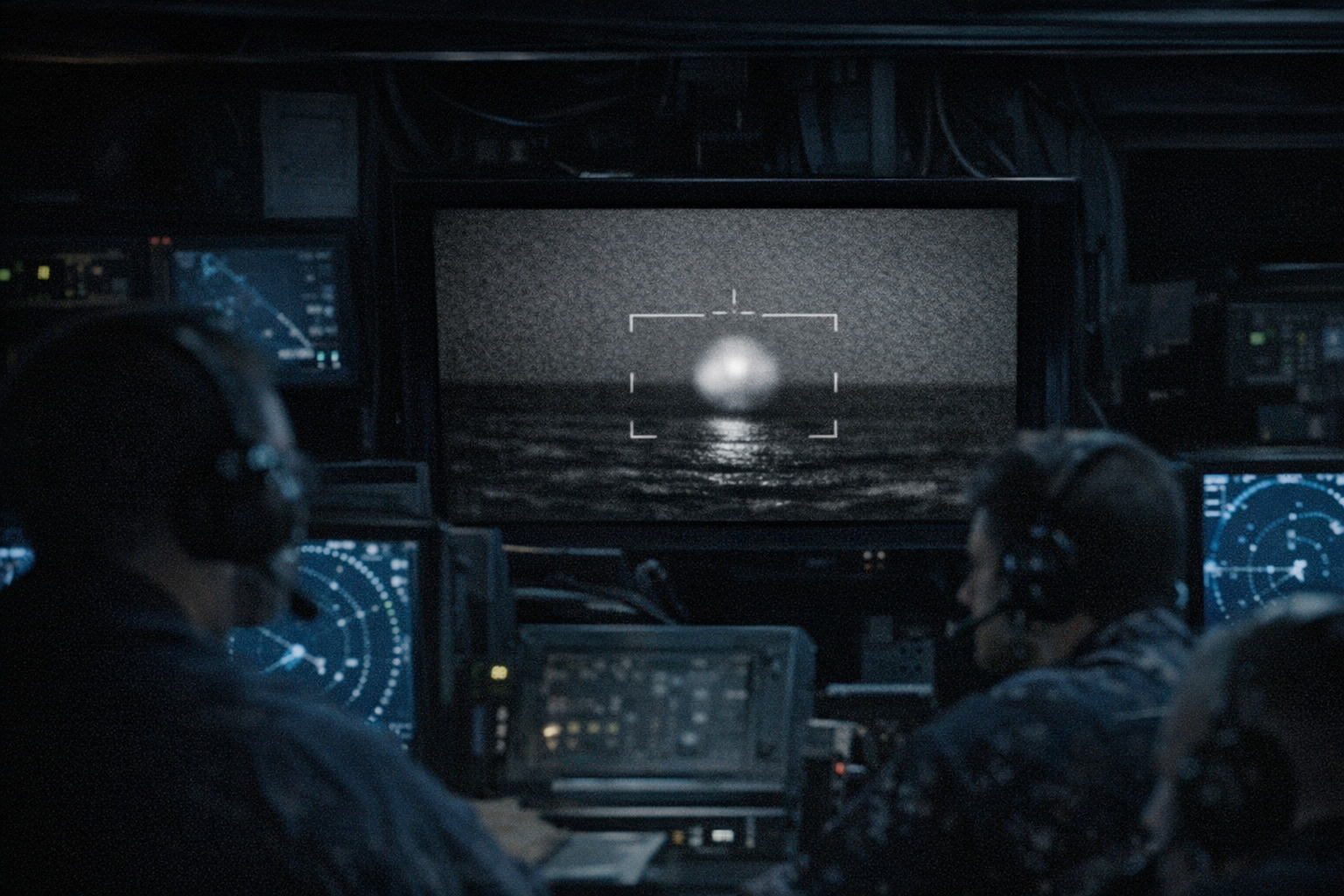
By the time the clip reached the public, the most important part of the story was already hidden: not a glowing spaceship, but a dark warship at sea, radar screens flickering in a sealed room, and sailors trying to name something they could track but not explain. That is why the USS Omaha UFO video still gets treated like a revelation, because it feels like a secret leaking out before anyone can agree on what it means.
The USS Omaha UFO video refers to infrared footage and related shipboard tracking from a July 2019 Navy incident off Southern California. People claim it shows a craft with extraordinary abilities, possibly even something non-human, especially because the object appears spherical and is said to enter the water. What reality likely shows is more limited: the Navy recorded a real unidentified object or objects, but the short video by itself does not prove what the object was, how it moved, or whether it was anything beyond a hard-to-identify airborne target in a tense military setting.
What Happened
On the night of July 15, 2019, sailors aboard the USS Omaha were dealing with something military crews are trained to take seriously: unknown tracks near a Navy vessel. Reports tied to the case say the ship and nearby systems detected multiple objects in a warning area off the coast of San Diego. That matters, because the Omaha story was never just one spooky clip. It started as a real security problem.
Inside a combat information center, the mood would not have been cinematic in the Hollywood sense. It would have been procedural, tense, and repetitive. Operators stare at screens, call out bearings, compare sensors, and try to decide whether what they are seeing is an error, a drone, a civilian object, or something more serious. In that kind of room, mystery is not exciting at first. It is a problem.
The public mostly knows the case from a short infrared video associated with the Omaha. In that footage, a small dark object appears against the cooler background of the night sky and ocean. The object does not display obvious wings or bright exhaust in the clip. That visual simplicity is part of why the case became so sticky. A featureless shape invites projection.
Supporters of the theory often add another dramatic detail: the object appears to descend toward the water and may have “splashed” or entered the ocean. That claim helped turn a narrow military sighting into a much bigger UFO story. Once people hear “sphere” and “transmedium,” meaning something that moves from air to water, the imagination does the rest.
But that is where the evidence problem starts. The clip is short. It is not a full sensor package. The public does not get every radar readout, every voice exchange, every time stamp, or every internal assessment. As with the broader Pentagon UFO Videos: What the Navy Footage Confirmed – and What It Didn’t, the existence of military footage confirms that trained personnel recorded something unknown. It does not automatically confirm the most dramatic explanation attached to it later.
Why People Believe It
The Omaha case hits several buttons at once. First, it involves the military, which gives the story instant weight. People assume that if a Navy crew could not identify something, then the object must be extraordinary. That is understandable, but it is not always sound logic. “Unidentified” describes the state of knowledge, not the nature of the object.
Second, the timing matters. By 2019, public attention around UAPs had already been rebuilt by earlier Navy-related cases. The Tic Tac UFO Incident: Best Military Evidence or a Story Bigger Than the Data? had already shaped how people read new footage. Instead of approaching each case from zero, audiences now had a ready-made frame: military sensors, unusual movement, secrecy, then possible disclosure.
Third, the sphere itself is powerful imagery. A blurry jet can be explained away. A distant drone sounds ordinary. But a sphere over open water feels almost designed to trigger UFO language. It looks stripped of normal clues. That does not make it alien. It makes it psychologically potent.
There is also a trust issue underneath the whole debate. Many readers no longer believe official institutions tell the full story quickly or clearly. So when the Pentagon confirms footage is genuine in the narrow sense, that Navy personnel really recorded it, people often hear a much broader admission. In public conversation, “real footage” easily turns into “real extraordinary craft,” even when those are very different claims.
Finally, Omaha sits inside a larger pattern of naval and military mystery stories. Once a case is linked to shipboard radar, warning areas, and repeated unknown tracks, it begins to feel less like one odd moment and more like part of a hidden history. That pattern-thinking is not irrational. It is just incomplete. Patterns can reveal something real, but they can also make weak evidence look stronger than it is.
Claims vs Evidence
Claim: The USS Omaha video proves a craft with advanced, non-human technology was operating near Navy ships.
Evidence: The public footage shows an unknown object recorded by Navy personnel. The case is serious enough that it was treated as a real incident. But the short infrared clip alone does not prove origin, propulsion, intent, or capability beyond being difficult to identify.
Claim: The object showed impossible movement.
Evidence: That is not clearly established by the public video itself. A short infrared clip can hide speed, distance, and orientation. Without full contextual data, viewers can overread what looks dramatic on screen. This is a recurring issue across military UAP footage, and it is one reason unresolved video should be handled cautiously.
Claim: The object entered the ocean, proving transmedium capability.
Evidence: People connected the case to a reported splash or water entry, but the public material does not conclusively demonstrate a seamless air-to-sea maneuver in the way believers often describe it. A descent toward the horizon, a loss of track, or an event reported separately from the clip can become fused together online as one clean proof sequence when it may not be one.
Claim: Multiple sensors make the case airtight.
Evidence: Multiple sensors can make a case more interesting, but not automatically airtight. Sensors can disagree, lose track, or require interpretation. That is why cases like this remain unresolved instead of graduating into confirmed breakthroughs. Even the broader AARO UAP Report: Clear Answers or a Review That Left the Biggest Claims Open? points toward a stubborn reality: some incidents stay unidentified, but unidentified is not the same as proven exotic.
Reality Check
The best way to understand the USS Omaha UFO video is to lower the temperature without flattening the mystery. Something real happened in the basic sense that Navy personnel recorded and discussed an object they could not immediately classify. That should not be dismissed. Unknown objects near military assets are a legitimate security concern.
At the same time, the strongest public version of the Omaha story often depends on stacking assumptions. One assumption is that military uncertainty means extraordinary technology. Another is that a sphere with no visible wings must be beyond known aviation. Another is that a reported splash equals confirmed transmedium travel. Each step may sound plausible on its own. Put together, they can create a conclusion that feels proven long before it actually is.
This is the misunderstood detail at the heart of the case: the ceiling of the evidence is lower than the ceiling of the story. The story can expand forever because it feeds on what the public does not have, full context, full data, and full explanation. The evidence cannot expand that easily. It stays tied to the clip, the reported tracking, and the limited official confirmation that the material came from Navy personnel.
There are ordinary possibilities that remain on the table: drone activity, incomplete sensor interpretation, limited visual information, or a genuine but unresolved object whose nature still cannot be established from public evidence. None of those explanations are as thrilling as “alien craft near a warship,” but they fit the known facts more honestly.
That is why Omaha works better as an evidence-breakdown case than as a proof page. It shows how a real military incident can become blended with a much bigger UFO frame. Once that happens, people stop asking the narrow question, what does this footage actually show, and start arguing over the widest one possible.
Conclusion
The USS Omaha UFO video is worth attention because it is a real Navy-linked mystery, not because it closes the case for extraordinary technology. The footage suggests an unresolved encounter in a military context, which is already significant. But it does not, on its own, prove alien craft, impossible motion, or a confirmed object diving into the ocean with capabilities beyond known systems.
If there is a lesson in the Omaha case, it is this: unknown footage gets more dramatic every time context drops away. The farther the clip travels from the ship, the easier it becomes to mistake uncertainty for proof. And that may be the real reason the video endures, not because it answers the question, but because it leaves just enough hidden to keep the question alive.
🔍 If this story stayed with you, the author suggests these real cases next:
- Pentagon UFO Videos: What the Navy Footage Confirmed – and What It Didn’t
- Tic Tac UFO Incident: Best Military Evidence or a Story Bigger Than the Data?
- UFO Evidence in America: The Cases, the Gaps, and Why the Mystery Keeps Rebuilding Itself
Explore more Alien & UFO Theories stories here: