
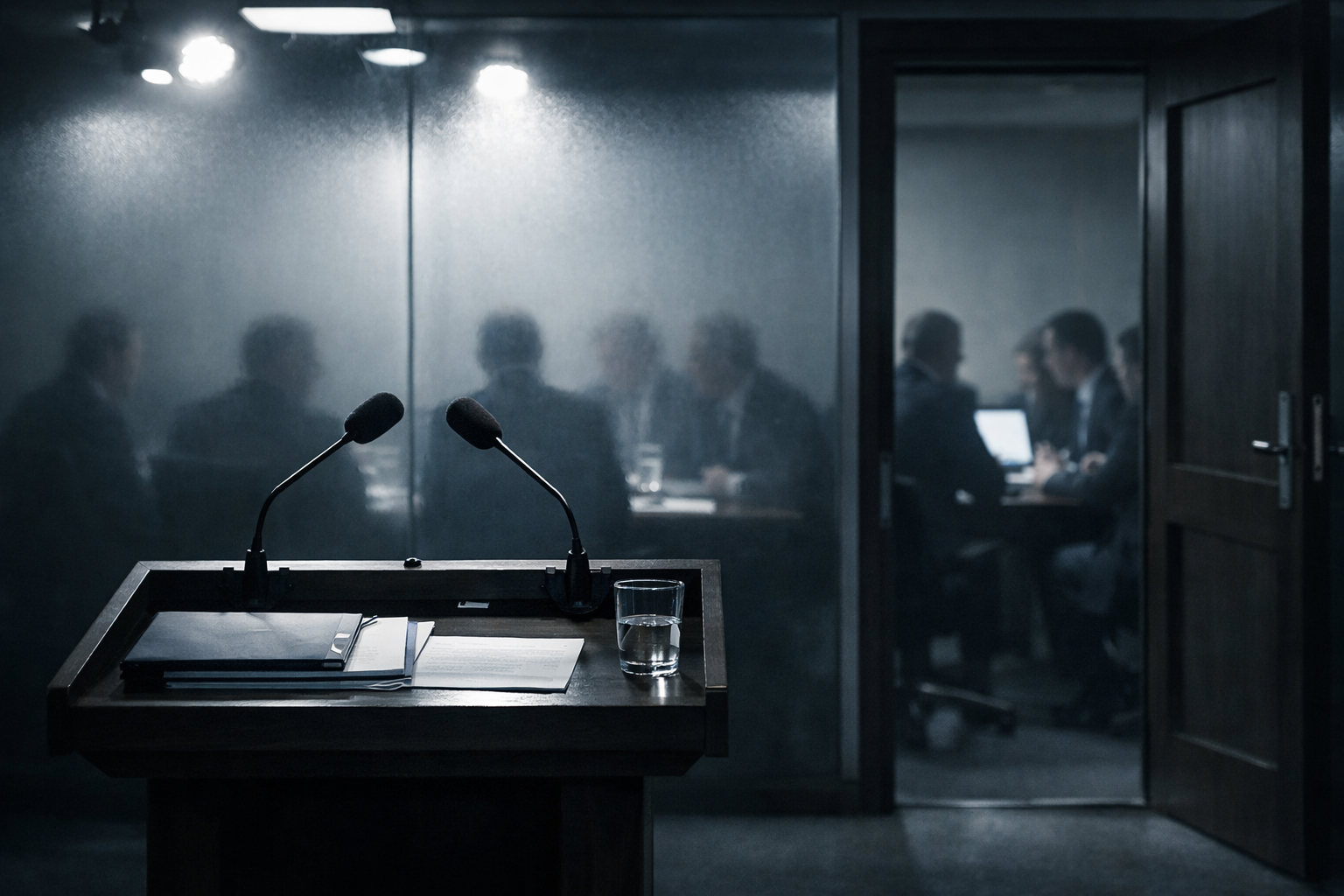
The people in front of the cameras looked calm. They read the speech, waved to the crowd, and stood beneath bright lights as if they were clearly in charge. But the old political puppet leaders theory begins in a darker place: sealed meeting rooms, private donor calls, intelligence briefings the public never sees, and the uneasy idea that the person on TV may only be the face of a machine run by others.
It is the kind of suspicion that grows in moments when power feels hidden. A president changes, a prime minister falls, a new face takes office, and yet the same wars continue, the same deals survive, and the same interests seem to keep winning. That is when many people start asking a simple question: if the leader is not really in charge, who is?
What Happened
The theory of political puppet leaders does not focus on one single event. It appears again and again whenever a public leader seems weaker, more managed, or more scripted than expected. The idea is that real control sits somewhere else — with advisers, party power brokers, wealthy donors, military officials, intelligence networks, or permanent bureaucracies that stay in place no matter who wins an election.
This suspicion has deep roots. In monarchies, people often believed royal advisers ruled from behind the throne. In modern democracies, the same fear shows up in new language. Instead of court insiders, people talk about handlers, deep-state actors, elite networks, or unelected forces. The labels change, but the emotional core stays the same: visible authority may not be real authority.
A common human moment drives the theory. Imagine a citizen watching a debate, then reading about lobbying pressure, classified briefings, donor access, and staff-written talking points. The next day, the leader announces a major policy shift that sounds polished but oddly detached. To that citizen, it can feel less like leadership and more like performance. That feeling is powerful, especially in countries where trust in institutions is already weak.
The theory often grows stronger during transitions of power. A reform candidate promises a clean break, then enters office and keeps parts of the old system intact. Military budgets remain high. Intelligence programs continue. Trade priorities barely move. To supporters who expected a sharp turn, continuity can look suspicious. To them, it does not feel like compromise. It feels like proof that someone behind the curtain is setting the limits.
This is why puppet-leader theories spread across very different political systems. They appear in discussions about authoritarian governments, fragile democracies, coalition states, and even local politics. Whenever the public sees a symbolic leader but senses pressure from stronger institutions, the theory finds fresh ground.
For readers who follow other hidden-power claims, this connects naturally with Deep State Explained: Hidden Ruling Network or Just the Machinery of Government?. Both theories ask whether elections tell the whole story of who actually governs.
Why People Believe It
People believe this theory partly because some version of influence is obviously real. Leaders do depend on advisers. Parties do manage messaging. Donors do buy access. Intelligence and military officials do hold information that elected leaders may not fully control at first. Bureaucracies also outlast campaigns, which means new leaders inherit systems they did not build.
History gives the theory more fuel. Real governments have hidden major actions from the public before. Intelligence agencies have run covert operations. Corporate interests have shaped policy. Backroom deals have happened. Once people learn that secrecy is not rare, they become more willing to imagine a stronger version of the same pattern.
The theory also matches how power looks from the outside. Public leaders often seem rehearsed, cautious, and surrounded by gatekeepers. They rarely speak with total freedom. Even their emotional reactions can appear managed. For people already suspicious, that polished image does not look professional. It looks controlled.
There is also a psychological reason. Random events are hard to accept. It is easier to believe there is a hidden hand than to believe huge decisions come from clumsy negotiations, compromise, ego, panic, and institutional momentum. A puppet-master story feels cleaner than reality. It gives chaos a shape.
That same search for hidden structure appears in other power-related cases, including Intelligence Agencies and Hidden Government Power: How Much Happens Behind Closed Doors?. When secretive institutions hold real influence, people naturally start wondering whether elected leaders are steering them — or being steered by them.
Claims vs Evidence
Claim: Public leaders are only figureheads, while unelected networks make the real decisions.
What supports the claim: There is real evidence that unelected actors can hold major influence. Senior advisers shape strategy. Donors and lobbying groups shape priorities. Intelligence agencies control access to sensitive information. Bureaucracies can slow, redirect, or quietly survive policy changes. In many governments, leaders do not act alone, and sometimes they cannot act quickly even when they want to.
What limits the claim: Influence is not the same as total control. Complex systems involve negotiation, not a single hidden puppeteer. A leader may be constrained by law, party politics, public opinion, courts, economics, and international pressure without being anyone’s puppet in a literal sense.
Claim: Policy continuity across different administrations proves the visible leaders are fake decision-makers.
What supports the claim: Continuity can be striking. Security policy, foreign alliances, surveillance structures, and economic priorities often survive elections. That consistency can make the public feel that the same people always win, no matter the campaign language.
What limits the claim: Continuity can also come from structural reality. States have existing treaties, budgets, agencies, and long-term interests. Some policies continue not because one secret group commands them, but because governments are large, slow systems built to resist dramatic swings.
Claim: Handlers, speechwriters, and media teams prove the leader is just an actor.
What supports the claim: Modern politics is highly staged. Messages are tested. appearances are planned. Crisis responses are tightly coordinated. The public usually sees a finished performance, not the messy process behind it.
What limits the claim: Message control is normal politics, not automatic proof of hidden rule. A speechwriter drafting a line is not the same as secretly governing a country. Public image management can make leaders look less authentic, but it does not by itself show they have no real power.
Claim: Certain leaders look especially weak or dependent, which suggests they were chosen to be controlled.
What supports the claim: Some leaders clearly rely heavily on staff, coalitions, or senior insiders. In weak states or unstable parties, this dependence can be extreme. There are real cases where leaders serve as compromise figures while stronger factions bargain around them.
What limits the claim: That still does not prove a universal puppet system. Politics often produces shared power rather than hidden ownership. A weak leader may be weak, but not fake.
Reality Check
The strongest version of the puppet-leader theory goes too far. There is no confirmed evidence that all public leaders are merely actors reading lines from one secret command center. Real governments are not usually that neat. They are crowded, competitive, and full of institutions pulling in different directions at once.
What we do know is more complicated — and in some ways more unsettling. Visible leaders are rarely fully independent. They operate inside webs of money, information, party loyalty, security pressure, and bureaucratic inertia. That means public power can be real while still being limited. A president or prime minister may lead, but not freely. They may decide, but only within boundaries set by forces that voters do not always see.
That distinction matters. If people call every constrained leader a puppet, they flatten the real story. They stop asking which institutions hold unusual leverage, which donors buy influence, which agencies hide too much, and which forms of continuity are normal versus dangerous. The broad conspiracy can become a shortcut that replaces serious analysis.
At the same time, dismissing every concern as paranoid would also miss the point. Democracies do contain hidden layers of power. Classified systems, private funding channels, party machines, and elite access networks all deserve scrutiny. The public is not foolish for noticing that power often looks different backstage than it does under bright lights.
The most honest conclusion is not that all leaders are puppets. It is that modern leadership is often part performance, part negotiation, and part genuine authority. Some leaders are stronger than they seem. Others are weaker. But the evidence supports a world of competing influence networks, not a simple theater run by one invisible hand.
Conclusion
The puppet-leader theory survives because it speaks to a real discomfort: the sense that democracy is visible on the surface and hidden underneath. That discomfort is not irrational. Public power really is shaped by people and systems the public rarely sees.
Still, the leap from hidden influence to total puppet rule is larger than the evidence allows. The clearer picture is less dramatic but more useful. Leaders are not usually empty masks. They are public faces operating inside dense systems of pressure, secrecy, and negotiation.
That may not satisfy people looking for one mastermind. But it does leave readers with something better than a slogan — a sharper way to watch power, question appearances, and ask who benefits when the person at the podium is not the whole story.
🔎 If this story stayed with you, the author suggests these real cases next:
- Deep State Explained: Hidden Ruling Network or Just the Machinery of Government?
- Intelligence Agencies and Hidden Government Power: How Much Happens Behind Closed Doors?
- Lobbying Power Influence: Legal Access or the Closest Thing to Hidden Rule?
Explore more Political Conspiracies stories here: