
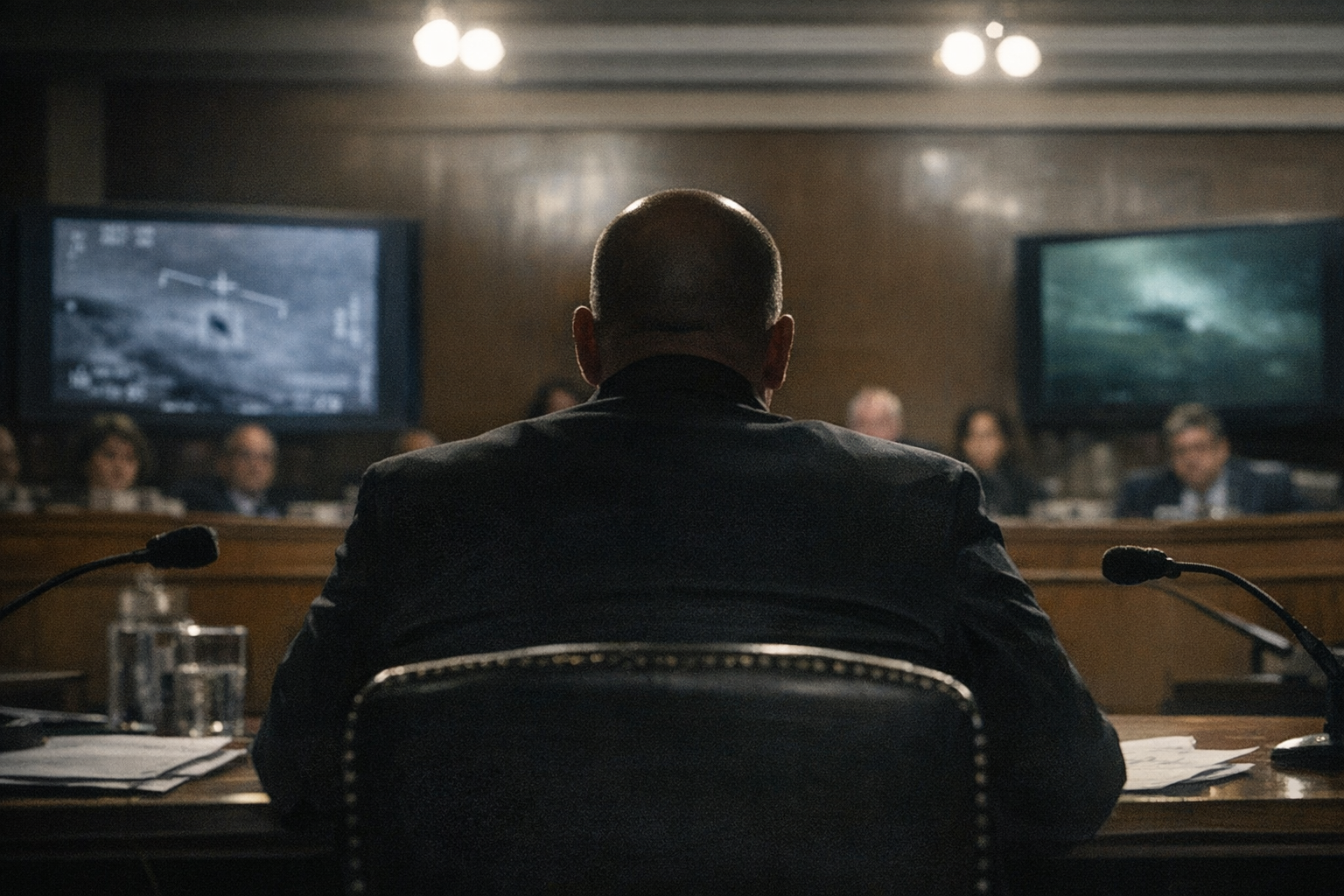
The room was public, the oath was real, and yet the most explosive part of the story seemed to live just out of reach. Under bright hearing-room lights, former intelligence officer David Grusch told Congress that hidden UFO programs existed, but the proof people wanted most was still locked behind classified walls, unnamed sources, and a question that would not sit still.
Also covered in: UFO Disclosure: Hearings, Whistleblowers, and the Proof Gap
David Grusch UFO claims refer to a set of allegations made by former U.S. intelligence official David Grusch about secret government programs tied to UFO crash retrieval and reverse engineering. Supporters say his background and sworn testimony make the story too serious to ignore. The likely reality is more narrow: Grusch made important allegations about oversight and secrecy, but the public still does not have verified physical evidence proving the biggest claims.
What Happened
David Grusch did not appear out of nowhere as a random internet personality. He was an Air Force veteran and intelligence official who worked with the U.S. government’s Unidentified Aerial Phenomena Task Force. That matters, because his story gained force from where he had been sitting when he made it. He was not pitching a theory from the outside. He was saying he learned disturbing things from inside the system.
The moment that pushed his name into the mainstream came in 2023, when he gave public interviews and later testified before Congress under oath. In that testimony, Grusch said the U.S. government had been involved in a long-running program to recover unidentified craft and study them. He also said he had been told that so-called non-human biologics had been recovered in connection with some of those incidents.
That is the sentence that made headlines. But the structure of his claim matters more than the headline. Grusch repeatedly said he was reporting what he had been told by other officials and sources he considered credible. He did not tell the public, “I personally touched a recovered craft,” or “I personally saw alien bodies.” He presented himself as someone who gathered accounts, documents, and testimony from others while working in official roles.
That distinction sounds technical, but it changes the whole story. Imagine being in that hearing room for a second. Cameras are running. Lawmakers are leaning forward. A witness with a high-level résumé says hidden programs exist and that Congress has been kept in the dark. The atmosphere feels historic. But at the same time, the witness is also saying the key facts came through a chain of interviews, briefings, and private disclosures rather than through direct public proof placed on the table.
Grusch also said he faced retaliation after raising concerns through official channels. That part is important because it shifted the conversation beyond “Are UFOs real?” into a second question: “Are oversight systems being blocked?” His allegations touched both mystery and bureaucracy, which is one reason they spread so fast.
In other words, the story was never just about alien craft. It was about secrecy, access, and whether a person inside the defense and intelligence world could be both credible and still unable to publicly prove what he was saying.
Why People Believe It
The first reason people take Grusch seriously is simple: his résumé gave him institutional weight. He was not an anonymous forum poster or a retired celebrity chasing attention. He had held intelligence roles connected to UAP work, and that gave his words a level of seriousness many earlier UFO stories never had.
The second reason is that he testified under oath. For many readers, that changes the emotional temperature instantly. A wild claim on a podcast feels easy to dismiss. A wild claim made before Congress feels different, even if the underlying evidence has not changed. The setting itself creates trust because the public reads sworn testimony as a riskier, more accountable form of speaking.
The third reason is timing. Grusch arrived during a period when interest in official UFO investigations was already rising. The Pentagon videos had already pushed the subject into mainstream discussion. Government offices had already admitted they were tracking unexplained incidents. Articles on government UFO programs and the larger alien disclosure timeline had already trained readers to think of UFO secrecy as a serious institutional topic rather than just late-night entertainment.
There is also a very human reason. People are used to the idea that big truths emerge in pieces. A whistleblower appears. Officials deny everything. Years later, some part of the story turns out to have been real. That pattern exists in real history, so it becomes a mental template. When Grusch says hidden programs exist, many people instinctively place him into that familiar whistleblower storyline.
And then there is the emotional force of the unknown. UFO stories hold attention because they sit right at the border between evidence and imagination. Grusch did not just offer a mystery in the sky. He offered a mystery inside the state. That combination is powerful. It lets believers feel that the missing evidence is not missing by accident. It is missing because someone powerful is keeping it out of sight.
Claims vs Evidence
This is the section where the story usually gets blurry, so it helps to separate the claim tiers clearly.
Tier one: verified public facts. David Grusch really did hold intelligence roles. He really did make these allegations publicly. He really did testify before Congress under oath. It is also true that the modern UAP debate includes real government attention, documented reviews, and cases that officials have treated as unresolved for periods of time. The debate is not built from fantasy alone.
Tier two: Grusch’s core allegations. He claimed there were secret crash retrieval and reverse-engineering efforts hidden from proper oversight. He also said witnesses told him non-human biologics had been recovered. These are the claims that made the story historic. But they remain allegations unless matched with public evidence that independent observers can examine.
Tier three: evidence limits. Grusch has said much of what he learned came from interviews, classified material, and people with direct knowledge. Publicly, however, those materials have not produced the kind of proof that ends the argument. No widely accepted physical artifact has been released. No lab-confirmed non-human sample has been opened to broad scientific review. No declassified file has landed with the kind of detail that would settle the case on its own.
Tier four: official response. U.S. defense officials have pushed back, saying they have not found verifiable evidence supporting claims of secret programs holding extraterrestrial craft or reverse-engineering non-human technology. That does not prove every allegation is false. But it does mean the public record remains a conflict between testimony and official denial, not a completed revelation.
This is where readers often confuse credibility with confirmation. Credibility matters. A witness with a strong background deserves attention. But credibility is not the same thing as proof. A trustworthy person can report what they sincerely believe they learned and still be passing along secondhand information that the public cannot yet verify.
That gap is why Grusch overlaps with existing discussions around UFO crash retrieval claims without simply duplicating them. The retrieval story is about the alleged program itself. The Grusch story is about how those allegations moved from private channels into public testimony without crossing the finish line into confirmed evidence.
Even the hearing’s most memorable lines work this way. They were dramatic because they hinted at hidden knowledge. But once you strip away the atmosphere, what remains is a careful but unresolved chain: source tells Grusch, Grusch tells investigators and lawmakers, public waits for material proof.
Reality Check
The most grounded way to read the David Grusch story is to separate two questions that people keep collapsing into one.
Question one: did Grusch raise serious concerns worth investigating? Yes. On that point, the answer is fairly straightforward. A person with relevant credentials said Congress and the public should look harder at possible hidden activity and failures of oversight. That alone is significant, especially in a field where stigma has often kept witnesses quiet.
Question two: did Grusch prove that the U.S. government possesses non-human craft or bodies? No. Not publicly. That is the part many headlines blurred. His testimony increased pressure, interest, and suspicion. It did not complete the evidentiary chain.
This does not mean the story is empty. It means its value may be different from what believers and skeptics both want. Believers often want a breakthrough that confirms the biggest theory. Skeptics often want a clean collapse that ends the story. Instead, Grusch sits in the uncomfortable middle. He makes the issue harder to laugh off, but not easy to prove.
There is also a pattern worth noticing. Modern UFO culture often builds momentum when official uncertainty meets human storytelling. A case starts with a real report. Then come leaks, secondhand accounts, expert commentary, documentaries, and endless clips online. By the time most people encounter the story, they are no longer meeting one claim. They are meeting a whole atmosphere. That happened with the Pentagon UFO videos, and it happened again with Grusch.
So the real logical test is not “Does this feel important?” It clearly does. The better test is “What can be independently checked right now?” Right now, the strongest publicly confirmed part of the Grusch story is that a serious insider made serious allegations about secrecy and oversight. The weakest part is the leap from that fact to certainty that non-human technology has been recovered.
That is the verification gap the planner’s angle points to. The person is real. The testimony is real. Some official concern is real. But the most extraordinary details still sit in a category that depends on trust, access, and future disclosure rather than present public proof.
Conclusion
David Grusch changed the UFO conversation because he moved it out of rumor alone and into a more formal, uncomfortable space. He brought the issue into Congress, tied it to oversight, and forced more people to take the subject seriously. That is a real impact, and it should not be minimized.
But serious does not automatically mean settled. The cleanest answer to the search question is this: David Grusch alleged that hidden UFO crash-retrieval and reverse-engineering programs exist, yet the public evidence available so far still falls short of confirming those allegations as fact.
That may be frustrating, but it is also the most honest place to land. If stronger evidence emerges, Grusch’s testimony may later look like an early warning. If it does not, his story may remain one of the most powerful examples of how credible insiders can deepen a mystery without conclusively solving it.
🔎 If this story stayed with you, the author suggests these real cases next:
- UFO Crash Retrieval Claims: Hidden Recovery Program or Testimony Without Proof?
- Alien Disclosure Timeline: Are We Seeing Revelation or Repackaged Secrecy?
- Government UFO Programs: Why the Files Never Really Closed
Explore more Alien & UFO Theories stories here: