
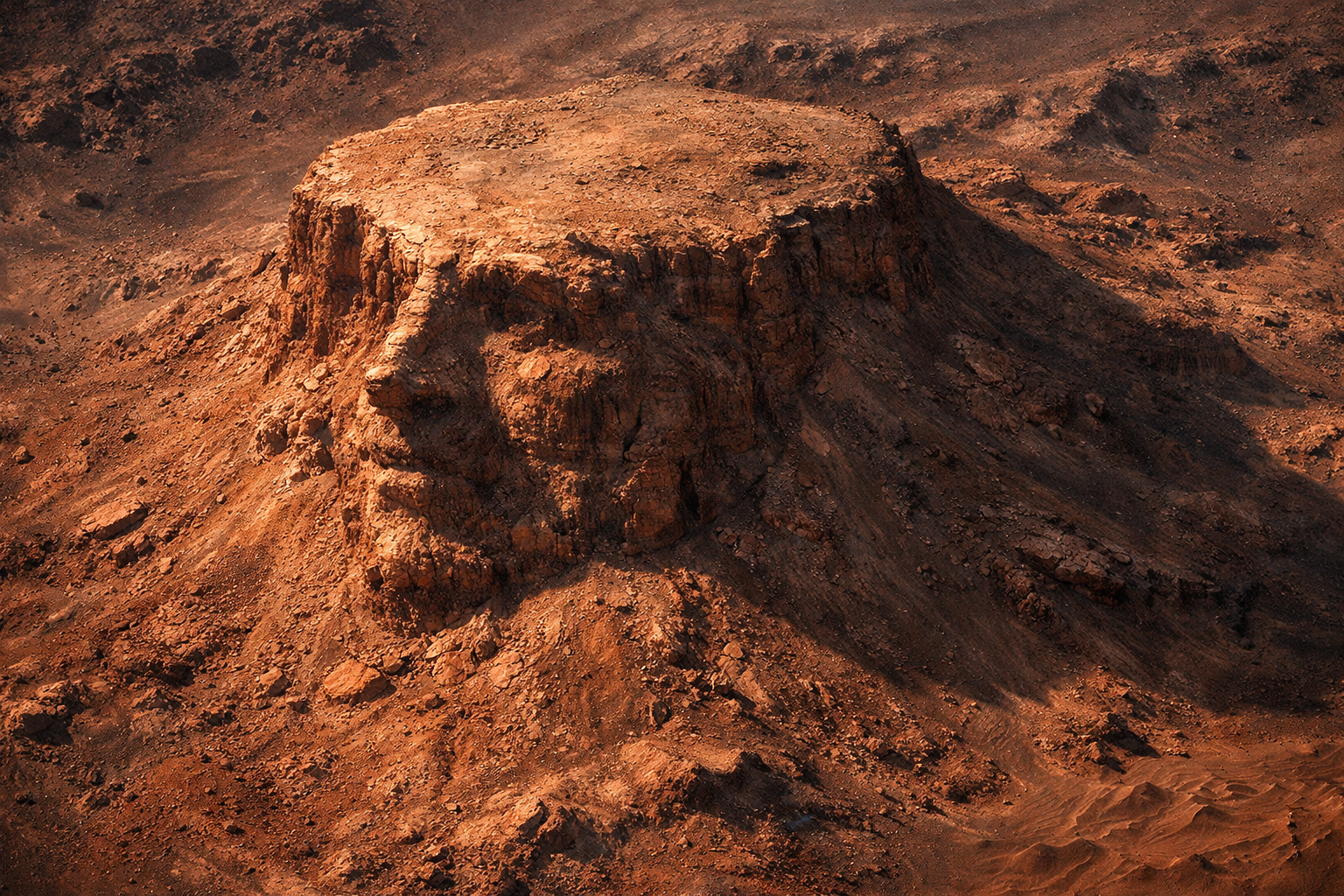
The image was never meant to feel personal. It was just a gray patch of Martian ground, snapped from orbit, filed into a growing archive of remote photographs, and handed to the public like one more technical record from a silent planet. But when that rocky shape seemed to stare back, the Mars structures theory exploded into something far bigger: a suspicion that NASA had photographed ruins on another world and then tried to explain them away before the questions got out of control.
What Happened
The modern version of this theory usually begins with a famous image from the Cydonia region of Mars. In 1976, NASA’s Viking 1 orbiter photographed a mesa that, under a certain angle of light, looked uncannily like a human face. The shadows lined up in a way that suggested eyes, a nose, and a mouth. To many viewers, it did not look random. It looked built.
That single image spread for a simple reason: you did not need a technical background to feel the shock of it. You could glance at the photograph for two seconds and understand why people started whispering about alien monuments. If one shape looked like a face, then the nearby hills and ridges could start looking like walls, pyramids, roads, or the buried edges of a dead city.
For conspiracy-minded audiences, the timing mattered too. Space agencies already carried an aura of secrecy. They handled classified contracts, filtered what images reached the public, and spoke in careful technical language. So when NASA said the face was probably a natural landform, many people heard something else: damage control.
The story grew through documentaries, talk radio, magazines, internet forums, and later YouTube channels. Each new retelling raised the stakes. The claim was no longer just that one formation looked strange. It became a larger allegation that Mars contained artificial structures and that official institutions were minimizing or hiding the evidence.
There was also a deeply human moment inside all this. Imagine sitting at a kitchen table in the late 1970s, newspaper open, looking at that blurry black-and-white image for the first time. Space was still full of promises, Cold War secrecy was normal, and the idea of life beyond Earth felt just close enough to touch. For many people, the face on Mars did not feel like a hoax. It felt like history peeking through a crack.
Why People Believe It
The theory survives because it sits at the intersection of mystery, psychology, and distrust. First, the photographs really do contain unusual shapes. Even skeptics admit that certain Martian images can look surprisingly geometric from one angle and one resolution. That visual punch matters. People believe what they feel they can see with their own eyes.
Second, humans are pattern-finding machines. We are built to notice faces, symmetry, and structure, even when none was intended. This tendency is called pareidolia, and it explains why people see faces in clouds, saints in burned toast, and figures in dark windows. On Mars, where the terrain is distant, grainy, and easy to misread, that instinct becomes even stronger.
Third, NASA’s caution can accidentally feed suspicion. When scientists say a claim needs better data, believers may hear evasion. When agencies release higher-resolution images years later, some people see transparency, while others see a cleanup effort. That gap between institutional language and public imagination gives the theory room to breathe.
The idea also connects to older UFO beliefs. If people already suspect governments have hidden evidence of extraterrestrial contact, then strange formations on Mars feel like one more missing piece. Articles like NASA Alien Contact Cover-Up: Did They Find Something They Didn’t Share? help explain why this suspicion spreads so easily from one space mystery to another.
Finally, Mars itself almost seems designed for this kind of story. It is close enough to map, remote enough to remain mysterious, and visually similar enough to Earth to stir the imagination. A strange rock on the Moon can feel cold and abstract. A strange formation on Mars feels like it might belong to a lost chapter of cosmic history.
Claims vs Evidence
Claim: Certain Mars photographs show artificial ruins, giant faces, pyramids, or city-like structures. Supporters point to formations that appear symmetrical or aligned in ways they believe nature would not normally produce.
What we know: Low-resolution imagery can make natural terrain look cleaner and more deliberate than it really is. Lighting is crucial. A hill that appears sculpted under one sun angle may look ordinary under another. The original Viking image of the so-called face became less dramatic when later missions photographed the same site in better detail.
Claim: NASA recognized these structures early and chose to downplay them to avoid public panic or to protect sensitive discoveries.
What we know: There is no confirmed evidence that NASA has hidden proof of alien ruins on Mars. In fact, the agency publicly discussed the face image, released additional observations, and allowed scientists and the public to examine newer data. That does not fit neatly with the idea of a total cover-up.
Claim: Repeating geometric forms across Mars suggest design rather than erosion.
What we know: Mars has wind erosion, dust movement, impact craters, landslides, volcanic history, and long geological timescales. Natural processes can create surprisingly regular shapes. On Earth, we also find columns, arches, hexagonal rock patterns, and mesa formations that seem intentional until geology explains them.
Claim: The strongest evidence is not any single photo but the pattern across many images.
What we know: This is where the theory becomes harder to test. Once people start searching huge archives for anything that looks artificial, they will inevitably find shapes that feel meaningful. But a collection of suggestive images is not the same as proof. Without confirmed artifacts, consistent measurements, or direct sampling, the case stays visual and interpretive.
That is also why comparisons to other space mysteries can mislead readers. A strange image can feel powerful, but feeling convinced is not the same as establishing evidence. The same tension appears in stories like Moon Base Conspiracy: Hidden Structures or Tricks of Light and Shadow?, where shadows and distance do much of the heavy lifting.
Reality Check
The Mars structures theory is compelling because it starts with a real image, a real emotional reaction, and a real problem in visual interpretation. That makes it stronger than theories built entirely from rumor. People are not inventing the weirdness out of thin air. They are responding to shapes that genuinely look strange under limited conditions.
But that does not mean the ruins are real. The strongest evidence still favors a simpler explanation: people saw meaningful patterns in low-quality images, then built a larger story around them. Later, clearer photographs weakened the original claims instead of strengthening them. If a structure is truly artificial, better evidence should make the case sharper. Here, the opposite usually happened.
There is also a logic test worth applying. A civilization advanced enough to build giant visible monuments on Mars would likely leave more than a few arguable shapes in satellite photos. We would expect stronger signs of planning, repeated materials, structural consistency, or artifacts visible across multiple imaging methods. That level of evidence has not appeared.
At the same time, dismissing believers as foolish misses the point. The theory thrives because it uses one of the oldest weaknesses in human thinking: we trust our eyes, even when our eyes are working with incomplete information. Add distance, secrecy, and the hope that we are not alone, and ordinary rocks can start to look like forbidden evidence.
So the most honest conclusion is not that people are crazy for wondering. It is that wonder outran the data. The face on Mars remains a great example of how mystery can begin in a single frame and then grow into a self-sustaining myth once distrust and imagination take over.
Conclusion
The Mars structures theory endures because it offers something hard to resist: the possibility that humanity briefly glimpsed proof of another intelligence and failed to recognize it in time. That is a powerful story. It feels cinematic, secretive, and almost believable.
Still, the available evidence does not show alien ruins. It shows how lighting, resolution, pattern recognition, and public mistrust can turn a remote landscape into an apparent revelation. For now, this case lands on the debunked side of the scale, not because Mars is boring, but because this specific claim has never moved beyond suggestive imagery.
Mars may still hold surprises. But if it ever reveals something truly artificial, the evidence will need to be clearer than a shadowed hill or a suggestive outline. It will need to survive better imaging, closer analysis, and the same skepticism applied to every extraordinary claim.
Until then, the most grounded view is simple: the famous shapes on Mars tell us more about human perception than alien architecture. They remain fascinating to look at, but fascination is not confirmation.
If this story stuck with you, you might want to explore these next: