
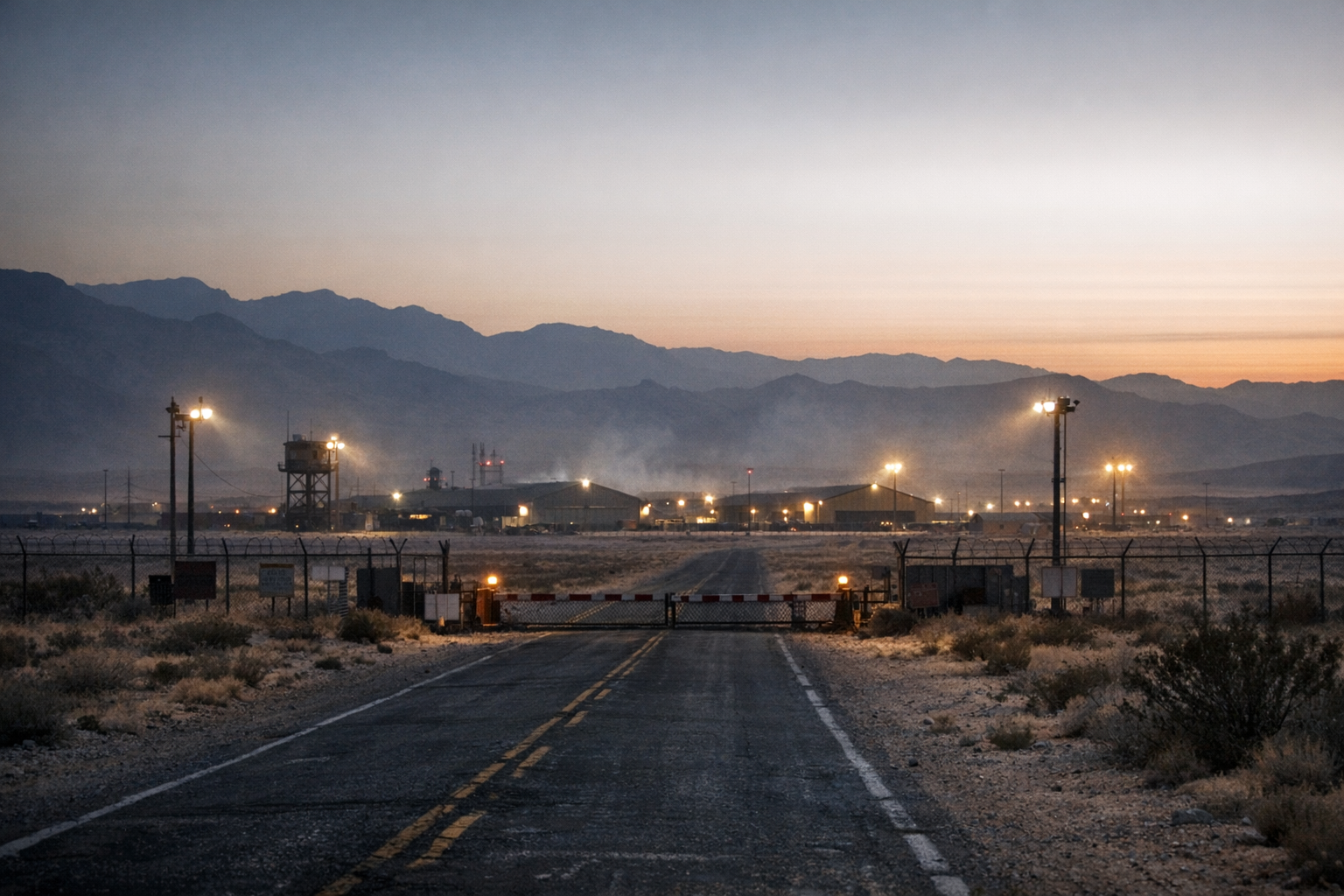
The warning signs come first. Then the empty Nevada desert, the fenced perimeter, the white trucks, and the simple fact that for decades the government treated Area 51 like a place that should barely exist in public language. When a real military site becomes that sealed off, it does not just protect secrets. It gives people the perfect container to pour every larger alien theory into.
Area 51 is a real classified test site in Nevada that became linked to aliens because it mixed genuine secrecy with strange sightings, advanced aircraft, and years of official silence. People claim the base hides recovered UFOs, reverse-engineered technology, and knowledge the public was never meant to see. The more grounded reality is that Area 51 did host secret programs and unusual aircraft, but the leap from hidden military work to alien evidence still has not been publicly proved.
What Happened
Area 51 sits near Groom Lake inside the Nevada Test and Training Range, and its reputation was built on something very concrete: it was a real place where the government tested things it did not want the world to understand yet. During the Cold War, aircraft such as the U-2 and A-12 flew in ways that looked deeply unusual to outside observers. Later stealth programs made the same pattern even stronger. People near the region were sometimes seeing aircraft that were genuinely unfamiliar, which meant the first layer of the myth grew from reality rather than pure invention.
That matters because Area 51 did not become famous the way a made-up internet rumor becomes famous. It became famous because secrecy kept producing sightings and silence at the same time. A pilot, rancher, or driver might see a strange shape, unusual lights, or motion that did not fit the aircraft they knew. Officials could not simply explain what was being tested without exposing classified programs, so the ordinary public was left to connect the dots with incomplete information.
Over time, the base became a kind of magnet for every unresolved question in UFO culture. If someone believed hidden technology existed, Area 51 felt like the natural place it would be stored. If someone believed governments had recovered something nonhuman, Area 51 felt like the natural place it would be hidden. That is why the site became tied not just to local sightings, but to wider stories about secrecy, cover-ups, and secret research.
The turning point for modern lore came when Bob Lazar Explained: Insider Whistleblower or the Story That Made Area 51 Legendary? entered the picture. Lazar claimed he worked near the base on recovered alien craft and described a hidden program built around reverse engineering. Whether one finds him persuasive or deeply questionable, his story changed the role of Area 51 forever. Before Lazar, the base was mysterious. After Lazar, it became the most famous candidate for where alien technology was supposedly being studied.
That new version of Area 51 then merged with older UFO touchstones such as Roswell UFO Crash: What the Original Witnesses Claimed and What the Records Actually Show. Once people already believed a crash recovery may have happened somewhere else, Area 51 offered a ready-made destination for the next question: where would those materials go? This is how the base stopped being just a secret site and became the central bridge between sightings, crash stories, insider testimony, and later disclosure debates.
Why People Believe It
The first reason people believe Area 51 is linked to aliens is that government secrecy here is not abstract. The base existed, access was heavily restricted, and official acknowledgment came late and in narrow ways. People are much more willing to believe extraordinary claims when the basic setting already includes genuine concealment. In other words, the soil was fertile before the alien story fully bloomed.
The second reason is that Area 51 feels like a place where normal explanations are always one step out of reach. If lights appear over an ordinary town, people may assume aircraft, drones, or weather effects. If the same thing appears near the most famous secret base in America, the meaning changes immediately. Context shapes interpretation, and Area 51 provides perhaps the strongest context cue in UFO culture.
Lazar’s claims remain the biggest accelerant. He did not just say the government had secrets. He gave audiences a dramatic internal map: hidden hangars, recovered craft, impossible technology, and a location already loaded with suspicion. His story also fed directly into the larger theme explored in Alien Technology Reverse Engineering: Secret Breakthroughs or Stories Built on Fragments?. Supporters see his account as the missing link between sightings and hardware. Critics see it as a powerful narrative with weak proof. Either way, it gave believers a structure that pure rumor had lacked.
Area 51 also thrives because it solves a storytelling problem for the public. UFO culture contains many loose pieces: odd sightings, military secrecy, pilot testimony, old crash stories, and modern hearings. A single symbolic location helps bundle all those pieces into one emotionally satisfying theory. The base becomes less a confirmed answer than a storage box for every unresolved suspicion people already carry.
Finally, people believe it because later public discussion about UAPs made older rumors feel less ridiculous than they once did. Once readers encounter topics like Government UFO Programs: From Project Blue Book to AATIP to AARO or the modern debate in UFO Disclosure: Hearings, Whistleblowers, and the Proof Gap, they naturally revisit Area 51 with fresh interest. Official attention to unusual aerial reports does not prove alien storage at the base, but it keeps the myth alive by suggesting the government has long taken some part of the subject seriously.
Claims vs Evidence
Claim: Area 51 stores crashed alien craft and studies nonhuman vehicles. Evidence: There is no publicly verified evidence proving that. No authenticated physical material, released records, or confirmed imagery has established alien craft at the base. The claim survives mainly through testimony, rumor chains, and the symbolic power of the location itself.
Claim: Bob Lazar proved alien reverse engineering happened near Area 51. Evidence: Lazar is central to the legend, but central is not the same as confirmed. His account is detailed and influential, yet still disputed on credentials, documentation, and corroboration. The strongest fair statement is that his story made Area 51 the heart of modern UFO lore; it did not settle the question as fact.
Claim: Strange craft seen near the base must have been extraterrestrial. Evidence: Some sightings probably involved aircraft or technologies that looked impossible to outside observers at the time. That is significant, but it points first toward hidden human technology, not automatically toward aliens. A classified test site is one of the few places where sincere witnesses should be expected to misread advanced but earthly systems.
Claim: Because the government hid so much, the biggest alien claims are probably true too. Evidence: Real secrecy can justify suspicion, but it cannot replace proof. The government had strong Cold War reasons to conceal flight testing, radar signatures, and program details. Those reasons explain a lot of the silence on their own. Suspicion may be understandable, but suspicion still needs evidence before it becomes a conclusion.
Claim: Area 51 is the likely destination for whatever was recovered in famous crash stories. Evidence: This idea fits neatly with later narratives like UFO Crash Retrieval Claims: Hidden Recovery Program or Testimony Without Proof?, but it remains an inference built on other unproven inferences. If one story is uncertain and the storage location is assumed because it feels plausible, the result is a stronger myth, not a stronger evidence chain.
Reality Check
The clearest way to understand Area 51 is to treat it as the perfect alien myth container. That phrase matters. The base did not need confirmed alien evidence to become legendary. It only needed real secrecy, real advanced technology, and a public with limited visibility into what was happening there. Once those three conditions existed, every later rumor had somewhere to land.
That does not mean the mystery is fake. The secrecy was real. The unusual aircraft were real. Public confusion was real. Even the distrust that many people feel toward official denials has a human basis, because governments really do keep major defense programs hidden. But the strongest verified story is still about hidden military development, not confirmed extraterrestrial contact.
Area 51 is also a good example of how conspiracy belief grows through layering. First comes an unexplained sighting. Then comes a hidden location. Then comes an insider claim. Then comes a broader culture already primed by decades of UFO stories. By the time modern UAP debates arrive, the public no longer sees Area 51 as just a base. They see it as the place where every unanswered question might converge.
That is why the article works best when it stays grounded. Area 51 should not be treated as proof that all “deep secrecy” UFO claims are true. It should be treated as a documented case where genuine government concealment helped a much larger mythology grow around it. The historical base is real. The symbolic monster built on top of it is much larger than the evidence.
Conclusion
Area 51 became the center of UFO lore because it offered almost perfect conditions for belief: a real classified base, strange things in the sky, limited public answers, and a later insider story that tied everything together. That combination made the base feel less like a location and more like a vault for forbidden knowledge.
What people claim is enormous: alien craft, reverse engineering, crash storage, and a hidden truth too large for the public to handle. What the evidence clearly supports is narrower but still fascinating. Area 51 is best understood as a place where authentic secrecy gave conspiracy culture its ideal stage. The base may have hidden revolutionary human technology. The alien conclusion is the part that still remains far ahead of what has actually been proved.
🔎 If this story stayed with you, the author suggests these real cases next:
- Bob Lazar Explained: Insider Whistleblower or the Story That Made Area 51 Legendary?
- Alien Technology Reverse Engineering: Secret Breakthroughs or Stories Built on Fragments?
- UFO Crash Retrieval Claims: Hidden Recovery Program or Testimony Without Proof?
Explore more Alien & UFO Theories stories here: