
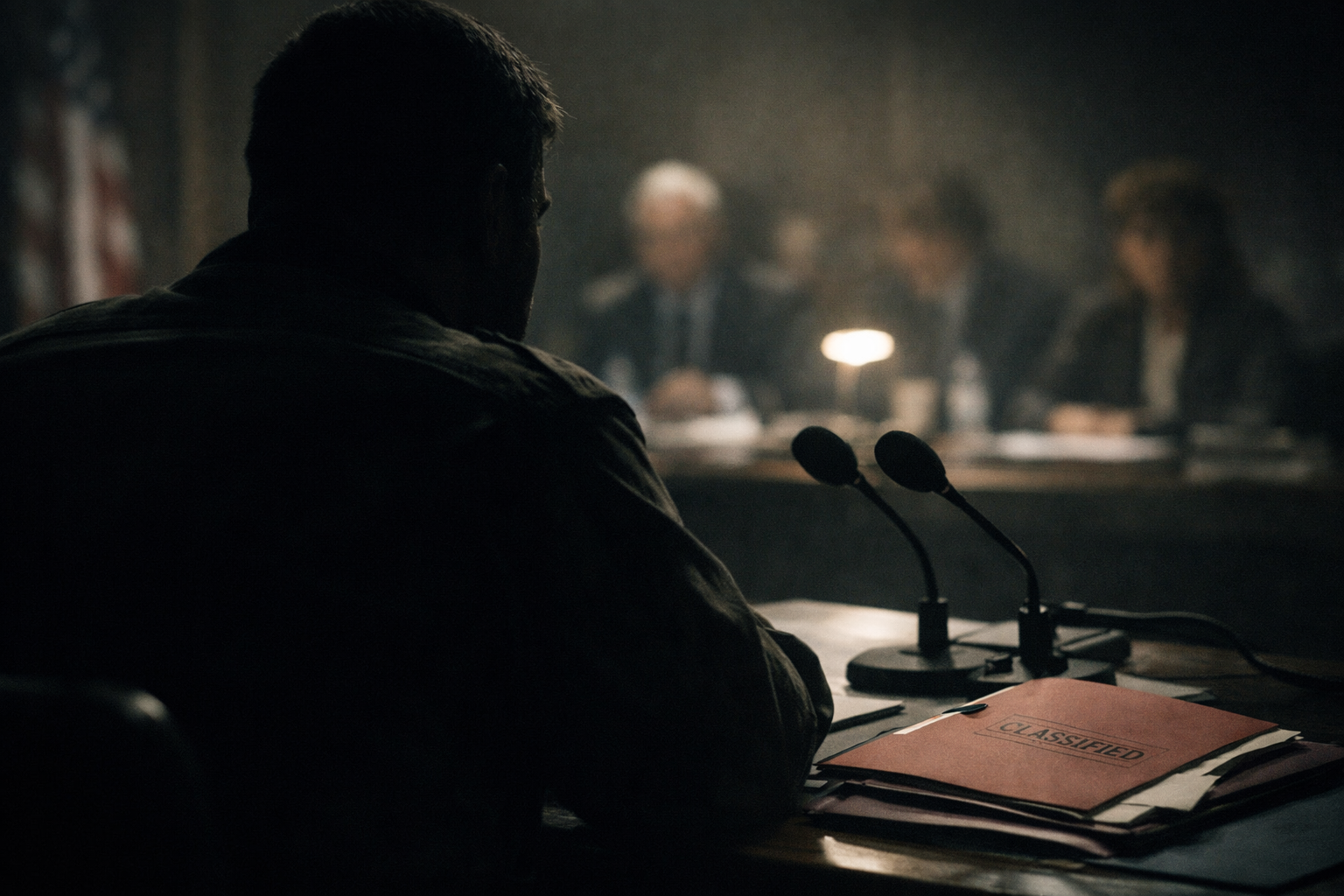
The witness is sworn in, the cameras are rolling, and the room suddenly feels like the edge of a secret. That is why UFO whistleblower claims keep landing so hard with the public: the testimony sounds like someone has finally stepped out of a locked system, even when the proof itself still stays behind the door.
UFO whistleblower claims are allegations from insiders or former insiders who say they learned about hidden UFO or UAP programs, secret investigations, or recovered-material stories inside government and defense circles. Supporters argue that credible witnesses with security backgrounds would not risk their careers without a reason. The more grounded reality is that testimony can point to real secrecy, real disputes, or real unanswered questions, but it still does not give the public direct proof of the biggest claims on its own.
What Happened
The modern version of this story did not begin with one magical leak that solved the UFO mystery. It built up in layers. First came years of military encounters, disputed footage, and official acknowledgments that some sightings were not immediately explained. Then hearings, inspector general complaints, media interviews, and witness statements shifted the focus from strange objects in the sky to people inside the system talking about what the public still could not see.
That change matters because testimony feels different from sightings. A blurry video can be argued over forever. A radar return can be dismissed as noise or incomplete data. But when someone with intelligence, military, or contractor credentials says they were told hidden programs exist, the emotional weight moves from the object itself to the institution around it. The mystery stops being only “what was that?” and becomes “what are they not telling us?”
That is why this draft needed to be sharpened. The site already has a direct retaliation-focused piece in UFO Whistleblower Retaliation: Silenced Witnesses or the Story That Makes Claims Feel True?, and it already has a broader disclosure explainer in UFO Disclosure: Hearings, Whistleblowers, and the Proof Gap. This article works best when it stays narrower than both. Its real job is not to cover every disclosure claim. Its job is to explain why insider testimony sounds stronger than it often is.
Picture the scene people carry in their heads. A witness sits under bright lights, speaking carefully because every sentence may cross into classified territory. The witness hints that more can be said in a closed session, or that other people inside secure compartments know much more. For believers, that feels like the threshold of revelation. For skeptical readers, it is still a story about proximity to evidence rather than evidence itself.
Recent public attention around David Grusch UFO Claims: What Was Alleged, What Was Verified? made this pattern especially clear. The public heard extraordinary allegations about crash retrieval and reverse-engineering programs, but what reached most readers was still testimony, secondhand reporting, and claims about what exists in private channels. The story became powerful not because the public saw the proof, but because the public saw someone credible describe a system that allegedly contains it.
That distinction is the heart of the topic. UFO whistleblower claims do not become persuasive only because of what is said. They become persuasive because they are delivered through a format that implies hidden verification somewhere offstage.
Why People Believe It
People believe these claims for understandable reasons. First, insider status carries social force. If an anonymous poster makes a wild claim online, most readers treat it like noise. If a former intelligence officer, pilot, or defense-linked source says something similar, the same claim feels heavier. Credentials are not proof, but they change how risk is perceived. The public assumes that serious people must have serious reasons for speaking.
Second, the UFO subject already comes with a documented history of secrecy. Official programs existed. Records were classified. Investigations were rebranded, closed, reopened, or buried under new language. That history means modern witnesses do not have to persuade people that secrecy is possible. They only need to persuade them that the secrecy went further than the public was told.
Third, testimony fits the emotional shape of a hidden-truth story almost perfectly. There is an insider. There is a barrier. There is a suggestion that the final answer exists just out of reach. Once that structure is in place, every missing file, every redacted paragraph, and every closed-door briefing starts to feel less like an absence of proof and more like proof by absence.
Another reason belief spreads so fast is that formal settings amplify credibility. Congressional hearings, interviews with major outlets, and references to official complaint processes all make a claim look more settled than it really is. The audience is not just reacting to the witness. It is reacting to the stage around the witness. A hearing chamber makes uncertainty feel official. A classified add-on makes a missing answer feel meaningful.
There is also a basic human reason this works. Testimony is vivid. A witness is easier to picture than a memo. A person describing what they were told, what they could not access, or why they think something was hidden creates a story readers can emotionally enter. That emotional bridge is powerful, which is exactly why it needs careful handling.
Claims vs Evidence
Claim: Credible whistleblowers have effectively confirmed hidden UFO programs, recovered craft, or non-human technology by speaking publicly about what they learned inside the system.
What supports that claim: some witnesses do have relevant backgrounds, some complaints have been serious enough to attract review, and some allegations line up with long-running secrecy narratives around defense and intelligence programs. Public debate around Special Access Programs and UFO Secrecy: Hidden Compartments or a Theory Built on Acronyms? also makes this feel plausible to many readers, because compartmentalized programs are real and can limit who sees what.
What that does not prove: that the biggest underlying story is true. A witness can be sincere, informed, and still be passing along secondhand claims rather than public evidence. A serious allegation can deserve investigation without being confirmed. And a classified setting can explain why details stay hidden without proving that the hidden details support the witness’s conclusion.
This is where people often slide too quickly from credibility to certainty. “This person sounds believable” is not the same statement as “the public case has been demonstrated.” In UFO culture, those two ideas get blended constantly. Once that happens, witness status starts doing the work that hard evidence should be doing.
That problem becomes even clearer when you compare insider testimony with topic-specific pages like UFO Crash Retrieval Claims: Hidden Recovery Program or Testimony Without Proof?. The largest claims in the cluster are still claims about materials, craft, hidden records, or programs the public cannot directly inspect. That does not make them false. It does mean the public is usually being asked to evaluate trust rather than verify facts.
There is another tension buried inside this subject. If a hidden program is truly vast, spanning decades, agencies, contractors, and secure compartments, people expect a flood of leaks. Yet what the public usually gets is fragments: testimony, rumor chains, selective documents, and repeated suggestions that decisive proof exists elsewhere. Believers interpret that as evidence of highly effective secrecy. Skeptics interpret it as a sign that the proof gap remains open. Both readings grow from the same missing center.
The best way to stay grounded is to separate levels of evidence. Public testimony matters. Documented government interest matters. Reviews like the AARO UAP Report: Clear Answers or a Review That Left the Biggest Claims Open? matter too, especially because they show how far official review has gone and where uncertainty still remains. But none of that automatically equals confirmation of crash retrieval, reverse engineering, or non-human origin.
In other words, whistleblower claims can raise the question without answering it. They can make a theory harder to dismiss, while still leaving it far from proved.
Reality Check
The most disciplined conclusion is that UFO whistleblower claims are important but incomplete. It is clearly true that credible people have made serious allegations. It is also possible that some of those allegations reflect real classified disputes, real blind spots in oversight, or real information silos inside government and defense networks. But it is still not publicly proven that these claims add up to hidden non-human craft or an established secret program exactly as believers imagine it.
That middle position is less exciting than full disclosure rhetoric, but it fits the evidence better. Testimony can point investigators toward something worth checking. It can reveal institutional friction. It can show that the public story was too simple. What it cannot do by itself is replace documents, direct access, physical evidence, or independent verification.
Think about the burden of proof in ordinary life. If someone says, “I was told a major secret exists,” that may be enough to justify follow-up questions. It is not enough to close the case. The same rule should apply here. UFO claims often feel different only because the setting is dramatic and the topic is already loaded with decades of suspicion.
That is why this article needs to stay out of the broad “deep disclosure” lane. The real issue is not whether every witness is a hero or every skeptic is blind. The real issue is how testimony functions inside a belief system built around restricted knowledge. Once a story teaches people that the strongest proof is always just beyond public reach, every new witness can sound like confirmation even when the public record barely moves.
What would actually change the picture? Not another vague promise that more exists in a secure room. Not another clip that goes viral because a witness looked confident under oath. What would matter is authenticated records with clear provenance, direct first-hand evidence that can be examined, or multiple independent confirmations that do not rely on the same rumor chain. Until then, the strongest public result of whistleblower testimony is not solved disclosure. It is sustained tension.
Conclusion
UFO whistleblower claims endure because they sit in the most persuasive part of the modern UFO story: the point where secrecy, authority, and missing evidence all meet. They feel like a breakthrough because the witness appears to stand right next to the hidden truth, even if the audience still cannot see that truth for itself.
That is why this topic deserves its own angle. It is not mainly about retaliation, and it is not just another generic disclosure timeline. It is about the burden of proof. Credible testimony can keep a mystery alive, and it can make the public take a subject more seriously. But until the underlying evidence becomes public and testable, testimony remains a signal, not a conclusion.
So the cleanest takeaway is simple. UFO whistleblower claims may point toward real secrecy. They may preserve leads worth investigating. But for now, they mostly show why this debate keeps resetting: the witness steps forward, the room leans in, and the public still ends up one layer away from the proof it actually needs.
🔎 If this story stayed with you, the author suggests these real cases next:
- David Grusch UFO Claims: What Was Alleged, What Was Verified?
- UFO Crash Retrieval Claims: Hidden Recovery Program or Testimony Without Proof?
- Special Access Programs and UFO Secrecy: Hidden Compartments or a Theory Built on Acronyms?
Explore more Alien & UFO Theories stories here: