
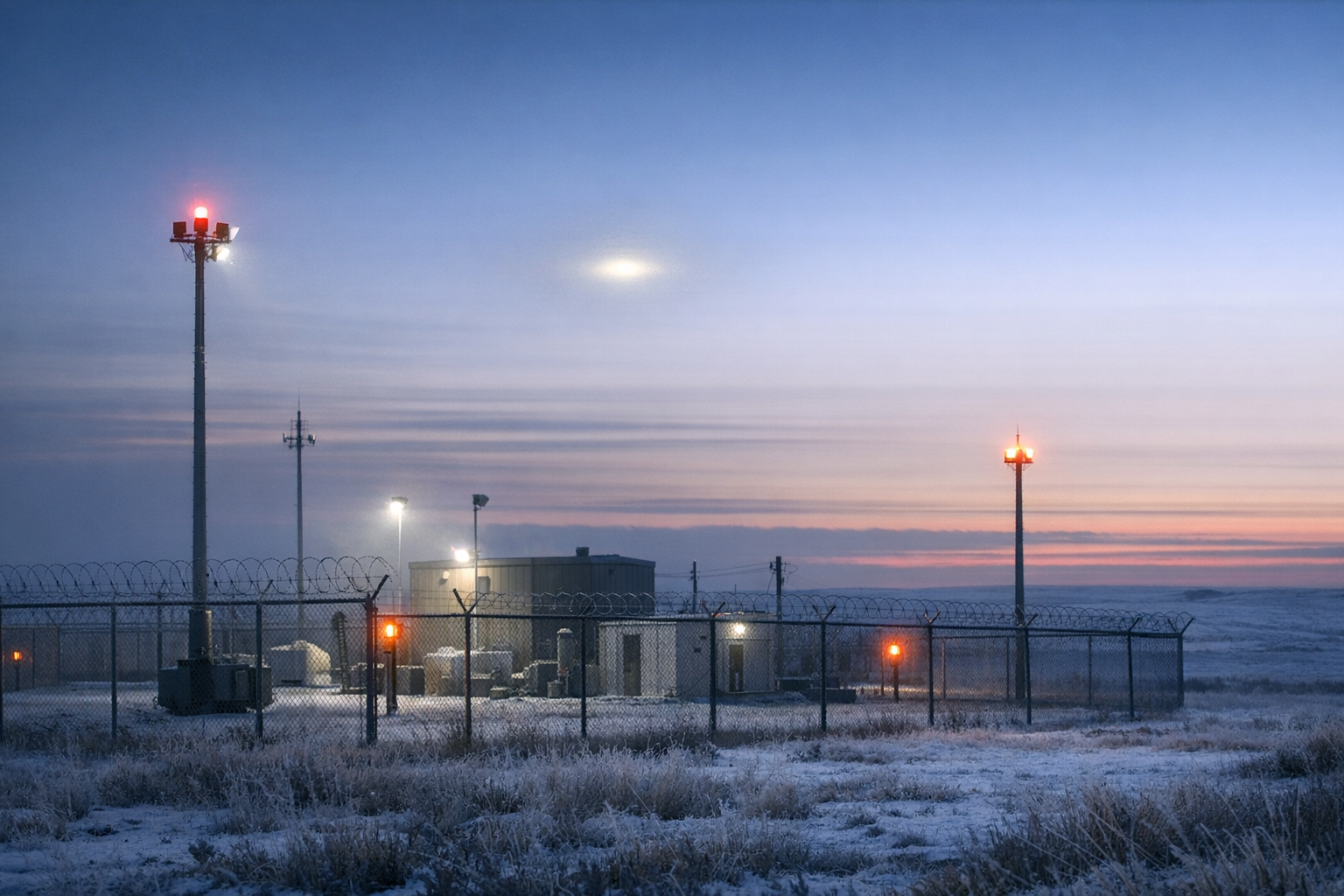
The call came from the surface, down into a sealed launch capsule buried under the Montana plains. Guards were saying they saw something strange above a nuclear missile site, and within minutes the missiles were no longer ready to launch. That is why the Malmstrom UFO incident never really goes away: it sounds like a secret brushing up against the most dangerous weapons on Earth.
The Malmstrom UFO incident refers to claims that unidentified objects were seen near Malmstrom Air Force Base missile sites in 1967, around the same time multiple nuclear missiles went offline. Supporters argue this suggests a UFO may have interfered with the missile system. The likeliest reality is narrower and more uncertain: the missile shutdown was real, witness stories exist, but the public evidence tying the shutdown itself to a UFO remains incomplete and heavily disputed.
What Happened
The center of the story is not just “UFOs over a base.” It is a specific technical claim: that a group of Minuteman missiles at Malmstrom went into a no-go condition at nearly the same time, and that this happened while unusual aerial activity was being reported nearby.
The documented part is important. In March 1967, missiles in the Echo Flight area at Malmstrom did indeed suffer a serious outage. Air Force records show that multiple missiles went offline almost simultaneously and had to be restored. That part is not rumor. It is the piece that gives the whole case its weight. If nothing had actually failed, the story would be just another Cold War sighting tale.
What turns it into legend is what came later. Years afterward, retired Air Force personnel, especially Robert Salas, said the outage happened in the middle of reports from security guards about a glowing red object or unusual lights hovering near the site. In the version that spread most widely, the scene is almost cinematic: a quiet early-morning shift, frozen ground outside, the kind of vast sky Montana is known for, then an urgent call from topside that something is hanging over the gate or near a launch facility. Then the alarms begin.
That mini-scene matters because it is how most people encounter the case. They do not start with engineering logs. They start with a missile crew underground, guards unsettled above them, and nuclear weapons suddenly dropping off alert. It feels like the kind of story that should have produced a final answer. Instead, it produced decades of argument.
There is also a second layer of confusion. The Malmstrom story is often retold as if it were one clean event, but different witnesses, flight designations, and later retellings have blurred parts of the timeline. Echo Flight is the documented missile shutdown case. Oscar Flight is often pulled into the story through witness recollections about unusual aerial reports. Over time, those threads have sometimes been woven together more tightly than the public record clearly supports.
That is why this case fits naturally inside the broader pattern covered in UFOs Over Nuclear Bases. But Malmstrom stands apart because readers are usually not asking about a broad pattern. They are asking one sharp question: did a UFO shut down the missiles?
Why People Believe It
People believe the Malmstrom story because it sits at the perfect intersection of fear, secrecy, and official ambiguity. Nuclear weapons are already surrounded by restricted access and high-stakes procedures. So when something goes wrong near a missile site, the public assumes there must be layers of information it will never fully see.
The witness factor also matters. This is not just a civilian reporting lights in the sky from a highway shoulder. The case became famous because former military personnel described it. That gives the story a different texture. Readers think: these were trained people in a controlled environment, around one of the most secure systems in the country. If they sounded shaken later, maybe something truly unusual happened.
Then there is the emotional logic of the event itself. If a UFO wanted to send a message, where would it appear? For many believers, a nuclear missile field feels like the most dramatic possible answer. The symbolism is almost too perfect. Humanity builds civilization-ending weapons, and then something unknown appears over them as if to say it is watching. That idea is powerful, even before evidence enters the discussion.
The case also benefits from the long public memory of government secrecy around UFO subjects. Once readers learn that official projects and investigations existed, they become more willing to believe there may be hidden chapters still missing from the record. Articles about government UFO programs reinforce that atmosphere. They do not prove Malmstrom, but they make the larger secrecy frame feel plausible.
And finally, Malmstrom keeps resurfacing because the case seems to promise hard evidence without ever fully delivering it. There was a real shutdown. There were real personnel. There were later witness statements. That combination gives believers more than just folklore, but less than a settled conclusion. Stories like that tend to live forever.
Claims vs Evidence
The strongest claim is simple: a UFO was present near the missile sites, and the missiles went offline because of that presence. That is the heart of the Malmstrom mystery. Everything else is secondary.
Now separate the pieces.
Claim: witnesses reported unusual aerial objects near missile facilities.
Evidence: later testimony from former personnel says such reports were made. That testimony is meaningful, but much of it became public years after the event, which makes it harder to test cleanly against the original moment.
Claim: the missile shutdown happened.
Evidence: this is supported by Air Force documentation. Multiple missiles in Echo Flight did go offline. That part is the most solid part of the entire case.
Claim: the shutdown was caused by the reported UFO.
Evidence: this is where the case weakens sharply. A real outage and a reported sighting are not the same thing as a proven causal link. Publicly available records have not given readers a clear technical chain showing that an external aerial object disabled the missiles.
This is the contradiction that keeps the story alive. The most dramatic part of the claim is also the least firmly documented. If you only focus on witness sincerity, the case seems powerful. If you only focus on public technical proof, the case seems unresolved at best.
Some skeptical readings go further and argue the witness accounts changed over time, or that details from separate events were mixed together. That does not automatically mean the witnesses invented everything. Memory is not a clean machine, especially after decades of retelling, interviews, documentaries, and debates. But it does mean the public has to be careful not to treat the most polished version of the story as if it were the original raw record.
That same tension appears in other military-UFO cases, including the analysis in Pentagon UFO Videos. Official attention can confirm that something unusual was taken seriously. It does not automatically confirm the most extraordinary explanation attached to it.
There is also a practical problem. Missile systems can fail for technical reasons that sound boring compared with a glowing object over a launch site. Boring explanations rarely win the cultural battle once a mysterious version exists. Yet for a case like this, the boring explanation is exactly what matters most. If the shutdown can be explained through system faults, power issues, testing, or other known causes, then the UFO claim becomes a parallel story rather than the demonstrated cause.
Reality Check
The most honest conclusion is that Malmstrom contains one verified event and one much-debated interpretation. Verified event: missiles went offline. Debated interpretation: a UFO caused it.
That distinction may sound less exciting than the legend, but it is what keeps the case intellectually useful. The outage is not fake. The witness reports are not meaningless. But the leap from “something strange was reported” to “an unknown craft shut down nuclear missiles” still depends on missing links the public has not been able to inspect directly.
If stronger proof existed, this would probably be one of the most important UFO cases ever documented. You would expect a cleaner record: contemporaneous reports tightly matching the later stories, technical analysis clearly ruling out normal system failure, and a chain of evidence showing that the aerial event and the outage were connected in more than timing. That is not what the public record looks like.
Instead, Malmstrom lives in the same uncomfortable space explored by the AARO UAP report: serious claims, real institutional interest, and a stubborn gap between what is alleged and what is openly proved. That gap does not erase the mystery. But it does limit what responsible writers can honestly say.
The unique angle for this article is the missile-shutdown claim itself. On that exact question, the answer is narrower than many retellings suggest. The outage is real. The witness story is real in the sense that people gave it. The causal link between the two remains unproven in public evidence.
That is why Malmstrom keeps returning whenever people talk about UFOs and national security. It offers just enough documentation to feel substantial and just enough uncertainty to resist closure. In other words, it is almost perfectly built to survive.
Conclusion
The Malmstrom UFO incident is compelling because it seems to place the unknown right beside the ultimate symbol of state power: nuclear missiles waiting underground. Few conspiracy-adjacent stories carry that kind of immediate tension.
But once the story is stripped down to its strongest parts, the key point becomes clear. The best-supported fact is not that a UFO shut down the missiles. The best-supported fact is that the missiles went offline and later witness testimony connected that failure to unusual aerial reports.
That may sound like a small difference. It is not. It is the whole case.
If new records ever close that gap, Malmstrom will deserve to be treated as a landmark event. Until then, it remains something more frustrating and more interesting: a case where the documented failure is real, the surrounding testimony is powerful, and the most important conclusion still outruns the public evidence.
🔎 If this story stayed with you, the author suggests these real cases next:
- UFOs Over Nuclear Bases: Security Threat or the Pattern That Won’t Go Away?
- Government UFO Programs: Why the Files Never Really Closed
- Pentagon UFO Videos: What the Navy Footage Confirmed — and What It Didn’t
Explore more Alien & UFO Theories stories here: