
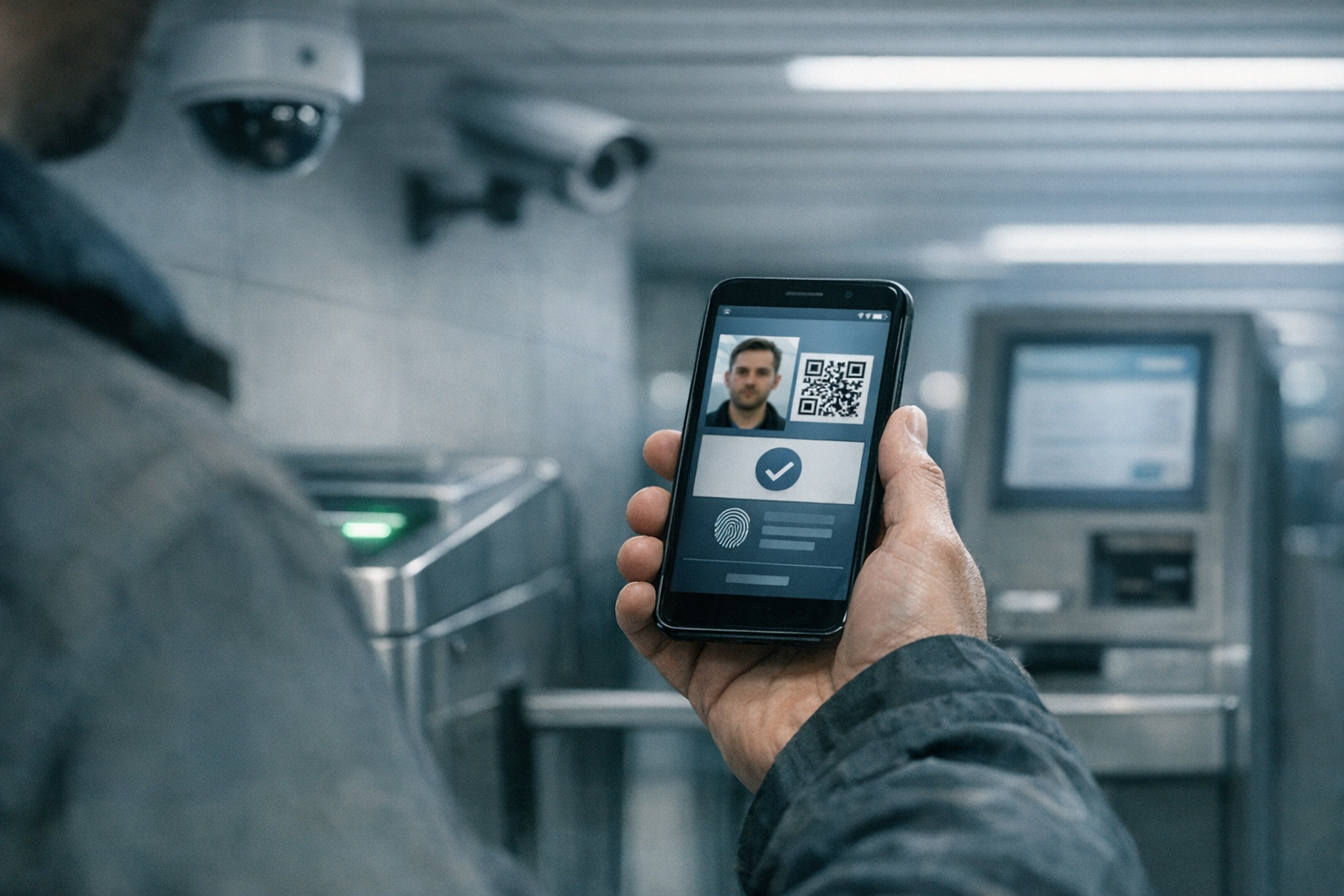
The screen lights up for half a second, asks for a face scan, and opens the gate without a word. Nobody says you have entered a control system. Nobody has to. In that quiet moment—one phone, one credential, one checkpoint, one invisible record left behind—the fear behind the digital ID conspiracy starts to make emotional sense.
A digital ID is a system that lets people prove who they are online or through connected devices, often for government services, travel, banking, or account security. The conspiracy version of the story claims these systems are not just about convenience, but about joining identity, movement, money, and behavior into one trackable network. The more grounded reality is that digital ID programs are real, and they can expand surveillance power, but the biggest control-state claims usually leap ahead of the evidence.
What Happened
Digital ID is best understood as the connective tissue between several separate modern fears, not as one isolated panic. People do not usually worry about digital identity in a vacuum. They worry about what happens when identity verification starts touching everything else.
That is why this topic keeps surfacing alongside arguments about airport screening, phone-based credentials, age verification, login security, government benefits, financial access, and online moderation. On paper, many of these systems solve normal problems. They reduce fraud. They speed up access. They give agencies and companies cleaner records. But once those systems begin to share data, or even look like they could share data, the story changes.
Imagine a person trying to renew a license, verify a payment app, enter a workplace, and log into a health portal in the same week. Each step feels routine on its own. A scan here. A code there. A selfie match. A digital wallet prompt. Nothing about any single action looks dramatic. Yet by the end, it is easy to feel as if identity has stopped being a document in your pocket and become a permanent permission layer wrapped around daily life.
That human feeling is a major reason the theory spreads. The public does not experience digital systems as policy diagrams. People experience them as small gates. When those gates multiply, even ordinary security tools can start to feel like pieces of one larger machine.
The real development underneath the fear is simple. Governments and private platforms around the world have spent years moving identity checks into digital form. Sometimes that means a phone-based government credential. Sometimes it means stronger know-your-customer checks at banks. Sometimes it means biometric verification tied to travel, employment, or social platforms. None of that automatically creates a unified tracking state. But it does create the conditions for people to imagine one.
That is where this story connects to Real ID Conspiracy: Security Standard or the Framework for National Tracking?. Real ID made many readers suspicious because it felt like an identity standard expanding through everyday infrastructure. Digital ID pushes that same fear into a newer form: less card, more system.
Why People Believe It
People believe the digital ID conspiracy because it does not begin with fantasy. It begins with pattern recognition. They can already see pieces of the pattern: more verification checks, more account linking, more biometric tools, more platform rules, and more institutions asking for identity before access.
That is a stronger starting point than many conspiracy theories get. There really are efforts to make identity portable across services. There really are systems that connect identity to permissions. There really are databases, fraud systems, and compliance tools operating behind the scenes. So when someone says digital ID is the missing link between surveillance fears, the claim lands on real ground before it stretches beyond it.
Another reason belief grows is that separate anxieties keep collapsing into one story. A person worried about facial recognition may also worry about cashless payments. A person worried about central bank digital currencies may also worry about deplatforming. A person worried about online speech controls may also worry about mandatory identity checks. These are not identical issues, but they rhyme. Once they start rhyming, people often assume they are coordinated parts of one master plan.
That is why the topic fits so neatly between biometric surveillance fears and the broader mass surveillance state discussion. Digital ID feels like the bridge. It gives a name to the moment when tracking stops looking like passive observation and starts looking like required participation.
The social-credit comparison makes the theory even stickier. Once people hear about systems that score trust, verify identity, restrict access, or shape behavior through incentives, they start imagining a future where every digital action feeds the same profile. That helps explain why social credit fears keep appearing in digital ID conversations even when the underlying policies are different.
There is also a trust problem. Many institutions say new identity systems are only for safety, efficiency, fraud prevention, or modernization. Those claims are often partly true. But the public has learned, sometimes for good reason, that systems built for one purpose can quietly expand into another. A database created for convenience can become useful for enforcement. A verification rule introduced for security can later become a gatekeeping tool.
That is the contradiction that gives this theory its staying power. The people building digital identity tools usually describe them as boring infrastructure. The people fearing them see early-stage architecture for behavioral control. Both sides are looking at the same wiring. They are just imagining different endpoints.
Claims vs Evidence
Claim: Digital ID systems are being built to merge identity, finance, movement, and speech into one central control grid.
What the evidence supports: Digital identity systems are real. Identity verification is expanding across both public and private life. Biometric checks, account linking, fraud screening, and digital credentials are increasingly common. Institutions often do want more reliable ways to know who is accessing a service, making a payment, crossing a checkpoint, or opening an account.
What that does not prove: that every digital ID effort is part of one secret, unified plan to create an all-purpose social control system.
This is the misunderstood detail at the center of the story: interoperability is not the same thing as total integration. Systems can be designed to talk to each other in limited ways without becoming one giant control dashboard. But from the outside, limited integration and future integration can look almost identical. That visual similarity is enough to fuel suspicion.
There is a second distinction people often miss. Identity systems do not have to be run by one central government authority to feel centralizing. If banks, platforms, agencies, employers, and transport systems all begin requiring stronger digital identity, the result can still feel like a single web of control even if no one office runs all of it. In other words, the public fear is not always about one villain. Sometimes it is about convergence.
That convergence logic is why the theory blends so easily with CBDC fears. Once money becomes more programmable or traceable, people naturally ask what happens if identity becomes the switch that turns access on or off. The same pattern appears with health records, benefits systems, age checks, and platform verification rules.
Still, the leap from “these systems could be linked” to “they are already a hidden social-control grid” is larger than supporters often admit. In many cases, digital ID programs are messy, fragmented, legally constrained, politically contested, and technically inconsistent. That does not make them harmless. It does make them less like a flawless secret architecture and more like a patchwork that could expand in troubling ways if left unchecked.
That patchwork point matters because conspiracy narratives often become too clean. They picture a single switchboard, a single intent, and a single destination. Real governance usually looks more chaotic. Agencies want efficiency. Companies want lower fraud. Regulators want compliance. Security teams want less risk. Civil liberties groups warn about mission creep. The result is not always a master plan. Sometimes it is a pile of incentives that accidentally builds something more powerful than any one actor publicly admits.
That is the deeper evidence question: is digital ID a hidden takeover, or is it a visible infrastructure trend that could become more controlling over time? The available evidence supports the second framing much more strongly than the first.
Reality Check
The best reality check is not to laugh off the fear. It is to separate plausible concern from inflated conclusion.
Digital identity systems really can increase surveillance capacity. They can make it easier to connect records, reduce anonymity, track access, and deny services in more automated ways. If those systems are poorly governed, loosely audited, or linked too aggressively, they can deepen the exact kinds of power imbalance people are worried about.
So the public concern is not baseless. It is rooted in something real: whenever identity becomes more digital, it often becomes more legible to institutions. And what is more legible can become more governable.
But the stronger conspiracy claim—that digital ID already proves a hidden, unified tracking state is being rolled out under one coordinated blueprint—goes beyond what the evidence clearly shows. What we see instead is a convergence risk. Different systems are moving in compatible directions. That can create a control environment without requiring a single secret command center.
In some ways, that explanation is less dramatic and more unsettling. A hidden cabal is easier to imagine than a world where bureaucratic convenience, fraud prevention, commercial incentives, and security culture all push toward the same loss of friction. If access to modern life keeps depending on verified identity, then control can grow through ordinary policy, ordinary software, and ordinary updates.
That is why the topic deserves skepticism in both directions. It is a mistake to say digital ID is nothing. It is also a mistake to say every identity system is proof of an inevitable social-credit regime. The honest position is narrower and sharper: digital ID is a real infrastructure shift, and because it can connect so many domains, people are right to watch it closely.
The most useful question is not “Is the conspiracy fully true?” The useful question is “What safeguards exist before identity systems expand further?” Can data be separated? Can access be limited? Can users appeal denials? Can participation stay voluntary in meaningful areas of life? Those are the questions that decide whether digital identity remains a tool or becomes a pressure system.
Conclusion
The digital ID conspiracy persists because it ties together a lot of separate modern fears into one clean picture. Real ID, biometrics, CBDCs, platform verification, and social-credit anxieties all start looking like parts of the same machine once identity becomes the common layer between them.
That is the angle that matters most. Digital ID does not scare people only because of what it is today. It scares them because it looks like the connector that could make other systems matter more.
So the clearest answer is this: digital IDs are real, and they can support more tracking and control than institutions usually admit in their public sales pitch. But the evidence stops short of proving one finished secret grid already rules the whole landscape. What exists right now is something more ordinary and more important to watch: a growing identity infrastructure that can either stay limited or become the backbone of a much tighter permission-based society.
If this story stayed with you, these related investigations are worth reading next:
- Real ID Conspiracy: Security Standard or the Framework for National Tracking?
- Biometric Surveillance Conspiracy: Public Safety Tool or the Next Step Toward Permanent Tracking?
- CBDC Conspiracy: Financial Control Grid or a Fear Built on Real Surveillance Anxiety?
Explore more Political Conspiracies stories here: