
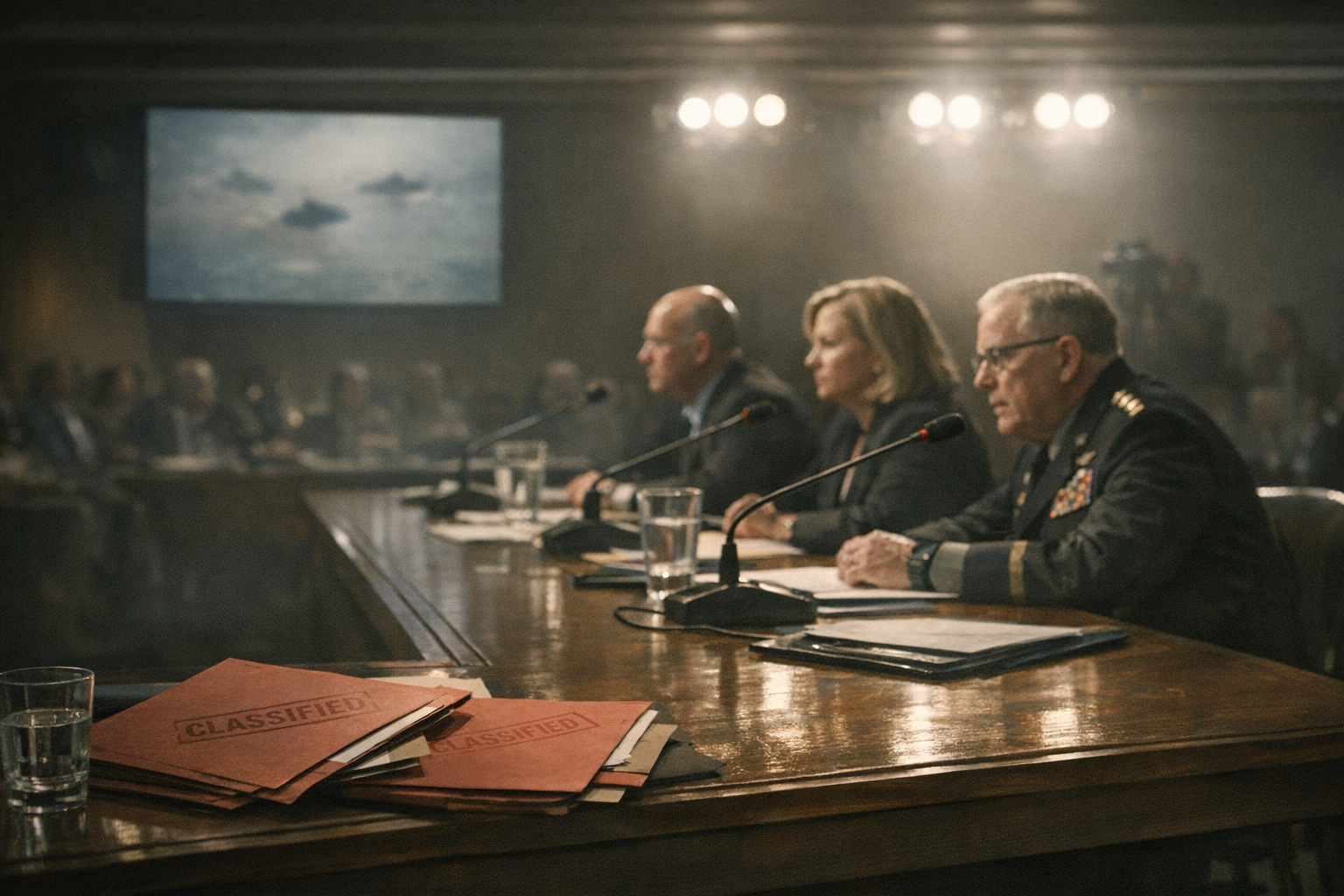
Behind the cameras and the clean sound bites, the latest hearing room felt like a vault with the door cracked open just an inch. Lawmakers spoke carefully, witnesses hinted at hidden compartments inside government, and for a few hours the old feeling returned: maybe this time the public was finally standing close to something it was never meant to see.
The 2026 UAP hearing claims are the newest round of public arguments over unidentified aerial phenomena, secret programs, and government disclosure. Supporters say the hearing added fresh testimony and pushed officials closer to admitting more than they have before. The more cautious reading is that some details were new, but the basic pattern was familiar: serious allegations, partial corroboration around process, and a public evidence gap where the biggest claims still remain unproven.
What Happened
The latest UAP hearing did not appear out of nowhere. It arrived after years of leaked videos, official task forces, whistleblower claims, inspector general complaints, and repeated public pressure for answers. By the time cameras turned on, the room already carried the weight of that backlog.
At the center of the hearing were claims about hidden information, restricted access, and whether parts of the government know more about unusual aerial incidents than they have publicly admitted. Some lawmakers focused on oversight. Some focused on aviation safety. And some leaned into the possibility that secret legacy programs still sit behind layers of classification.
That mix matters. A hearing like this is never just one story. It is at least three stories moving at once: a national security story, a bureaucracy story, and a public mystery story. People often hear the third one loudest, but the first two usually explain more.
There was also a familiar human scene beneath the headlines. Witnesses answered in careful fragments. Members asked questions that sounded blunt but often ran into the same wall: what can be said in public, what belongs in closed session, and what remains a claim without documents the public can inspect. In that sense, the hearing felt less like a revelation than a checkpoint in a very long argument.
What was actually new? Mostly the current packaging. New hearing, new phrasing, newer references, and a fresh round of political attention. But the core structure looked familiar to anyone who has followed this topic through the modern disclosure timeline: testimony raises stakes, officials acknowledge interest, public attention spikes, and then the hardest evidence remains just out of reach.
Why People Believe It
People believe hearings like this matter because hearings feel official. A rumor on a forum can be ignored. A witness speaking under oath in a government chamber feels different. Even when a hearing does not prove the biggest claims, it changes the emotional temperature of the story.
There is also a trust problem working underneath the entire subject. The U.S. government really did study UFO reports at different times and under different names. That history means skepticism toward official denials is not irrational by itself. When a system has kept secrets before, people naturally wonder what else remains hidden.
That is why the hearing language lands so hard. Phrases like restricted access, compartmented programs, and withheld records do not sound like fantasy language. They sound like the normal grammar of real secrecy. Once that tone is set, many listeners start filling in the blanks with the biggest possible explanation.
Another reason belief grows is that the hearing did not exist alone. It connected naturally to stories readers already know, including David Grusch’s claims, debates over the AARO UAP report, and the spread of names like Immaculate Constellation. Each new event feels less like an isolated moment and more like another tile in a mosaic.
There is also a simple psychological force at work: people hate an unfinished picture. If officials admit that some encounters remain unexplained, many readers do not stop at “unexplained.” They move immediately to “covered up.” That jump is emotionally satisfying because it closes the gap. But satisfying is not the same thing as proven.
Claims vs Evidence
The strongest claim around the hearing is that it represented genuine new disclosure. That is partly true in a narrow sense. New testimony, new questions, and new public pressure do count as developments. But “new disclosure” can mean two very different things.
It can mean new public conversation. On that level, yes, the hearing was new. It added momentum, gave reporters fresh material, and forced officials to respond again. But if it means new public proof of hidden nonhuman craft, recovered materials, or secret programs operating beyond oversight, the case is much weaker.
This is the same distinction that often gets lost in UFO coverage. Process evidence is not object evidence. A witness can credibly describe being blocked, ignored, or alarmed by what others told them. That may support the idea that something inside the system deserves investigation. It does not automatically verify the most dramatic version of the story.
That is why the hearing sits in the same gray zone as other modern disclosure moments. The public may gain better evidence that officials argue internally, classify aggressively, or protect sensitive compartments. But that still leaves the biggest question open: what, exactly, is being hidden, if anything, beyond ordinary defense secrecy?
A misunderstood detail is the word “unidentified.” In public debate, it often gets treated like a path leading directly to extraterrestrial proof. In practice, unidentified usually means something more limited: the available data was not enough to make a confident call. That may be interesting. It may even be troubling from a defense standpoint. But it is not the same thing as confirmation.
The same logic applies to renamed or newly surfaced program labels. A striking name can travel far faster than the evidence attached to it. Readers saw that with Immaculate Constellation, just as they saw it earlier with older program debates covered in government UFO program history. The name creates shape. The proof has to do much more work.
Reality Check
The cleanest reality check is this: the hearing may matter politically before it matters evidentially. That sounds deflating, but it is important. Political significance means the topic is now difficult to push fully back into the shadows. Lawmakers, journalists, and agencies have to keep addressing it. That is real.
But evidential significance is a higher bar. To clear it, the public would need material that can be inspected, challenged, and verified beyond storytelling. Documents with substance. Data with chain of custody. Images or objects with serious analysis behind them. Or multiple direct witnesses whose claims can be independently checked in a meaningful way.
Right now, the hearing still points more toward unresolved oversight questions than toward a settled answer about nonhuman technology. That may frustrate both believers and hard skeptics. Believers want the last locked drawer opened. Skeptics want the cycle to stop unless hard proof appears. Instead, the public gets something messier: enough seriousness to keep watching, not enough evidence to close the case.
There is also a contradiction worth noticing. Each new hearing is promoted as if it might finally break the pattern, yet the pattern itself keeps repeating. Testimony grows. Headlines multiply. Program names circulate. Public trust strains further. And still, the gap between allegation and verifiable proof remains the central fact of the story.
That does not mean nothing is there. It means the hearing does not solve the problem people want solved. If anything, it sharpens it. The latest round may have shown that officials cannot simply laugh the subject away anymore. But it did not turn suspicion into conclusion.
In plain terms, the most honest answer is that the 2026 hearing gave the disclosure era another burst of energy while leaving its biggest weakness untouched. The mystery is not kept alive by one explosive fact. It is kept alive by the repeated collision between official secrecy, partial admissions, and the absence of publicly testable proof.
Conclusion
The latest UAP hearing claims matter because they show the disclosure story is still moving. They added visibility, pressure, and another layer to the public record. But when you strip away the atmosphere of secrecy and the pull of headline language, the hearing still fits an older pattern more than it breaks one.
That is the angle worth holding onto. What is new here is not a fully new reality. It is a new chapter in the same long struggle between testimony and verification. For now, the hearing widened the conversation more than it closed the case.
🔎 If this story stayed with you, the author suggests these real cases next:
- David Grusch UFO Claims: What Was Alleged, What Was Verified?
- AARO UAP Report: Clear Answers or a Review That Left the Biggest Claims Open?
- Alien Disclosure Timeline: Are We Seeing Revelation or Repackaged Secrecy?
Explore more Alien & UFO Theories stories here: