
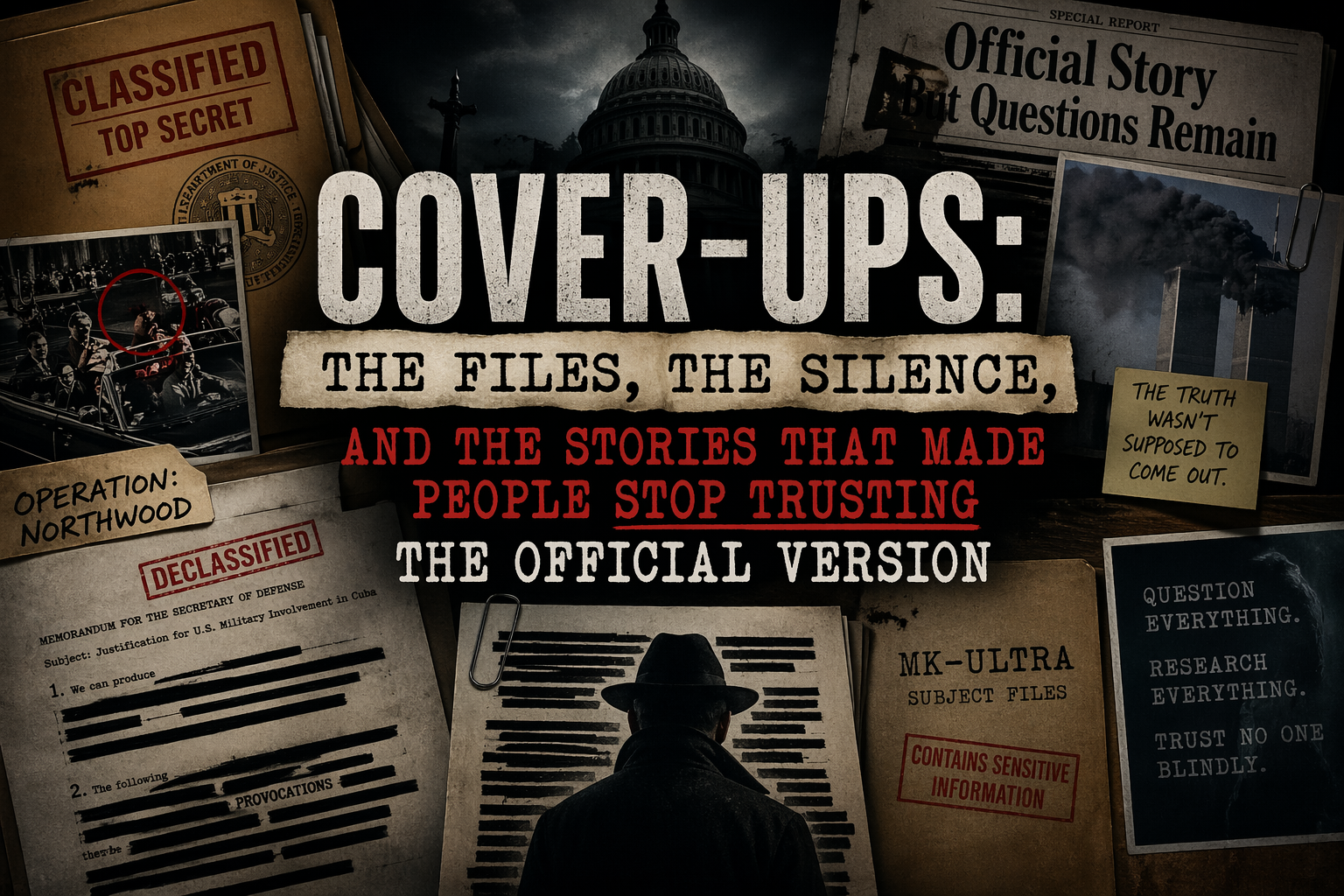
A cover-up does not need to be fully proven to change a country’s trust forever. Sometimes the thing that breaks belief is not a confession, a leaked tape, or a final smoking gun. Sometimes it is the silence. A file stays sealed too long. A family gets half-answers. A whistleblower speaks and then disappears into a wall of lawyers, denials, or redacted pages. That is the point where the official version may still stand on paper, but it no longer feels complete in the public mind.
That is why cover-up stories are so powerful. They do not all belong to the same kind of event, and they do not all end the same way. Some involve governments hiding ugly truths. Some involve institutions protecting themselves while people suffer. Some begin with real documented misconduct and then collect speculation around the edges. Others are mostly myth, but they survive because the culture has already learned one uncomfortable lesson: when powerful systems control information, doubt grows fast.
The Cover-Ups category works best when you read it as a pattern, not a pile. Operation Northwoods shows what happens when a declassified plan proves officials once discussed deception at a shocking level. The Tuskegee Syphilis Study shows the long human cost of a real, documented cover-up carried out in the name of institutional control. Princess Diana Death Theories shows how a tragedy surrounded by fame, speed, and conflicting public emotion can create an information vacuum that conspiracy fills almost instantly. Boeing Whistleblower Cases brings the pattern into the present, where public distrust moves at internet speed. And The Montauk Project sits at the outer edge, where a lack of proof does not stop a cover-up legend from becoming culturally durable.
Where to Start
If you want the cleanest path into this category, start with the cases that show the full range. Begin with Operation Northwoods, because it is the easiest reminder that institutions really have proposed deception in the past. Then read The Tuskegee Syphilis Study, because it shows how real secrecy can destroy trust across generations. Move next to Princess Diana Death Theories, where the evidence is more contested but the vacuum of trust is just as important. After that, read Boeing Whistleblower Cases to see how modern corporate stories become cover-up narratives almost in real time. Finish with The Montauk Project, which shows how a story can survive mostly because the culture already expects hidden programs to exist.
What Makes a Cover-Up Story Stick
The most durable cover-up narratives usually have four ingredients. First, there is a real institution people believe is capable of hiding something: a government agency, a military system, a corporation, or a royal establishment. Second, there is a gap between what the public first hears and what later evidence reveals. Third, there is a human cost, because stories become unforgettable when people can point to victims, families, or witnesses who seem to have been pushed aside. Fourth, there is delayed disclosure. The longer information stays restricted, partial, or inconsistent, the easier it becomes for suspicion to harden into a lasting worldview.
That does not mean every cover-up theory is equally strong. It means the public has learned to treat information gaps as meaningful. In a healthy trust environment, a delay might look like bureaucracy or confusion. In a damaged trust environment, the same delay looks like intent. This is the emotional logic behind the category. Once a society has seen enough real secrecy, even weak cases gain strength by standing next to stronger ones.
Operation Northwoods and the Proof That Some Plans Were Real
Operation Northwoods matters because it removes the easiest skeptical escape route. You cannot dismiss it as mere fantasy, because the proposal was real, documented, and declassified. The plan was not carried out, and that detail matters. But its significance lies in the fact that it reached formal discussion at all. Once people learn that officials seriously considered staging or simulating incidents to shape public support, a threshold gets crossed. The imagination no longer has to do all the work.
This is one reason cover-up culture keeps returning to Cold War material. The era produced a historical archive that feels stranger than fiction while still being rooted in paper trails. When a real document proves that high-level deception was discussed, it changes how later generations interpret every secrecy dispute that follows. Northwoods is less important as a one-off scandal than as a permanent demonstration that state power and narrative control have, at times, been more entangled than the public was meant to see.
Tuskegee and the Cost of Silence
The Tuskegee Syphilis Study shows the category at its most devastating because this was not only a trust problem. It was a human betrayal. Men were misled. Treatment was withheld. Institutions continued the study despite mounting ethical knowledge. This is not a story that needs exaggeration. The documented facts are already enough to explain why communities remember it as a wound rather than a case study.
Tuskegee also explains why medical and government mistrust can persist long after official apologies arrive. Once people know that authorities once hid the truth while presenting themselves as caretakers, later public-health messaging no longer enters a neutral space. It enters a memory field shaped by betrayal. That is a crucial lesson for the entire Cover-Ups category: real secrecy does not stay contained inside one era. It teaches future audiences how to interpret new uncertainty.
Princess Diana and the Vacuum That Conspiracy Loves
Princess Diana Death Theories sits in a different part of the category because the strongest conclusions are far less certain. Official investigations blamed the fatal crash on speed, intoxication, and the chaotic pressure around the event. Yet the public never processed it as a simple traffic story. The setting was too charged, the symbolism too heavy, and the emotional stakes too high. When one of the most watched women in the world dies in a sudden, violent, globally televised shock, suspicion arrives before the evidence has finished forming.
This is how cover-up stories expand beyond proven misconduct. A tragedy with incomplete, messy, or emotionally unsatisfying answers becomes a magnet for larger theories. The more public pressure, fame, and institutional distance involved, the more people feel that a normal explanation cannot possibly be the whole truth. Diana’s case shows that a cover-up narrative does not need conclusive proof to become durable. It only needs enough unresolved space for the public to keep asking whether the official story settled too little, too fast.
Boeing, Whistleblowers, and the Modern Speed of Distrust
Boeing Whistleblower Cases brings the category into a new environment, one where institutional suspicion moves faster than formal investigation. A whistleblower speaks. News breaks. Legal filings appear. A death or disputed event enters the timeline. Within hours, online audiences begin assembling a pattern. Some of that pattern-building is responsible scrutiny. Some of it outruns the evidence. But the speed itself is the story. Modern cover-up culture no longer waits for books, documentaries, or archives. It forms in public, in real time.
The reason the Boeing case resonates so strongly is that it combines recognizable institutional incentives with life-and-death stakes. People already know large systems can protect themselves, bury embarrassing information, and frame failure as isolated error. Once that expectation exists, every missing answer looks intentional. Whether a particular suspicion proves true is a separate question. The larger point is that modern audiences are primed to interpret silence as strategy, especially when corporations control complex systems the public cannot directly inspect.
Montauk and the Myth Edge of the Category
The Montauk Project shows what happens when the cultural memory of real secrecy gives legend extra power. The claims around mind control, underground experiments, time travel, and hidden military research remain unverified. The strongest evidence does not support the wildest conclusions. But the story survives because it sounds like the kind of thing a secrecy-saturated culture has been trained to half-believe. A closed base, restricted spaces, rumors of classified programs, and books that connect one hidden-history claim to another are enough to keep the myth alive.
This matters because it explains the outer boundary of the category. Cover-up culture does not stop at what can be proven. It expands into the territory where real institutional secrecy, speculative storytelling, and public imagination start feeding each other. Montauk is not strong because the evidence is strong. It is strong because the surrounding cultural conditions make the story feel possible.
Claims, Evidence, and the Trust Gap
The best way to read these stories together is to resist two equal mistakes. One mistake is to assume every official denial is false simply because some institutions have lied before. The other is to assume every conspiracy interpretation collapses because some claims overreach. The truth sits in the harder middle. Some cover-ups are real and documented. Some are partially real, then layered with speculation. Some are mostly myth but still socially powerful because earlier real scandals trained the public not to relax.
What we do know is that cover-up stories gain force under three conditions: when disclosure is delayed, when institutions protect themselves first, and when ordinary people feel the official explanation leaves the most human questions untouched. That is why the category is larger than any one case. It is really about the moment public trust cracks and never fully seals again.
The Stories That Made People Stop Trusting the Official Version
Cover-Ups: The Files, the Silence, and the Stories That Made People Stop Trusting the Official Version is not a claim that every famous cover-up theory is true. It is a map of why these stories matter so much, and why they keep returning. Operation Northwoods proves that shocking deception proposals can be real. Tuskegee proves that institutional betrayal can be historical fact. Princess Diana shows how emotionally unresolved events create permanent suspicion. Boeing shows how little time modern audiences need to build a concealment narrative. Montauk shows how myth grows fastest where secrecy already taught people to expect hidden layers.
Once you see the category that way, the pattern becomes harder to ignore. The stories that changed public trust were not always the loudest ones. They were the ones where silence felt active, where withheld information felt deliberate, and where the official version arrived looking technically complete but emotionally unfinished. That is where cover-up culture lives. Not only in what was hidden, but in what people learned from the hiding.