
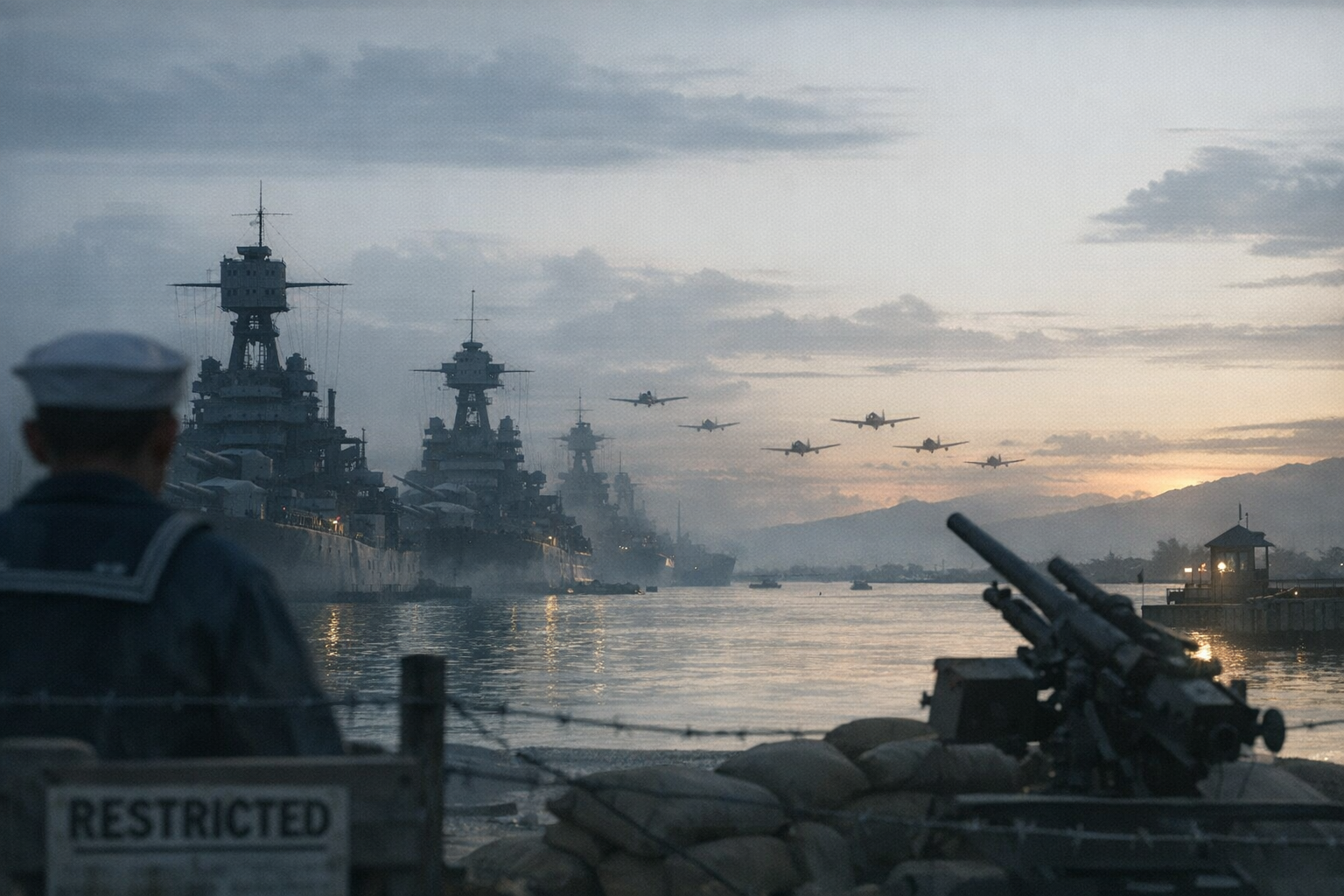
The warnings were scattered across desks, coded into intercepts, and buried in routines that felt too ordinary to fear. In the tense days before December 7, 1941, the idea of Pearl Harbor foreknowledge began with a haunting image: men in uniform handling fragments of danger while the harbor itself still looked calm in the morning light.
What Happened
On the morning of December 7, 1941, Japanese aircraft struck the U.S. Pacific Fleet at Pearl Harbor in Hawaii. The attack killed more than 2,400 Americans, damaged or sank multiple battleships, destroyed aircraft, and pulled the United States directly into World War II. To the public, it looked like a complete surprise. That feeling of shock shaped the entire American memory of the event.
But almost as soon as the smoke cleared, another question followed behind the first one. Could something this large really happen with no warning at all? The United States and Japan had been moving toward conflict for months. Negotiations were collapsing. Sanctions had tightened. Japanese expansion in Asia had raised alarms. The Pacific was not peaceful. It was loaded with tension.
That is why the foreknowledge theory never fully disappeared. It does not start with a wild fantasy about secret machines or impossible physics. It starts with a more human suspicion: if war was clearly approaching, maybe people in power saw the blow coming and failed to stop it, or worse, allowed it to happen because the political result would be useful.
The facts behind that suspicion are real enough to keep the story alive. U.S. leaders had sent war warnings to commanders in Hawaii in late November 1941. Admiral Husband E. Kimmel and General Walter Short were told that negotiations with Japan had effectively broken down and that hostile action was possible at any moment. Those warnings mattered, but they were broad. They did not say Pearl Harbor would be the target. They reflected a fear of war in the Pacific, especially against places like the Philippines, Thailand, or British territories.
Then came the smaller moments that look chilling in hindsight. On the morning of the attack, a U.S. destroyer, the USS Ward, reported engaging a Japanese midget submarine near Pearl Harbor. A radar operator also spotted a large incoming formation of aircraft, but it was dismissed because American bombers were expected from the mainland. At the harbor itself, ships were lined up in ways that made them easier to hit, and many aircraft were grouped together because commanders were more worried about sabotage than an air raid.
Picture that morning for a second. Men are beginning a Sunday routine. Some are on shore leave. Others are working through a quiet shift. A radar blip appears. A submarine report comes in. Somewhere else, diplomats are still moving through the final motions of a collapsing peace process. No single piece looks like a complete picture. But when later generations lay those pieces side by side, the pattern starts to feel eerie.
That eerie feeling is the fuel behind Pearl Harbor foreknowledge. If clues existed, why were they not assembled in time? If Japanese intentions were becoming obvious, why was the harbor not in a stronger defensive posture? And if some officials understood that an attack might unite the American public behind war, did that create an incentive not to push too hard against the danger?
Why People Believe It
People believe this theory because it lives in the space between documented warning and documented failure. There really were signs of danger. There really were intercepted communications, rising tensions, and official messages that war could break out. There really were missed warnings on the morning itself. That means believers do not have to invent everything from nothing. They can point to real fragments and say the fragments add up.
There is also a political reason the theory feels plausible. Pearl Harbor transformed American opinion overnight. Before the attack, debate over entering the war had been intense. After the attack, it largely vanished. That makes the event look, from a conspiratorial angle, almost too convenient. If a single shocking blow could accomplish what months of argument could not, some people naturally wonder whether leaders saw strategic value in that shock.
Supporters also point to comments and records that sound suspicious when pulled out of context. One of the most quoted examples is Secretary of War Henry Stimson’s diary entry about how the United States might maneuver Japan into firing “the first shot.” To believers, that line sounds like open proof of a deliberate trap. In practice, it shows something more limited but still important: U.S. leaders wanted Japan to appear as the aggressor if war came. That is not the same thing as proving they knew the exact target, date, and method of attack.
The theory gains power from how governments sometimes really do hide things. History has no shortage of secret planning, intelligence failures, or official half-truths. That is part of why readers who distrust simple explanations often move from Pearl Harbor to other historical mysteries such as the JFK assassination. Once people see one national trauma as only partly explained, they begin scanning others for the same fingerprints.
There is a psychological layer too. Randomness is hard to accept after a disaster. A chaotic mix of underestimation, poor communication, and bad luck feels unsatisfying. A hidden hand feels cleaner. It gives shape to the pain. It turns a catastrophe into a plot. In that sense, the foreknowledge theory is not just about wartime intelligence. It is about the human need to believe that events this large must have a design behind them.
Claims vs Evidence
Claim: President Roosevelt and top U.S. officials knew Japan would attack Pearl Harbor specifically and allowed it to happen.
Evidence: There is no confirmed evidence showing Roosevelt or his inner circle possessed a clear, actionable warning that Pearl Harbor itself would be attacked on the morning of December 7. What the historical record does show is broader awareness that war with Japan was increasingly likely and that hostile action could happen soon.
Claim: Intercepted intelligence proved the attack was coming, but it was hidden from Hawaii on purpose.
Evidence: The United States had access to important diplomatic and intelligence material, including decrypted Japanese communications. However, historians generally note that the available information was incomplete, fragmented, and often more useful in hindsight than in real time. It signaled danger, but not a clean, unmistakable attack order for Pearl Harbor.
Claim: The November 27 war warning proves commanders in Hawaii were set up to fail.
Evidence: The warning was real and serious, but it was also general. It did not point directly to Hawaii. Kimmel and Short interpreted the danger differently, focusing more on sabotage and broader Pacific threats than on a carrier-based surprise strike against the harbor. That does not erase their responsibility, but it does make the failure look more like a breakdown in judgment and preparation than a simple scripted sacrifice.
Claim: The radar sighting and submarine report on the morning of the attack prove Washington or local commanders deliberately stood down.
Evidence: Those incidents show missed opportunities, not clear proof of deliberate stand-down orders. The USS Ward report was not acted on fast enough. The radar contact was misread. Both are disturbing. Both show how real warnings can fail inside a system. But neither one proves a conscious decision to let the attack happen.
Claim: Multiple official investigations only existed to cover up the truth.
Evidence: There were numerous official inquiries into Pearl Harbor, and their findings generally pointed toward intelligence gaps, poor coordination, underestimation of Japanese capability, and confusion between Army and Navy responsibilities. Critics argue these inquiries protected higher-level officials. That criticism is part of why the theory survived. Still, the existence of flawed or politically limited investigations does not automatically confirm the biggest claim.
In other words, the evidence supports secrecy, bureaucratic failure, and reasons for suspicion. It does not clearly support the strongest version of the conspiracy. That distinction matters. A story can involve real withheld information and still fall short of proving deliberate sacrifice.
Reality Check
The most grounded conclusion is that Pearl Harbor was neither a perfect surprise nor a fully known attack that leaders calmly accepted. It was a collision between growing strategic warning and terrible operational failure. That is less dramatic than the strongest conspiracy version, but it fits the record better.
Japan’s intentions were becoming increasingly aggressive, and American officials knew war was possible. Yet knowing war is possible is not the same as knowing exactly where the blow will land. Intelligence before Pearl Harbor was spread across different offices, services, and assumptions. Signals were incomplete. Some officers expected attacks elsewhere. Others underestimated the possibility of a carrier strike on Hawaii. Once the attack happened, those errors looked unforgivable, and that made room for theories that replaced confusion with design.
There is also an uncomfortable middle ground here. A government does not have to know every detail in advance to still bear blame for conditions that made a disaster more likely. Poor coordination, excessive secrecy, and weak communication can create outcomes that feel indistinguishable from betrayal to the people who suffer them. That is part of why the story remains potent. To many Americans, the difference between being deliberately sacrificed and being disastrously unprotected can feel morally thin.
But if the goal is clarity, the strongest responsible statement is this: there is no confirmed proof that Roosevelt knowingly allowed the Pearl Harbor attack to proceed in order to enter the war. There is strong evidence that the United States had warning signs, interpreted them badly, and failed to build a defense equal to the danger. That is a serious historical failure on its own.
It is also why Pearl Harbor belongs beside stories like the Moon Landing Hoax, where public doubt thrives not only on facts, but on what people think powerful institutions are capable of hiding. Sometimes that doubt exposes real cracks. Sometimes it stretches those cracks into a grand design that the evidence cannot actually support.
Conclusion
Pearl Harbor foreknowledge endures because it asks a question that never feels fully settled: when warning signs exist before a national disaster, where does incompetence end and hidden intent begin? That question is bigger than one harbor in Hawaii. It goes straight to the public’s trust in power.
What we do know is enough to keep suspicion alive. Officials saw rising danger. Commanders were warned. Signals were missed. The attack was not born out of total peace and total ignorance. But what we do not have is solid proof that top leaders knowingly allowed Pearl Harbor itself to be struck as part of a deliberate political strategy.
So the story lands in a difficult place: partially explained, still argued over, and powerful precisely because the documented failures were real. Sometimes conspiracy theories survive not because the biggest claim is proven, but because the smaller truths underneath it are serious enough to make people wonder what else stayed hidden.
🔎 If this story stayed with you, the author suggests these real cases next:
- JFK Assassination: What Really Happened in Dallas?
- Moon Landing Hoax: Was Apollo 11 Real or the Greatest Illusion Ever Created?
- Ancient Aliens: Did Extraterrestrials Really Shape Human Civilization?
Explore more Historical Conspiracies stories here: