
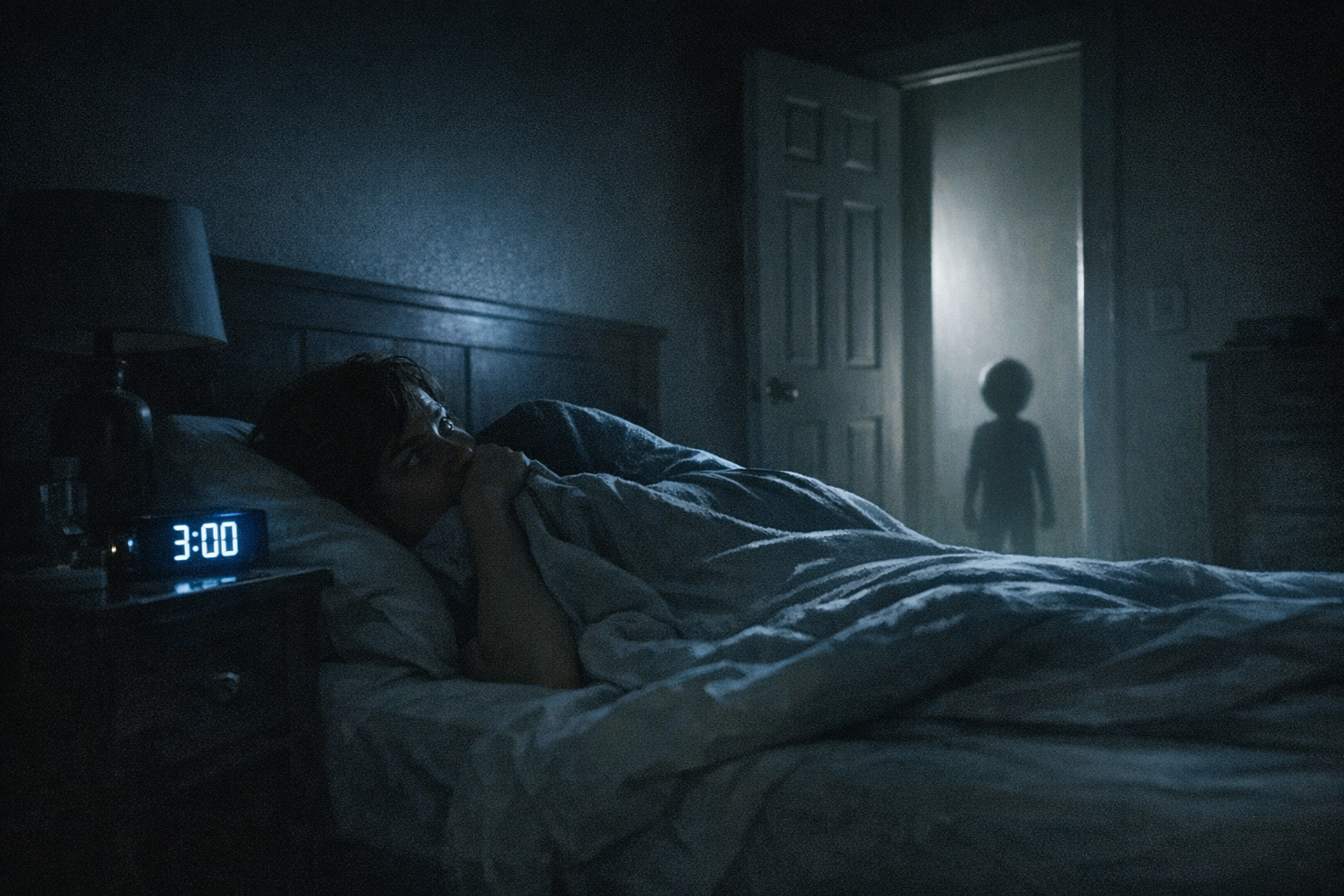
The bedroom is dark, the clock glows 3:17 a.m., and for one frozen second the door looks wider than it should. A person tries to lift an arm and nothing happens. In that terrible stillness, alien abduction stories stop feeling like internet folklore and start feeling like forbidden evidence from somewhere just outside the room. That is part of why these accounts endure: they begin in private, in fear, and in places where no one else can confirm what happened.
What Happened
Alien abduction claims became a major part of UFO culture in the second half of the twentieth century. The basic pattern is now familiar. A person reports missing time, an encounter with unusual beings, bright lights, a sudden inability to move, or memories that return in fragments. Some describe a bedroom visit. Others describe being taken from a car on an empty road. Many say the event felt more real than an ordinary dream.
One reason these cases spread so widely is that the stories often share striking details even when the witnesses are strangers. People report small gray beings, medical-style examinations, intense white light, humming sounds, floating sensations, and the disturbing sense that ordinary rules stopped working. That overlap makes believers think they are seeing a real pattern rather than random imagination.
🔎 Related Investigation:
But the history is more complicated than that. Famous cases helped shape the script. The 1961 Betty and Barney Hill case became one of the most influential abduction stories in American culture. Their report included missing time, unusual lights, and later recalled imagery that reached millions through books, interviews, and television. After that, later witnesses often described experiences that sounded similar. That does not automatically make them false. It does mean later reports emerged in a culture that already had a strong template.
Then there are the highly emotional modern accounts. A person wakes up in bed, chest tight, eyes open, sure that something is standing near the wall. The figure may look human for a second, then wrong in some small way: too thin, too still, too silent. They try to shout for help and nothing comes out. When movement returns, the room is empty. By daylight, the witness is left with a hard question: was that a terrifying brain event, or a genuine encounter no one else can prove?
Some of these stories overlap with broader UFO witness culture. People who already feel drawn to unexplained sightings may interpret odd nighttime experiences through the same lens used for cases like UFO Sightings: What People Are Really Seeing in the Sky. Others connect abductions to high-profile witness narratives such as Travis Walton UFO Incident: The 5 Days That Turned a Logger Into a Legend, where missing time and personal testimony became central to the mystery.
Over time, abduction stories moved from fringe reports into documentaries, talk shows, books, and online forums. That visibility gave witnesses language for their own experiences, but it also created a feedback loop. The more the culture repeated a certain kind of alien encounter, the easier it became for new experiences, memories, and fears to fit that pattern.
Why People Believe It
The first reason people believe abduction claims is simple: the witnesses often sound sincere. Many do not present themselves like performers chasing fame. They sound shaken, embarrassed, or even reluctant. Some say they avoided talking for years because they knew how unbelievable it would sound. That kind of emotional honesty can be powerful.
The second reason is that the experiences feel intensely physical. People report pressure on the chest, racing heartbeat, temporary paralysis, buzzing sounds, marks on the skin, and vivid sensory details. A story becomes harder to dismiss when the person telling it is not just describing an idea, but describing a body-level memory.
🔎 Related Investigation:
There is also the pattern argument. Believers point out that different witnesses describe similar beings and similar events. In their view, that consistency suggests a shared external cause. If people in different places keep describing bright lights, missing time, and nearly identical visitors, the theory starts to feel less like fantasy and more like a hidden reality.
Another reason belief survives is distrust. Many people assume that if nonhuman encounters were happening, governments or institutions would never admit it openly. That mindset means the lack of official confirmation does not weaken the theory for believers. Sometimes it strengthens it. Silence becomes suspicious.
And then there is the emotional force of the stories themselves. Abduction accounts do not just present a puzzle. They present a violation. A person is in a home, a car, or a familiar landscape and suddenly loses control. That makes the stories memorable in a way that dry evidence debates are not. Even skeptical listeners can feel the fear in them, and fear travels fast.
Claims vs Evidence
Claim: People reporting alien abductions are describing literal encounters with nonhuman beings.
Evidence: There is no verified physical evidence that clearly proves this. No publicly confirmed biological samples, device records, or authenticated materials have established alien abduction as a factual event. The strongest evidence remains witness testimony, and testimony matters, but it is not the same as proof.
Claim: The similarity between stories proves they are real.
Evidence: Similarity can point to a real pattern, but it can also come from shared culture. Once books, films, documentaries, and famous cases establish a recognizable alien image, later experiences are more likely to be remembered and described in that language. Repetition alone does not settle the question.
Claim: Missing time is evidence of abduction.
Evidence: Missing time is a real and disturbing experience for some people, but it has several possible explanations. Stress, dissociation, sleep disruption, trauma, substance effects, and ordinary memory gaps can all distort how an event is perceived and recalled. Missing time is significant, but not uniquely alien.
Claim: Sleep paralysis is just a lazy skeptic excuse.
Evidence: Sleep paralysis is one of the strongest non-alien explanations because it matches many of the reported details. People can wake up while the body is still temporarily immobilized, feel a presence in the room, hear sounds, see figures, and experience overwhelming terror. To the person in the moment, it can feel absolutely real. That does not make the fear imaginary. It means the source may be neurological rather than extraterrestrial.
Claim: Hypnosis helps recover hidden abduction memories.
Evidence: Hypnosis can increase confidence in a memory without increasing accuracy. That is a serious problem. It may help a person narrate an experience, but it can also introduce suggestion, reshape fragments, and harden uncertain impressions into vivid but unreliable stories.
Reality Check
The strongest reality check is that alien abduction stories sit at the exact point where human psychology becomes hardest to separate from external mystery. The experiences are often private, brief, emotionally intense, and recalled after confusion or sleep disruption. That is a perfect setup for sincere testimony and weak evidence to exist side by side.
Sleep paralysis deserves special attention because it explains so much of the core pattern. People often report waking in bed, sensing a figure nearby, feeling trapped in their own body, hearing buzzing or footsteps, and believing they are in immediate danger. Across cultures, people have given this experience different supernatural names. In modern UFO culture, some interpret the same event as alien visitation. The experience is real. The interpretation is where the argument begins.
False memory and suggestion matter too. When people are frightened and searching for meaning, they do not always build memories like a camera recording. Memory is reconstructive. It changes. It absorbs hints from conversation, media, and expectation. That helps explain why certain alien images became more common after they were already famous in public culture.
That does not mean every witness is lying. In fact, many probably are not. A more grounded explanation is that many abduction stories come from real experiences that were terrifying but misidentified: sleep paralysis, vivid dreams, trauma responses, dissociation, or memory reshaping after an unexplained event. A few cases may remain genuinely unresolved. Unresolved is still not the same thing as confirmed alien contact.
The theory lands in partial territory. The emotions are real. The witnesses are often genuine. The overlap in stories is interesting. But the evidence stays weak when it needs to be strongest. If alien beings were physically taking people in measurable numbers, we would expect more than recurring testimony and symbolic detail. We would expect clearer, repeatable proof.
Conclusion
Alien abduction stories endure because they live in one of the most unsettling spaces in human experience: the place where fear feels absolute, memory feels personal, and evidence refuses to solidify. That is why people keep returning to them. The accounts are too vivid to shrug off easily, but too weakly supported to accept at face value.
The most reasonable conclusion is not that nothing happened. It is that something happened to many of these witnesses, and that something felt life-changing. The problem is that the best-supported explanations point more often toward sleep paralysis, false memory, and cultural storytelling than toward extraterrestrial visitors. The mystery is real. The alien conclusion still is not proven.
If this story stayed with you, the author suggests these real cases next:
- Roswell UFO Crash: What the Original Witnesses Claimed and What the Records Actually Show
- Men in Black Stories: Witness Protection Myth, Pop Culture Legend, or UFO Intimidation Pattern?
- Alien Signals from Space: Do Strange Radio Bursts Really Suggest Intelligence?
Explore more Alien & UFO Theories stories here: