
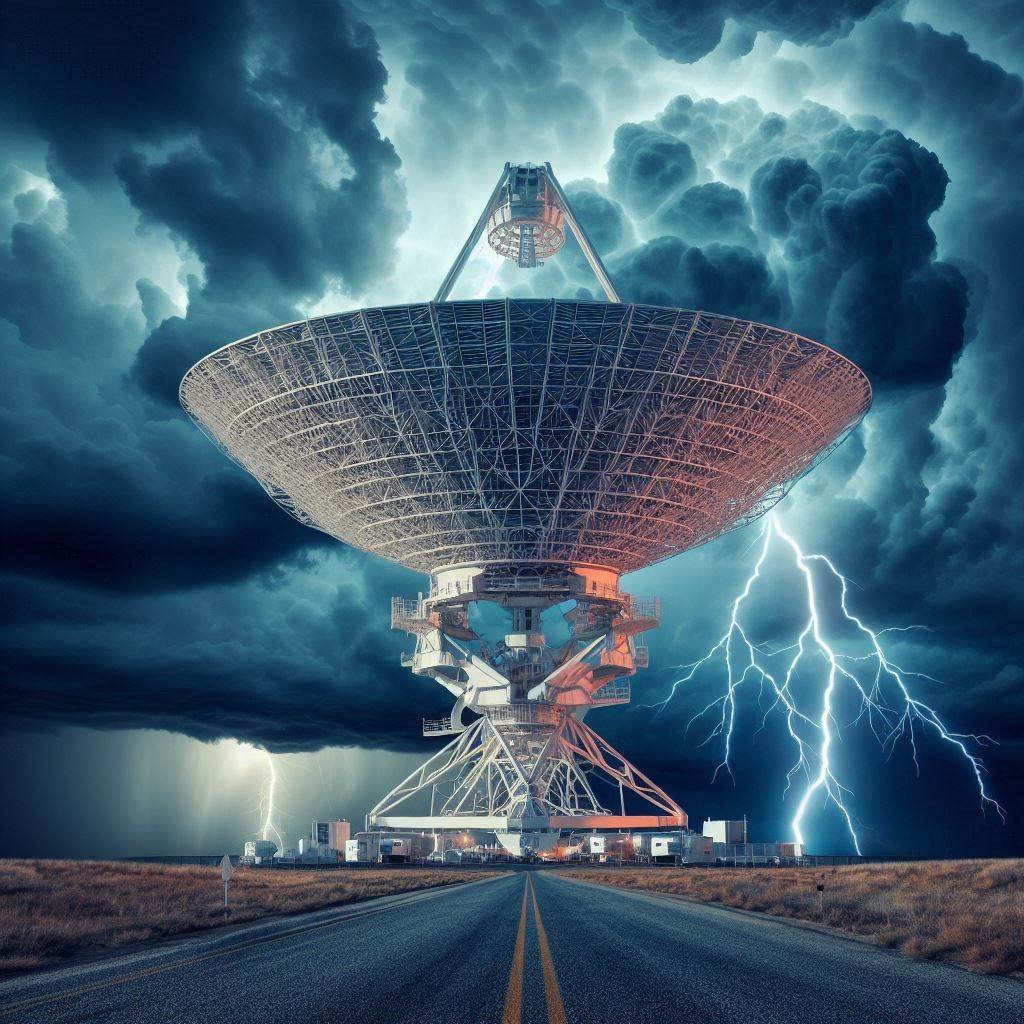
What if the storm outside your window was not entirely natural? What if the lightning, the drought, or the strange shift in temperature was not just weather—but a test, a signal, or a weapon? For years, that fear has fueled one of the internet’s most persistent theories: that HAARP, a real research program with giant antennas and government ties, is secretly being used to control the weather. It sounds like the plot of a thriller. But when you strip away the mystery, what remains?
If stories about hidden systems and secret technology pull you in, you’re not alone. Posts like 5G Health Concerns and Project Blue Beam show how quickly modern technology can become the center of global suspicion. HAARP sits right in that same uneasy space—real enough to sound believable, technical enough to sound dangerous, and mysterious enough to invite endless speculation.
Weather Manipulation and HAARP: Secret Technology or Misunderstood Research?
What People Claim
The theory usually begins with a simple but dramatic idea: the weather is no longer fully natural.
According to believers, powerful governments or hidden agencies have developed the ability to influence storms, trigger droughts, steer hurricanes, or even create unusual heat waves using advanced technology. At the center of many of these claims is HAARP—the High-frequency Active Auroral Research Program.
To conspiracy communities, HAARP is rarely described as a scientific tool. Instead, it becomes something much larger. A machine in Alaska that can beam energy into the sky. A hidden military system capable of interfering with the atmosphere. A technology that could allegedly disturb natural patterns and reshape weather on command.
In some versions of the theory, HAARP is blamed for hurricanes. In others, it is tied to wildfires, freezing events, floods, earthquakes, and blackouts. Some go even further, suggesting that weather disasters are not natural tragedies at all, but deliberate operations designed to control populations, destroy crops, or create political pressure.
That is what makes this theory so powerful. It offers an explanation for chaos. When nature feels too destructive, too random, or too cruel, the human mind often searches for intention. If something terrible happened, someone must have caused it. That emotional leap is where the theory begins to grow.
Why HAARP Became the Perfect Target
HAARP has all the ingredients of a conspiracy magnet.
It has a technical name that sounds cold and official. It was connected to government and military funding. It involved high-frequency radio waves and the ionosphere—terms that sound unfamiliar to most people. And visually, the facility itself looks unusual: rows of antennas standing in a remote Alaskan landscape, almost like something built for a science-fiction film.
That image matters.
Most people never see the inside of a weather lab. They do not read atmospheric research papers. They do not spend time learning how ionospheric science works. So when they see photos of a strange field of antennas and hear that the project can “excite” part of the upper atmosphere, imagination rushes in to fill the gaps.
And once imagination takes over, the theory almost writes itself.
A remote government-linked facility. A machine that sends energy upward. Weather becoming more extreme. Public trust in institutions already weakened. From there, the suspicion is almost automatic.
This is the same pattern seen in many modern conspiracy theories. A real object or program exists. Its true function is complicated and technical. The public only partially understands it. Fear enters that empty space. Then the unknown becomes sinister.
What HAARP Actually Is
This is where the story shifts from rumor to reality.
HAARP is a real research facility. That part is not in dispute. It was built to study the ionosphere, a layer of Earth’s upper atmosphere that affects radio communication and other electromagnetic activity. Scientists use facilities like this to better understand how radio signals behave, how the atmosphere responds to energy, and how communication systems can be improved or protected.
That may sound unimpressive compared to the theory, but it matters.
HAARP was not designed as a weather machine. Its work focused on the ionosphere, which is far above the lower part of the atmosphere where day-to-day weather happens. Storm systems, rainfall patterns, wind circulation, and hurricanes operate in atmospheric layers much closer to Earth’s surface. That does not automatically make public fear foolish—but it does weaken the central claim.
This is one of the most important details in the entire theory: people often treat “the atmosphere” as one giant connected space where any disturbance anywhere could reshape weather everywhere. But the atmosphere is layered, and different processes happen in different regions. Studying one layer is not the same as controlling all of them.
Why People Still Find It Convincing
Because the theory is not really built on atmospheric science. It is built on emotional logic.
When someone sees a storm that feels unnatural, hears about strange cloud formations, or watches temperatures swing in disturbing ways, they may not respond like a scientist. They respond like a human being trying to make sense of instability.
And instability is exactly what modern life provides in abundance.
Climate anxiety is real. So is distrust in governments. So is frustration with media coverage that often feels selective, shallow, or politically charged. When public trust falls, even ordinary scientific projects start looking suspicious.
That is why HAARP remains so compelling. It gives a face to a larger fear. It turns climate chaos into a villain. Instead of accepting that weather systems are complex, changing, and often unpredictable, the theory offers something emotionally cleaner: someone is behind this.
It also helps that weather is hard for most people to verify on their own. If a person hears a claim that a hurricane changed direction “unnaturally” or that clouds looked “engineered,” they usually do not have the scientific background to test that idea. So they rely on pattern recognition instead. And human beings are famous for seeing patterns even when none exist.
The Internet Effect
The internet did not create this theory, but it supercharged it.
Before social media, strange weather stories spread slowly. Now a dramatic video can circle the world in hours. Someone records an unusual cloud formation. Another person adds music and text claiming it is proof of weather engineering. A third account connects it to HAARP. Soon the claim is no longer a question. It becomes a narrative.
That is how modern conspiracy culture works. Claims do not rise because they are tested. They rise because they are emotionally sticky. The more shocking, cinematic, and threatening a theory feels, the more likely it is to spread.
HAARP content thrives in that environment because it sits at the intersection of science, secrecy, government, disaster, and fear. It does not need strong evidence to survive. It only needs uncertainty.
And once a person begins to believe, every major storm becomes fresh proof. Every drought becomes a clue. Every flood becomes part of a pattern. Contradictory events do not weaken the theory—they expand it.
The Problem With the Theory
The biggest weakness in the weather manipulation and HAARP theory is not that it asks hard questions. Hard questions are healthy. The problem is that it takes a giant leap from “this technology exists” to “therefore it controls weather on a global scale.”
That leap is enormous.
Influencing the weather in any meaningful, repeatable, large-scale way would require an extraordinary level of power, precision, timing, and understanding. Weather systems are massive, chaotic, and influenced by countless variables. Temperature, pressure, ocean patterns, wind currents, humidity, seasonal shifts, and geographic conditions all interact in ways that scientists still struggle to model perfectly.
That matters because if predicting the weather with full certainty remains difficult, controlling it with precision would be even more difficult.
And that is the part conspiracy storytelling often skips. It treats weather like a switch that can be flipped. But weather is not a light bulb. It is a global system of interacting forces, many of them still only partly understood.
Where Real History Adds Fuel
Part of the reason the theory survives is that weather modification is not pure fantasy. Human beings really have experimented with limited forms of weather intervention, especially cloud seeding. That history gives conspiracy theories just enough reality to feel grounded.
But limited intervention is not the same as total control.
There is a major difference between trying to encourage rainfall under certain conditions and secretly steering hurricanes across oceans. Yet once people hear that weather has been studied, influenced, or modified in any form, they may assume far more advanced abilities exist in secret.
This is a common conspiracy pattern: a small truth becomes the launching pad for a much larger unsupported claim.
The same thing happens in theories around surveillance, medicine, and secret government projects. A real historical example exists. Public trust weakens. Then imagination stretches that example beyond what the evidence supports.
The Attraction of Hidden Power
There is another reason this theory stays alive: it reflects a deep cultural fear that ordinary people are no longer in control.
Weather used to be one of the last things humans accepted as beyond their reach. You could build cities, fight wars, shape economies—but you could not command the sky. The HAARP theory flips that completely. It says the sky itself may now be controlled by hidden power.
That idea is terrifying. It is also strangely seductive.
If the weather can be manipulated, then disasters are not random. If disasters are not random, then they have purpose. And if they have purpose, then the world feels dark—but understandable.
For some people, that is easier to live with than uncertainty.
Randomness is emotionally hard. Chaos is hard. Climate systems shifting in ways that no single person can stop are hard. But a hidden operator? A secret machine? A deliberate act? Those feel horrifying, yet oddly easier for the mind to grasp.
What Science Suggests Instead
The evidence points to a much less cinematic conclusion.
HAARP is best understood as a research facility that became a symbol. A real place. A real program. But one whose purpose was reshaped in the public imagination until it stood for something much bigger than itself.
Extreme weather is real. Climate concerns are real. Human influence on the planet is real. Public distrust is real. But that does not automatically make HAARP a weather weapon.
In fact, one reason the theory survives so well is because it blends real concerns with unsupported conclusions. It takes legitimate unease about environmental change and redirects it toward a cleaner, more dramatic villain.
That makes the story emotionally satisfying—but not necessarily true.
Reality Check
So where does that leave us?
The weather manipulation and HAARP theory is compelling because it combines real science, real fear, and real distrust into one dramatic package. It asks a question many people secretly want answered: is someone controlling more than we realize?
But the available evidence does not support the idea that HAARP is secretly engineering storms, steering hurricanes, or controlling the weather on a global scale.
What the theory really reveals is not hidden climate warfare. It reveals how modern conspiracy thinking works. A technical project becomes a symbol. A symbol becomes a threat. A threat becomes an explanation for everything that feels unstable, unfair, or frightening.
That does not mean people are wrong to ask questions. It means the strongest questions should lead to stronger evidence—not just stronger suspicion.
Because once every disaster becomes proof of secret control, reality gets harder to see. And when reality gets harder to see, fear becomes easier to manipulate than the weather ever could.
In the end, HAARP may be less important as a machine than as a mirror. People look at it and see whatever they already fear most: military secrecy, scientific arrogance, environmental collapse, or hidden elites pulling unseen strings. That is why the theory lasts. Not because the evidence is overwhelming, but because the symbolism is.
And that may be the most revealing part of all.
🔎 If this story pulled you in, read these next:
- 5G Health Concerns: The Theory That Turned Faster Internet Into a Global Fear
- Project Blue Beam: Could a Fake Alien Invasion Ever Be Staged?
- Shadow Governments
📂 Explore more in this category:
Science and Technology