
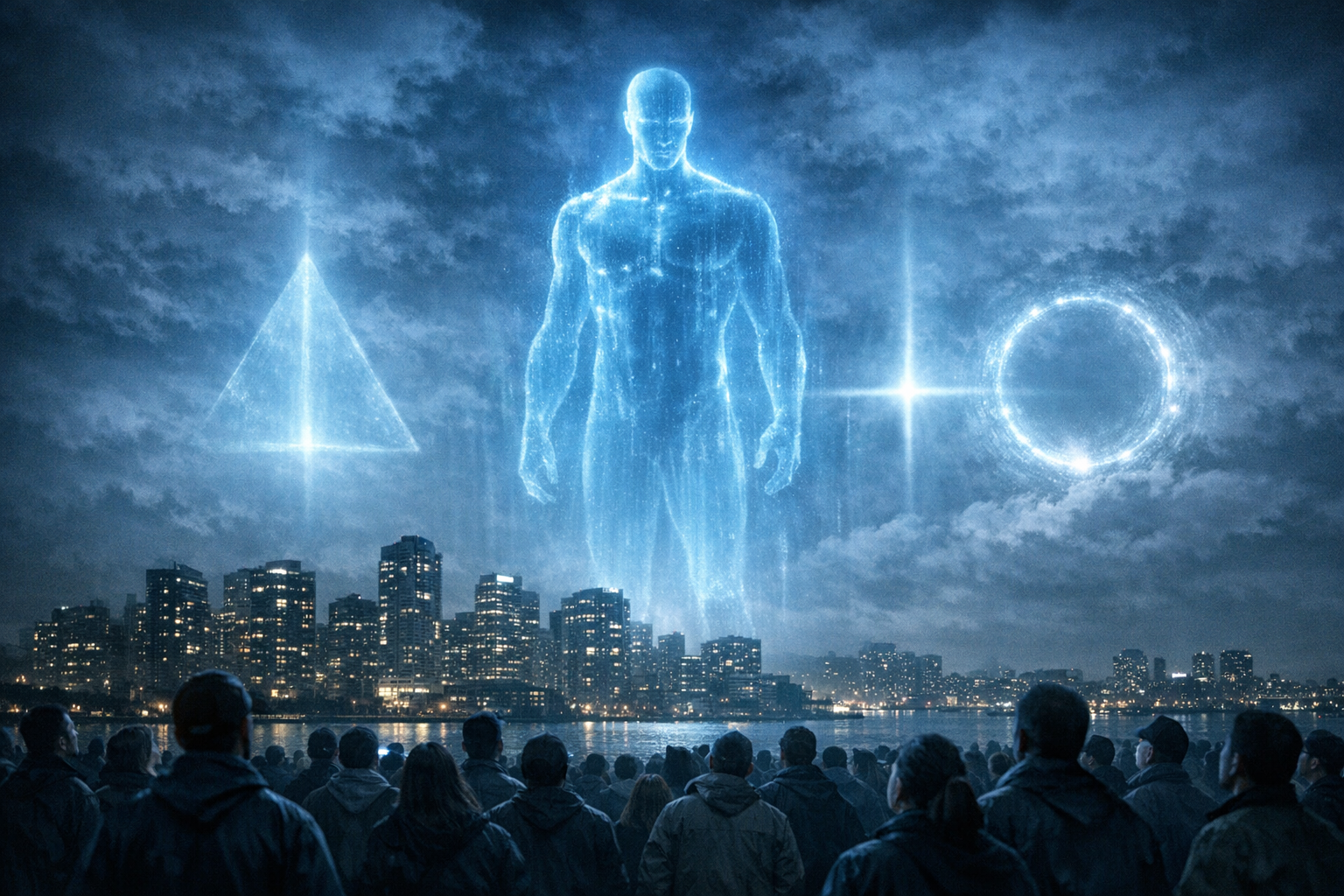
Behind closed control rooms, under the cold glow of blue screens and city lights, the Project Blue Beam theory begins with a chilling idea: what if the sky itself could be used as a weapon? The claim says a staged global spectacle, filled with projected signs and false miracles, could be used to frighten millions into accepting a new form of control.
What Happened
Project Blue Beam is usually traced back to Serge Monast, a Canadian writer who described the theory in the 1990s. He claimed a hidden plan was being prepared to reshape religion, politics, and public belief through manufactured crises and advanced technology.
According to the story, the plan would unfold in stages. First, old beliefs would be shaken by false discoveries or manipulated events. Then huge projections or sky-based illusions would appear, making people think a divine sign, alien arrival, or supernatural event was taking place.
🔎 Related Investigation:
- Internet Conspiracies: The Communities, the Hoaxes, and the Patterns That Turn Rumors Into Movements
🔎 Related Investigation:
Over time, the theory grew online. Different versions added holograms, satellites, mind-control signals, fake messiahs, and a final push toward centralized world authority. The original idea was already extreme, but the internet made it even larger and harder to pin down.
What can be verified is much narrower. Serge Monast did promote the theory. The internet did help it spread. And modern audiences already live in a world shaped by digital effects, misinformation, and deep suspicion of institutions.
Why People Believe It
The theory survives because it targets a basic fear: that people can be manipulated on a massive scale without realizing it. In a media environment full of edited footage, viral rumors, and synthetic images, that fear feels more believable than it once did.
It also borrows power from real examples of deception and secrecy. Governments and organizations have hidden programs before, and propaganda has been used throughout history. That history does not prove Blue Beam, but it gives the theory emotional fuel.
There is also the visual side of it. The idea of giant images appearing in the sky over crowded cities is cinematic and unforgettable. Once someone imagines that scene, it becomes easier to believe the world might already be close to staging it.
🔎 Related Investigation:
- Internet Conspiracies: The Communities, the Hoaxes, and the Patterns That Turn Rumors Into Movements
For readers drawn to how strange claims spread in modern culture, it connects naturally with Weather Manipulation and HAARP and broader distrust stories like The New World Order.
Claims vs Evidence
Claim: Governments or global elites could fake an alien invasion or religious event using advanced projections. Evidence: Large-scale projection technology exists in limited forms, and visual effects can fool people in controlled settings. But there is no verified evidence showing a real, secret program capable of staging a convincing worldwide sky event at the scale Blue Beam describes.
Claim: The theory proves a plan for a one-world government. Evidence: This is where the theory shifts from a specific claim into a much larger worldview. It often assumes intent, organization, and technical ability without documents, whistleblower evidence, or independent confirmation.
Claim: Satellites, signals, or hidden devices could make people hear voices or believe false miracles. Evidence: Versions of this claim usually rely on speculation rather than testable proof. They often combine real technology with major leaps that are not supported by public evidence.
Claim: Because modern media can create convincing illusions, Blue Beam is probably already possible. Evidence: Media manipulation is real, but that does not automatically mean a global fake invasion can be executed in secret. A believable video clip and a synchronized worldwide event are very different things.
Another useful comparison is Moon Landing Hoax, where public distrust often outlives the available evidence. The same pattern appears in Flat Earth Theory, where the strength of the belief comes less from proof and more from a self-reinforcing worldview.
Reality Check
Project Blue Beam works best as a modern fear story. It takes real anxieties about propaganda, surveillance, and digital illusion, then pushes them into a single dramatic scenario. That makes it memorable, but not necessarily credible.
The biggest weakness is evidence. There are no verified official documents, no reliable chain of proof, and no clear event that demonstrates the theory in action. Most versions grow through repetition, reinterpretation, and internet amplification rather than confirmed facts.
There is also a practical problem. Pulling off a fake alien invasion on a global scale would require extraordinary coordination across technology, governments, media systems, and public space. Claims that large rarely stay hidden without strong leaks or hard evidence.
That does not mean the underlying fear is foolish. People are right to ask how technology can shape belief. But the leap from mass persuasion exists to a staged sky invasion is underway remains unsupported.
Conclusion
Project Blue Beam remains one of the internet’s most striking conspiracy theories because it turns the sky into the final stage set. It speaks to a world where trust is thin, screens are powerful, and almost anything can look real for a moment.
But once the smoke clears, the theory looks far stronger as a cultural myth than as a documented operation. The fear behind it is understandable. The evidence for a real hidden program is not.
If this story stuck with you, you might want to explore these next:
- Weather Manipulation and HAARP
- The New World Order
- Moon Landing Hoax
- Flat Earth Theory